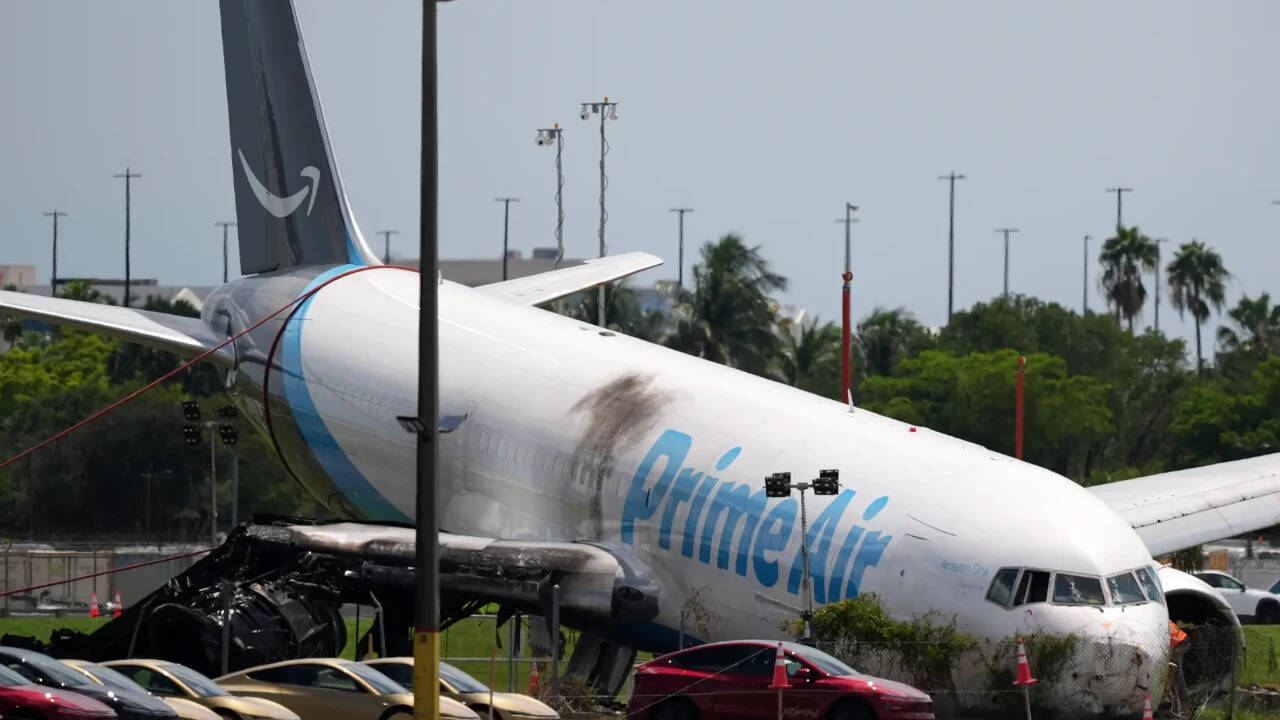
The sky over Miami International Airport was a sheet of bruised purple. Rain did not fall so much as it hung, a heavy, blinding curtain that blurred the boundary between the tarmac and the night. Inside the cockpit of an Amazon Air Boeing 767, the atmosphere was a study in absolute, practiced discipline. Two sets of eyes scanned the instrumentation. Every switch, every dial, every glowing amber and green readout had been double-checked.
Then came the descent.
To the casual observer, a commercial landing is a slow, graceful slide down an invisible staircase. To the pilot, it is a controlled fall requiring thousands of micro-decisions per minute. On this particular night, the elements conspired against those decisions. Crosswinds pushed hard against the massive fuselage. The runway lights flickered through the sheet-rain, appearing and disappearing like distant stars in a storm.
As the aircraft crossed the threshold, something shifted.
The wind shear hit. It is an invisible predator of the skies, a sudden, violent shift in wind speed and direction that can snatch lift away from wings in a fraction of a second. The nose dropped. The descent rate spiked. The ground rushed up not as a landing surface, but as an imminent collision.
In that split second, the human element took over from the machinery.
(Note: The following reconstruction of the crew's actions is drawn from official NTSB investigative findings and standard aviation safety protocols for unstable approaches.)
"Go around!"
The command was barked, sharp and absolute. The crew recognized the danger of the unstable landing before the aircraft crossed the point of no return. Power was slammed forward. Engines screamed as they fought to spool up from idle to maximum thrust, demanding hundreds of thousands of pounds of force from turbines that take agonizing seconds to respond.
Those seconds are an eternity when the ground is rising to meet you.
The heavy freighter touched down hard, far down the wet concrete. Too far down. The brakes bit into the slick surface with anti-skid systems wailing, but physics is an unforgiving accountant. Momentum, mass, and velocity refused to be negotiated away. The aircraft overran the runway, carving a path through the mud and safety zones before finally coming to a shuddering, breathless halt.
Silence followed. Then the frantic dance of checklists, fuel shutoffs, and evacuation protocols.
When we read reports of aviation incidents, we tend to consume them as cold statistics. We look at numbers, tail codes, and regulatory filings. We digest the dry shorthand of aviation boards. But behind every headline about an overrun runway is a crew making life-or-death choices in the dark, wrestling with multi-ton machines when nature decides to rewrite the rules.
Consider the physics of a modern cargo jet. A fully loaded Boeing 767 is a cathedral of aluminum and titanium weighing hundreds of thousands of pounds. When it touches down at over one hundred and forty miles per hour, it possesses kinetic energy that defies easy stopping, especially when hydroplaning strips the tires of their grip. The tires skim across a microscopic layer of water, floating like a stone skipping across a pond. Brakes become useless ornaments.
The pilots knew this. They knew it the moment the wind shear caught them. They knew it when they tried to abort the landing and wrestle the heavy jet back into the bruised Miami sky.
Why did they try to land in the first place? Why do crews push forward when the weather turns foul?
The answer lies in the relentless machinery of modern logistics. Every minute an aircraft sits idle, every hour a cargo flight is delayed, ripples outward through a vast, intricate web of supply chains. Warehouses wait. Delivery trucks idle at loading docks. Millions of consumers expect their packages on their doorsteps by morning. The pressure to complete the mission is an invisible passenger in every cockpit, whispering to the crew that they can handle just a little more crosswind, just a little more rain.
Yet, training is the ultimate counterweight to pressure.
Commercial aviation is one of the safest human endeavors precisely because it is built on a culture of brutal honesty. Every mistake, every near-miss, every aborted landing is dissected by safety boards not to assign blame, but to strip away ego and find the truth. The crew in that Miami cockpit survived because they possessed the one thing algorithms still cannot replicate: the situational awareness to say that the current path is wrong, and the courage to change it, even when the margins for error have vanished.
Accidents do not happen because of a single catastrophic failure. They happen when a chain of small, seemingly insignificant anomalies aligns perfectly. A drop in wind speed here. A slick patch of water there. A momentary delay in engine spool-up. The art of modern flight is breaking that chain before the links lock together.
On that night in Miami, the chain almost held. The aircraft left the concrete, but the crew walked away.
As the investigation closed and the reports were filed, the wreckage was cleared away. Life resumed its normal rhythm. Flights departed on time. Packages arrived at doorsteps. But out on the tarmac, long after the rain had stopped and the purple sky had faded into dawn, the invisible weight of those final seconds remained, a quiet reminder of what it takes to keep the world moving when the earth and sky refuse to cooperate.