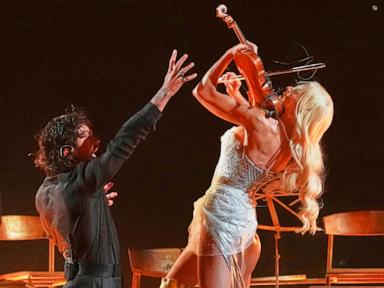
Pyrotechnics are the cheap perfume of the music industry. They are designed to mask the scent of a rotting composition. When the headlines start screaming about Finland’s "hotly tipped" performance because it features a wall of fire and a multimillion-euro violin, you aren't looking at a musical breakthrough. You are looking at a desperate insurance policy.
The lazy consensus among Eurovision commentators is that "spectacle equals success." They point to the LED floors, the gravity-defying rigs, and the literal tons of propane used to singe the front row as evidence of "production value." It’s a lie. In reality, the more a delegation spends on stage-dressing, the less they trust the three minutes of audio they’re actually there to sell.
The Stradivarius Fallacy
Let’s talk about that "valuable violin."
Dragging a rare instrument onto a stage filled with high-intensity heat, artificial fog, and enough humidity to warp a floorboard isn't an artistic choice. It’s a gimmick. If you need a $5 million instrument to make a melody "work," the melody was broken in the demo stage. The human ear, compressed through a television broadcast and a pair of mediocre living room speakers, cannot distinguish the tonal warmth of a 1710 Stradivarius from a well-crafted carbon fiber replica.
The value isn't for the audience’s ears; it’s for the press release. It creates a narrative of "prestige" where there is none. When you hear that an artist is using a high-stakes prop, it’s a signal that the songwriting team hit a wall. They couldn't find the hook, so they found a historical artifact instead.
I’ve sat in production meetings where the conversation shifts from "the bridge needs more tension" to "can we make the drum kit explode?" The moment that shift happens, the music is dead. Finland isn't bringing a violin; they’re bringing a distraction.
The Fire Tax
Every flame burst on the Eurovision stage is a confession of weakness.
The "Fire Tax" is the literal cost of pyrotechnics subtracted from the creative effort of the performance. If you watch the winners of the last decade, the ones that actually shifted the cultural needle—think Salvador Sobral or even the raw energy of Måneskin—the common denominator wasn't the budget for explosives. It was the lack of them.
- Sobral (2017): Won with a forest of trees and a microphone. Zero fire.
- Måneskin (2021): Won with lighting and attitude. The pyros were secondary to the sweat.
- Loreen (2023): Won by being trapped in a panini press.
When you lean on flames, you are gambling on a lizard-brain response. "Look, shiny thing! Look, heat!" It’s a physiological trick, not an emotional connection. The data shows that while fire might get you through a semi-final, it rarely wins the trophy. The audience remembers the feeling of a song, not the temperature of the room.
The Tech Bloat Crisis
We are currently witnessing "Tech Bloat" in live entertainment.
Production teams are so obsessed with what they can do with augmented reality and kinetic staging that they’ve forgotten what they should do. Finland’s reliance on these elements is a symptom of a larger industry sickness: the belief that the stage is a cinema screen rather than a platform.
When the staging becomes the star, the artist becomes a prop. We see this in Vegas residencies and stadium tours constantly. The performer is relegated to a specific 2x2 meter square because if they move six inches to the left, they’ll be decapitated by a moving LED screen or missed by a pre-programmed spotlight. This kills spontaneity. It kills the "live" in live music.
If an artist is terrified of being scorched by their own stage effects, they aren't singing to you. They are surviving a choreographed industrial accident.
Why the "Expert" Predictions are Wrong
The "People Also Ask" sections of the internet are currently flooded with variations of "Who has the best staging this year?" This is the wrong question.
The question you should be asking is: "Which song can survive a power outage?"
If the lights go out and the fire fails, does Finland have a song? Or do they just have a very expensive violin and a lot of soot? Historically, the entries that generate the most "pre-show hype" for their technical complexity are the ones that underperform on the night. The "visual overload" causes a sensory disconnect. The human brain can only process so much stimuli before it checks out.
When you combine a fast-paced track with strobe lights, a rare instrument, and a pyrotechnic display, you aren't creating a "moment." You are creating visual white noise.
The High Cost of Playing It Safe
By following the "fire and props" blueprint, Finland is playing it safe. It sounds counter-intuitive—how is a multimillion-euro violin safe? Because it follows a proven, albeit boring, formula for middle-of-the-pack success. It ensures you won't be forgotten immediately, but it also ensures you won't be loved.
True art requires the risk of being empty. It requires the performer to stand there, vulnerable, with nothing but their voice. Adding a "valuable" prop is a suit of armor. It protects the artist from the criticism that the song is mediocre. "Well, at least the violin was cool," the casual viewer says. That is the death knell of a career.
Stop Rewarding the Gimmick
We need to stop treating technical complexity as a proxy for talent.
The industry insiders praising Finland’s "ambition" are the same people who sell the propane and insure the violins. They have a vested interest in making you believe that a stage needs to look like a Michael Bay set to be valid. It doesn't.
If you want to know who will actually impact the charts after the glitter is swept away, look for the artist who looks bored by the pyro. Look for the one who treats the multimillion-euro instrument like a tool, not a trophy.
The flame is a flicker. The song is the fuel. And right now, the Eurovision stage is looking a lot like a bonfire of the vanities.
If the music can’t stand on its own in a dark room, it’s not a performance. It’s an upholstery show.
Turn off the fire. Put the violin back in the museum. Let’s see if there’s actually anyone home.