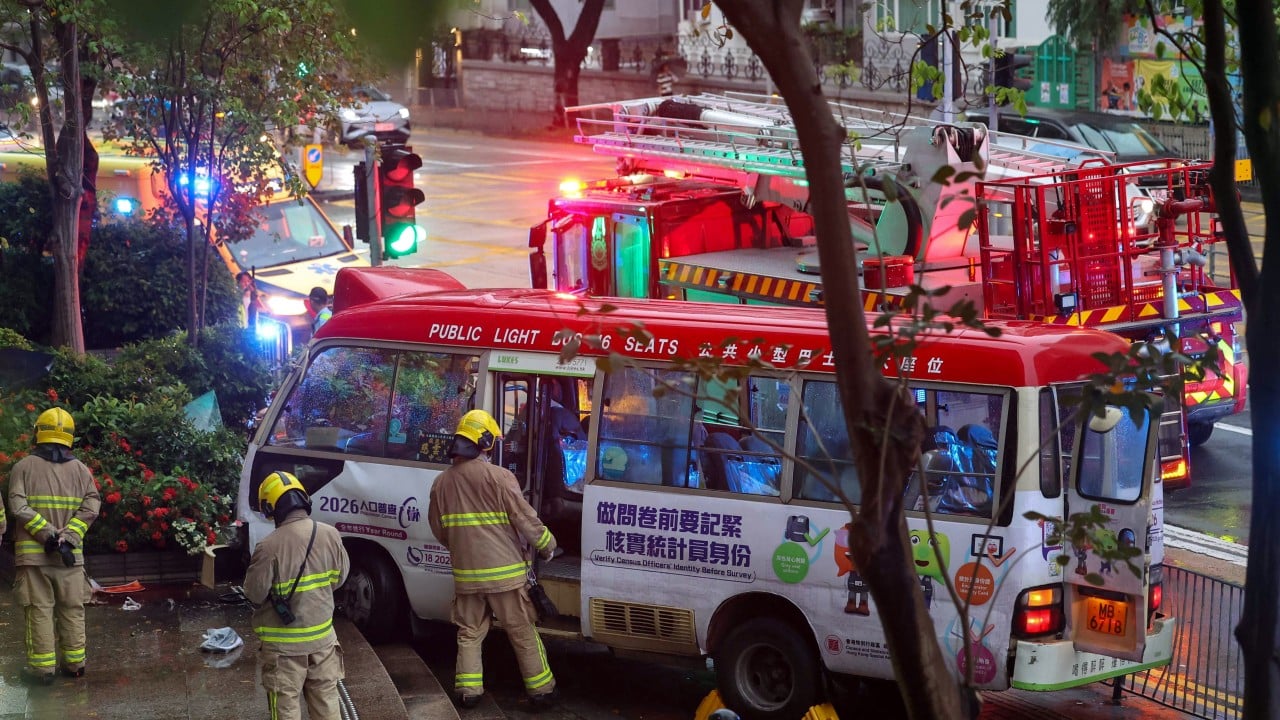
A lethal crash in Hong Kong involving a green minibus mounting a pavement and striking pedestrians has left one person dead and two others seriously injured. The tragedy reflects a structural systemic failure in the territory's public transport regulatory framework. It is not an isolated incident. Decades of regulatory inertia, an aging workforce, and aggressive commercial incentives have turned these iconic vehicles into a persistent public safety hazard. Resolving this crisis requires looking beyond driver error to examine the operational mechanics of the minibus industry itself.
The Illusion of Driver Error
Initial investigations into public transport accidents routinely default to a predictable narrative. The police cite driver distraction, mechanical failure, or sudden illness. The public registers outrage. The government promises a thorough review.
This cycle obscures a more uncomfortable reality. Hong Kong public light buses operate under conditions that practically guarantee catastrophic failure.
To understand why a multi-ton vehicle veers onto a crowded walkway, one must examine the daily pressures shifting behind the steering wheel. Green minibuses run on fixed routes with regulated fares. However, the operators face rigid timetables and tight margins. Drivers are often compensated based on the number of trips they complete or work under tight scheduling constraints. When a route is backed up by Hong Kong's chronic traffic congestion, the driver bears the burden of making up that time.
Speeding becomes a structural necessity. Navigating narrow, pedestrian-dense corridors like those in Mong Kok, Sham Shui Po, or parts of New Territories requires intense, sustained concentration. Under pressure, human processing limits break down. A split-second delay in braking, an over-correction on a tight turn, or a brief lapse in situational awareness converts a standard commute into a lethal event.
An Industry Powered by an Aging Workforce
The demographics of Hong Kong public transport workers paint a bleak picture for the future of urban safety. The average age of a minibus driver in the territory now hovers well over 60 years old. It is entirely common to find octogenarians operating high-frequency transit routes.
Younger workers refuse to enter the trade. The reasons are obvious.
- Long shifts extending up to 12 hours a day.
- Minimal base pay with volatile performance incentives.
- High-stress environments with no clear career progression.
- Lack of corporate benefits compared to MTR or major franchise bus companies.
An aging driver population introduces serious physiological variables into the public safety equation. Visual acuity declines. Reaction times slow down significantly. The risk of sudden medical episodes, such as cardiac arrest or stroke while operating a vehicle, increases exponentially.
While the Transport Department requires drivers aged 70 or older to submit a medical examination report when renewing their licenses, these checks are often superficial. They assess basic fitness at a single point in time. They do not account for the cumulative exhaustion of a man in his late 70s driving a 12-hour shift through torrential rain and dense traffic.
The industry survives by exploiting a vulnerable, elderly labor pool. Until the economic model shifts to attract younger professionals through stable salaries and humane working conditions, the physical capability of the workforce will remain a critical vulnerability.
The Technological Deficit in the Cabin
Modern automotive safety has advanced rapidly over the past two decades. Advanced Driver Assistance Systems (ADAS) featuring autonomous emergency braking, lane-keep assist, and pedestrian detection are standard in new passenger cars.
The Hong Kong minibus fleet operates in a technological time capsule.
Many vehicles currently in service lack even basic modern telemetry. While the government mandated the installation of electronic data recorders (the equivalent of a vehicle black box) and speed display devices on newly registered minibuses, these measures are retrospective. They help investigators determine how fast a vehicle was traveling after it kills someone. They do nothing to actively prevent the impact.
Consider the layout of a standard public light bus. It is a lightweight, high-capacity shell optimized for passenger volume, not impact mitigation. The structural design dates back to concepts developed in the late 20th century. When these vehicles mount a curb, the flat front fascia offers no pedestrian deflection. The energy of the impact is transferred directly into the human body.
Operators resist retrofitting fleets with active safety technology due to the upfront cost. In a fragmented market where individual routes are sub-contracted out to small-scale operators or owner-drivers, margins are razor-thin. A capital expenditure of a few thousand dollars per vehicle for forward-collision warning systems is viewed as a threat to survival. The government has failed to provide the aggressive financial mandates or subsidies needed to force a comprehensive technological overhaul.
Pedestrian Infrastructure is Forcing the Crisis
Traffic accidents are a function of geometry and spatial planning. Hong Kong possesses some of the highest pedestrian density metrics on earth. Its streets are battlegrounds for space.
In many older urban areas, pavements are narrow, cluttered with street furniture, and immediately adjacent to active traffic lanes. There is no buffer zone. If a minibus suffers a mechanical failure or a driver loses consciousness, the distance between the roadway and a pedestrian is often less than half a meter.
The design of the transport network forces oversized interactions into undersized spaces. Minibuses are designed to fill the gaps left by the mass transit railway system. They serve hilly terrain, narrow alleys, and feeder routes that standard double-decker buses cannot physically access. This means they are consistently directed into the exact environments where vehicle-pedestrian conflict is most likely to occur.
Relying on roadside railings to protect pedestrians is an outdated strategy. Standard metal guardrails used across Hong Kong are designed to guide pedestrian flow, not stop an unguided vehicle traveling at 50 kilometers per hour. When hit, these railings frequently fracture, turning metal shards into secondary projectiles that cause further injury to bystanders.
The Failure of Enforcement and Regulatory Inertia
The legislative response to public transport safety in Hong Kong has historically been reactive. Regulations are written in the wake of public mourning, then enforced half-heartedly once the news cycle shifts.
Speed display devices inside minibuses were supposed to leverage passenger pressure to keep drivers slow. The theory was simple. If a driver exceeded the limit, a loud beep would alert passengers, who would then shame the driver into slowing down.
The theory failed. Over time, the beeping became background noise. Passengers rushing to work or exhausted after a long shift rarely confront aggressive drivers. Drivers learned to ignore the displays or found ways to temporarily disable the alerts.
Police enforcement campaigns rely on sporadic crackdowns rather than continuous surveillance. Speed cameras cover major expressways, but they are sparse on the secondary urban routes where minibuses do the majority of their dangerous driving. Penalties for operators who push drivers past legal working hours are practically non-existent. The liability lands almost exclusively on the individual driver, shielding the corporate entities that profit from the underlying system.
Rebuilding the Public Transit Model
Tweaking the current framework will not stop the next crash. The entire operational philosophy of the public light bus system requires structural reconstruction.
First, the compensation model must be decoupled from speed and trip frequency. Drivers must be transitioned to stable, fixed hourly wages that remove the financial incentive to drive aggressively. This shift cannot be left to voluntary corporate compliance. It must be a strict condition of route licensing.
Second, the Transport Department must mandate active collision-avoidance technology across the entire fleet. Vehicles without automatic pedestrian braking systems should be phased out of high-density urban routes entirely within a strict timeline. If small operators cannot afford the upgrade, the government must utilize its massive fiscal reserves to fund the transition, treating it as an infrastructure investment rather than a private subsidy.
Finally, urban planning must prioritize physical separation. In high-risk transit corridors, pavements must be widened at the expense of private vehicle lanes, and reinforced bollards capable of stopping a multi-ton vehicle must replace flimsy metal railings.
Every day the current system persists, more elderly drivers will take the wheel of technologically obsolete vehicles, navigating them through poorly designed streets under intense commercial pressure. The crash in Hong Kong was a mathematical certainty. Until the structural architecture of the industry is dismantled and rebuilt, the next fatality is simply a matter of time.