The smell of a French automotive assembly plant is unmistakable. It is a thick, metallic perfume of hydraulic oil, fresh rubber, and cooling steel—the scent of suburban commutes, school drop-offs, and weekend trips to the coast. For over a century, the Renault diamond on the hood of a car meant something predictable. It meant utility. It meant peace.
Walk into certain engineering corridors in France today, however, and the air feels entirely different. The heavy stamping presses that shape hatchbacks and electric crossovers are still humming, yet the blueprints pinned to the digital whiteboards no longer belong exclusively to the highway. They belong to the sky. Recently making headlines in this space: Inside the Hydro-Québec Power Deficit Nobody Saw Coming.
Renault is advancing into military drones.
Read that sentence twice. Let the dissonance settle in your chest. A company famous for affordable family compacts is now actively developing unmanned aerial systems for modern warfare. On paper, in the dry language of corporate press releases and defense-sector briefings, it looks like a neat strategic diversification. A smart play in an uncertain European market. Additional information into this topic are detailed by Bloomberg.
Beneath the surface, it is a profound tremor in the way we live, work, and survive.
The Shift in the Assembly Line
To understand how an automaker ends up in the business of unmanned flight, consider a hypothetical character we will call Marc. Marc is fifty-two years old, a veteran powertrain engineer in northern France who spent three decades obsessing over fuel injection, battery thermal management, and reducing cabin vibration so a toddler could sleep in the backseat.
Marc never wanted to build weapons. Nobody in his graduating class at engineering school talked about loitering munitions or reconnaissance airframes. They talked about aerodynamics to save a tenth of a liter of fuel per hundred kilometers. They talked about safety cages and crumple zones.
Yet, when Marc looks at the anatomy of a modern military drone, he sees ghosts of his own life’s work.
A long-range unmanned aerial vehicle is, stripped of its camouflage paint and sensor pods, an exercise in extreme automotive engineering. It needs an ultra-efficient propulsion system that refuses to fail in freezing rain. It needs lightweight composite materials that maximize payload without sacrificing structural integrity. Above all, it needs to be built fast, reliably, and at a scale that traditional aerospace giants simply cannot match.
Traditional defense contractors build machines like Swiss watches—exquisite, astronomically expensive, and painfully slow to roll off the line. An automaker builds machines like a heartbeat. One every sixty seconds. Day and night. Rain or shine.
When European defense ministries looked at the brutal, attritional reality of twenty-first-century conflict, they realized that exquisite Swiss watches were no longer enough. Modern battlefields consume drones the way a furnace consumes coal. Thousands per month. Tens of thousands per year. You cannot win a war of industrial endurance with boutique manufacturing. You need the assembly line.
So, the state came knocking on the factory doors of the automotive giants. And Renault answered.
Why Cars and Drones Share the Same DNA
It is easy to feel a knot of unease when civilian industry merges with defense. I remember the first time I stood beside a heavy industrial drone at a European trade exhibition—not a toy quadcopter, but a fixed-wing machine with the wingspan of a small dining room and the cold, matte-gray skin of a shark. Up close, the illusion of high-tech glamour vanishes. You see the rivets. You see the wiring harnesses held together with standard industrial zip-ties. You see commercial-grade electric motors that look suspiciously like the ones driving the power windows and cooling fans in a mid-size sedan.
That was the moment the abstraction collapsed for me. The line between civilian comfort and military hardware is not a thick concrete wall. It is a pencil sketch in the rain.
To grasp why Renault’s push into military drones is making such waves across Europe, you have to understand the quiet revolution happening inside electric vehicles. Over the past decade, automakers poured billions of euros into mastering three specific technologies: high-density battery packs, compact electric motors, and autonomous sensor fusion—the cameras, radar, and software that allow a car to stay in its lane and brake before hitting a pedestrian.
Now, take those exact three pillars and lift them off the asphalt.
A high-density battery becomes the silent heart of a reconnaissance drone, allowing it to loiter above a treeline for hours without the thermal signature or roar of a combustion engine. A compact, mass-produced electric motor becomes a cheap, replaceable propulsion unit. And autonomous navigation software—originally designed to read faded white lines on a rainy highway—becomes the brain that guides an aircraft through jammed radio frequencies where GPS signals have been completely wiped out.
Renault did not have to reinvent itself from scratch to enter the drone sector. The company realized it was already sitting on the exact industrial toolkit that modern militaries were desperate to buy.
The Invisible Stakes of European Sovereignty
Why now? Why is a French automotive icon stepping into a space that carries undeniable reputational risk?
Follow the money, certainly. The European auto industry is currently caught in a brutal vise. On one side, strict emissions mandates are forcing expensive transitions to electric fleets. On the other, aggressive foreign competitors are flooding the market with cheaper electric cars. Profit margins are shrinking. Factories are underutilized. Defense contracts offer something rare in the modern corporate world: guaranteed, state-backed demand with long-term horizons.
If the story ended at corporate balance sheets, it would be cynical. It would be easy to dismiss.
The truth is far heavier. Europe is staring down a crisis of industrial survival. For thirty years after the Cold War, the continent enjoyed what economists politely called the peace dividend. Factories closed. Ammunition stockpiles shrank. Heavy manufacturing was outsourced to wherever labor and energy were cheapest. Europeans convinced themselves that history had ended, and that industrial capacity was an expensive relic of the twentieth century.
Then the ground shook. War returned to the European continent, bringing with it a terrifying lesson: sovereignty is not a speech given in Brussels or Paris. Sovereignty is the ability to manufacture what you need to defend your borders without begging another continent for spare parts.
When French officials talk about mobilizing the civilian industrial base—a concept often referred to in Paris as the war economy—they are acknowledging a stark reality. France’s dedicated defense companies, brilliant as they are, do not have the floor space, the supply chains, or the raw manufacturing velocity to equip a modern military for high-intensity conflict.
Renault does.
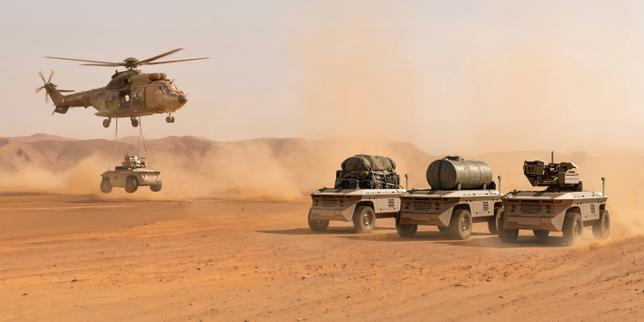
Through partnerships with specialized defense firms and drone developers, Renault is lending its industrial muscle to bridge that gap. The automaker brings mass-production engineering, supply-chain mastery, and rigorous quality control; the defense partners bring the tactical software, encrypted communications, and battlefield doctrine. Together, they are turning automotive know-how into airborne eyes and ears—and, increasingly, airborne strike capabilities.
The Human Weight of Dual-Use Technology
Still, knowing the geopolitical logic does not erase the human friction.
Return for a moment to our hypothetical engineer, Marc, sitting at his kitchen table in northern France. His daughter asks him what he worked on today. For thirty years, his answer was simple: I helped make the new Clio quieter. Or: We got twenty more kilometers out of the battery pack.
What does he say now? I helped optimize the stator windings so a reconnaissance drone can fly ten kilometers deeper into contested airspace.
There is no clean moral arithmetic here. We live in an era of dual-use technology, where almost every brilliant civilian innovation casts a military shadow. The same artificial intelligence that detects early-stage breast cancer on a mammogram can also identify camouflaged artillery from five thousand feet. The same lithium-ion chemistry that powers a quiet morning commute powers a loitering munition.
For the workers on the factory floor, this transition requires a quiet psychological reckoning. Many are proud to contribute to national defense, especially in an era where threats feel uncomfortably close to home. Others feel a lingering unease watching the tools of everyday mobility repurposed for the realities of modern warfare. Both reactions are deeply human. Both are entirely valid.
History reminds us that this is not an anomaly; it is a return to the norm. During the twentieth century, the very same factories that built family cars built aircraft engines, armored vehicles, and field radios. Renault itself has a long, complex history intertwined with French military production, from the famous Taxi de la Marne that ferried troops to the front in 1914 to the FT light tank that reshaped armored warfare a few years later. For eighty years, we treated the separation between civilian cars and military hardware as permanent. Looking at the sweep of history, that separation was the exception.
What Happens When the Line Disappears
So, what does Renault’s push into military drones actually mean for the rest of us?
First, it signals that the wall between tech companies, automakers, and defense contractors has permanently dissolved. When you buy a car in the coming decade, you will be funding research and development that feeds directly into national security infrastructure—and vice versa. The economies of scale work both ways. Better batteries developed for military endurance will eventually trickle down into cheaper, longer-range electric vehicles for everyday drivers.
Second, it exposes a profound vulnerability in our modern worldview. We love to imagine technology as purely progressive, clean, and frictionless. We like our gadgets sleek and our supply chains invisible. Yet when crisis hits, it is always the unglamorous, heavy, oil-stained work of physical manufacturing that decides the outcome. Code cannot stop an advancing column. Software cannot patrol a border in a blizzard. Only physical machines, built by human hands in real factories, can do that.
I admit, there is something unsettling about watching the emblems of everyday peace migrate onto machines built for conflict. It forces us to confront a truth we spend most of our lives trying to ignore: the world is not as safe, or as predictable, as our morning commute makes it feel.
Late at night, long after the day shift has gone home, the automated welding arms in France’s industrial heartland keep moving in the half-dark. Sparks arc through the air like tiny shooting stars, fusing alloy to alloy with blinding precision. In the morning, some of those parts will be bolted into a hatchback destined for a quiet suburban driveway. Others will be packed into crates, shipped to discreet hangars, and lifted into a gray, uncertain sky.