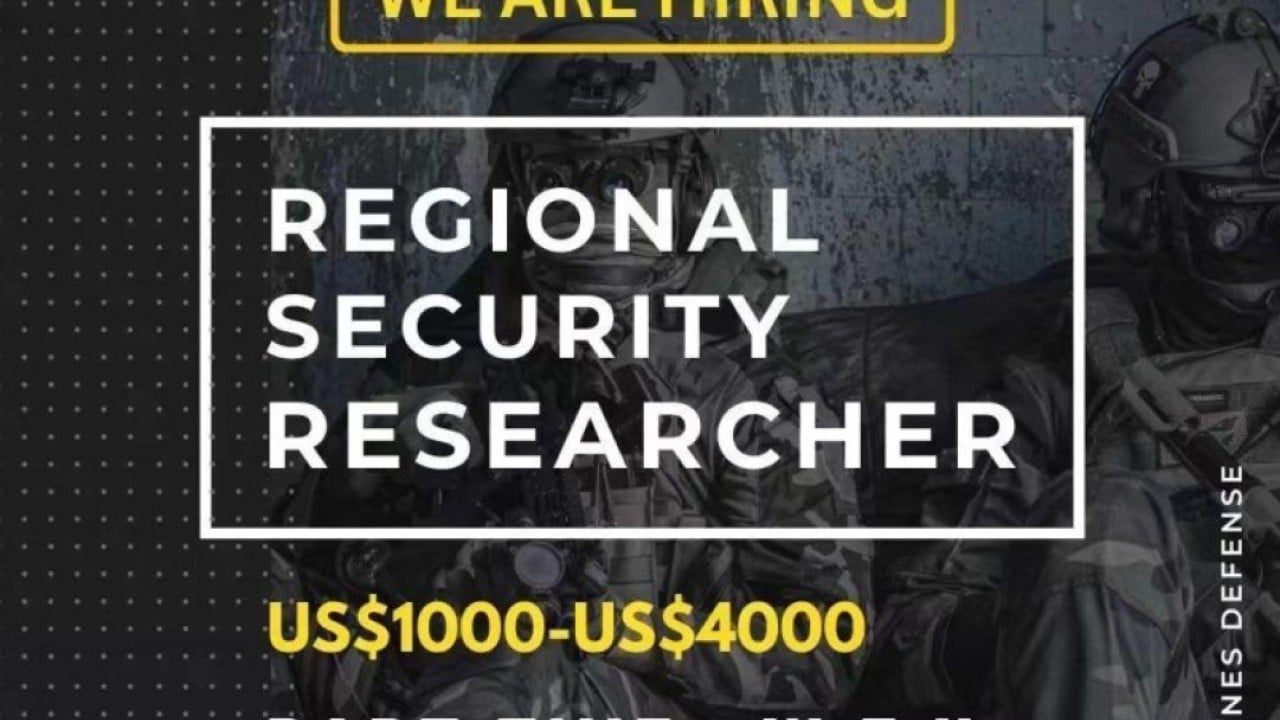
Foreign intelligence agencies have weaponized the Philippine job market by flooding social media with fraudulent military recruitment advertisements designed to harvest sensitive data from active-duty personnel and high-ranking officials. This is not a simple case of identity theft or financial fraud. It is a calculated intelligence-gathering operation that exploits the high social standing of the Armed Forces of the Philippines (AFP) to identify vulnerabilities within the national security apparatus. By masquerading as official procurement or recruitment channels, these actors create a direct pipeline into the private lives and digital devices of the country's defenders.
The mechanism is deceptively straightforward. A soldier scrolls through a popular social media platform and sees an ad for a specialized training program or a fast-track promotion scheme. The branding looks legitimate. The language mimics official AFP directives. When the soldier clicks, they are directed to a phishing site or asked to submit a detailed "application" that includes their unit designation, security clearance level, current deployment location, and personal contact information.
The Anatomy of a Digital Ambush
This operation functions on the principle of social engineering. Intelligence operatives know that military personnel are conditioned to follow instructions and respect hierarchy. By mimicking that hierarchy online, they bypass the natural skepticism a civilian might have toward a random job ad. These are not broad-net scams; they are spear-phishing attacks at scale.
The data harvested through these fake ads serves as the foundation for more advanced operations. Once an operative has a soldier's personal email and phone number, they can deploy tailored malware or initiate "long-con" relationships. In some cases, the goal is to find a single individual with financial troubles or professional grievances who can be turned into an internal asset. In others, the goal is purely technical—getting a malicious link clicked on a device that might eventually connect to a secure network.
The sophistication of these ads suggests state-backed resources. We are seeing high-quality graphic design, professional copywriting in local dialects, and paid promotion strategies that target specific geographic locations near military bases like Fort Magsaysay or Camp Aguinaldo. This level of precision requires an intimate understanding of the Philippine military's internal structure and the daily habits of its members.
Data as the New Front Line
We often think of espionage as shadowy figures in trench coats, but modern spying is built on spreadsheets and databases. The recruitment pipeline allows foreign actors to build a comprehensive map of the Philippine chain of command without ever setting foot in the country. They are cataloging who reports to whom, who has access to which facilities, and who is currently stationed in sensitive areas like the West Philippine Sea.
When a captain in a specialized naval unit inadvertently shares his deployment schedule through a fake "security update" form, he isn't just risking his own safety. He is handing over a piece of a much larger puzzle. Aggregated over thousands of personnel, this data allows a foreign power to predict troop movements, identify morale issues, and understand the readiness levels of specific divisions.
The infrastructure behind these ads is often hidden behind layers of shell companies and proxy servers. However, the linguistic patterns and the specific timing of the campaigns often align with regional geopolitical tensions. When diplomatic friction increases, the volume of these fraudulent ads spikes. It is a form of gray-zone warfare that remains below the threshold of open conflict but inflicts long-term damage on national resilience.
Exploiting the Human Element
The Philippine military is a deeply communal organization. Information often travels through informal "mistah" networks and group chats. Scammers exploit this trust. If one respected officer shares a fake recruitment link in a private group, his peers are much more likely to trust it. The attackers aren't just hacking computers; they are hacking the social fabric of the officer corps.
Financial desperation also plays a role. Despite recent salary increases, many enlisted personnel look for side hustles or post-retirement opportunities to support their families. A fake ad promising a high-paying "consultant" role for a foreign security firm can be incredibly tempting. This is the classic "MICE" framework of recruitment—Money, Ideology, Coercion, and Ego—modernized for the smartphone era.
The Limits of Current Defense
The AFP has issued warnings, and the Department of Information and Communications Technology (DICT) has attempted to take down some of the offending pages. But the sheer volume of the attacks makes manual removal impossible. For every page that is banned, three more appear within hours. The platforms themselves—Facebook, X, and Telegram—have been slow to implement the kind of rigorous verification needed to distinguish a legitimate military notice from a state-sponsored forgery.
Relying on "awareness" is a losing strategy. Human beings will always make mistakes. The solution requires a fundamental shift in how military organizations handle their public-facing digital presence. There is currently a massive gap between the physical security protocols of a military base and the digital security protocols of the people who live and work inside them.
The Infrastructure of Deception
The technical backbone of these campaigns often involves "bulletproof" hosting providers and disposable domains that are registered minutes before a campaign begins. The attackers use automated scripts to generate thousands of variations of the same ad, making it difficult for automated filters to catch them.
Once a user interacts with the ad, they are often led through a series of redirects designed to hide the final destination from security crawlers. This is a common tactic in the world of affiliate marketing fraud, repurposed here for high-stakes espionage. The final landing page often features a "chat with a recruiter" function, which is actually a gateway for a human intelligence officer to engage the target in real-time.
The intelligence value of these real-time interactions is immense. By chatting with a "recruiter," a soldier might reveal information about their specific equipment, training deficiencies, or the identity of their commanding officers. This is "soft" intelligence that, while not classified on its own, becomes highly sensitive when synthesized.
Countermeasures and Reality Checks
To combat this, the Philippines needs more than just better firewalls. It needs a centralized, authenticated platform for all government and military communications that is easily verifiable by the average citizen. If an ad doesn't lead to a .gov.ph or .mil.ph domain that is protected by multi-factor authentication and visible on a public registry, it must be treated as hostile by default.
Furthermore, the military must adopt a "zero trust" posture regarding the personal devices of its members. This is an unpopular opinion because it infringes on personal privacy, but the reality is that a soldier's smartphone is a persistent surveillance device carried into the heart of the national defense infrastructure. If that device is compromised via a fake job ad, the entire base is compromised.
Education must go beyond "don't click links." It needs to involve deep-dive training on the specific tactics of foreign intelligence services. Personnel need to understand that they are targets not because of who they are as individuals, but because of the uniform they wear and the access they hold.
The threat is not going away. As the Philippines continues to assert its rights in disputed territories, the digital pressure from regional rivals will only intensify. The job ads are just the opening move in a much longer game. The goal is to weaken the internal cohesion of the Philippine state by making its defenders feel watched, vulnerable, and compromised.
Stopping this pipeline requires a level of digital sovereignty that the country is currently struggling to achieve. It demands a partnership between the military, the tech sector, and the intelligence community that transcends traditional bureaucracy. Until then, every "Apply Now" button on a suspicious ad remains a potential breach of the nation’s most guarded secrets. Security is not a state of being; it is a process of constant, paranoid verification.
The most dangerous weapon in this conflict isn't a missile or a stealth jet. It is a well-placed advertisement on a mobile screen, waiting for the right person to click.