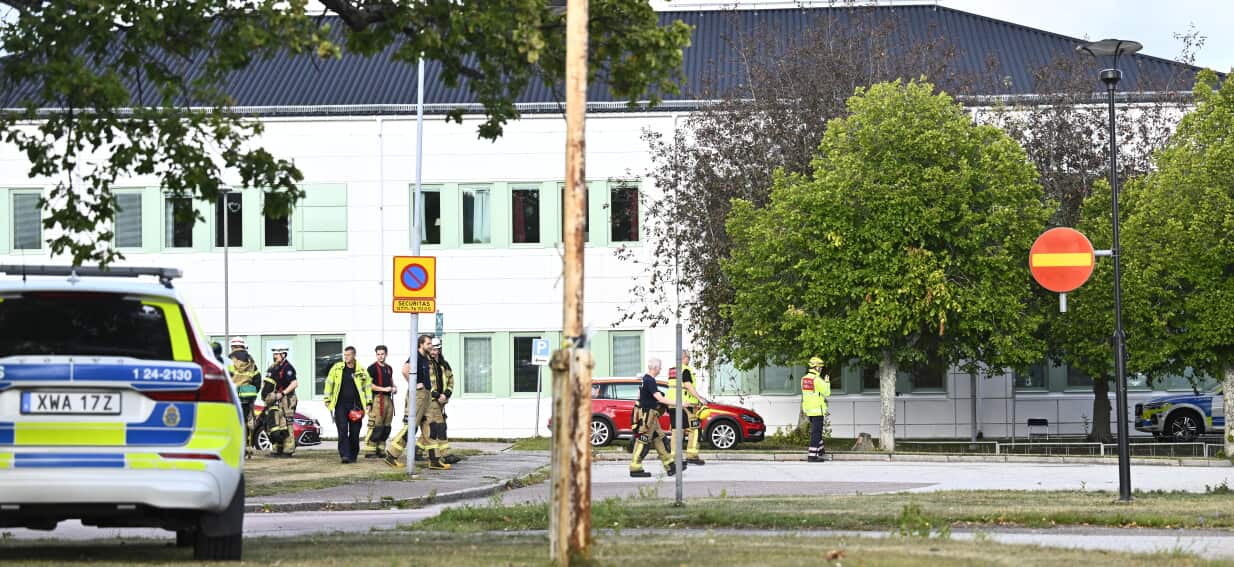
An eighteen-year-old assailant armed with an edged weapon breached the Brinell School in Fagersta, central Sweden, executing a targeted assault that resulted in one fatality and multiple serious injuries. The attack occurred during active session hours shortly after the academic term resumed, exploiting the structural vulnerabilities inherent to open educational environments. Law enforcement neutralized and detained the perpetrator utilizing targeted ballistic intervention during the arrest sequence.
Deconstructing this event requires moving past superficial reports to analyze the operational dynamics of school security failures, the velocity of tactical response, and the broader institutional risk vectors facing Scandinavian educational infrastructure.
The Operational Anatomy of Institutional Ingress
Educational facilities function under an institutional design philosophy prioritizing accessibility and community integration over physical fortification. This architectural openness creates a distinct security deficit.
- Perimeter Permeability: Modern high schools maintain multiple ingress vectors to accommodate hundreds of students and staff, rendering absolute perimeter control functionally impossible without transforming the facility into a panopticon.
- The Transition Window: Incidents frequently cluster around temporal transition points—such as shift changes, breaks, or the immediate post-recess window—when foot traffic volume degrades the efficacy of informal monitoring.
- Asymmetric Armament: An assailant possessing an edged weapon retains absolute tactical initiative over unarmed occupants during the critical minutes before armed intervention arrives.
In the Fagersta instance, the eighteen-year-old suspect—reportedly a former student—navigated these institutional design realities. Public safety officials confirmed that emergency services processed the initial alarm in the early afternoon, initiating a multi-agency response involving tactical cordons, local facility lockdowns, and immediate medical triage protocols.
Risk Aggregation in Scandinavian Secondary Institutions
While Sweden maintains low baseline rates of violent crime relative to global benchmarks, educational facilities have experienced an upward trajectory in high-profile targeted violence over recent years. This pattern indicates a systemic shift rather than isolated anomalies.
Prior incidents, such as the Malmo secondary school stabbings and historical structural attacks, underscore several recurring variables:
- The Insider Threat Vector: Perpetrators frequently possess legitimate prior familiarity with the layout, administrative blind spots, and security protocols of the targeted institution.
- Motive Fragmentation: Motivations often span acute personal grievance, social alienation, and simulated emulation loops found within digital extremist subcultures.
- Information Control Dynamics: Investigative bodies deliberately withhold operational details during active phases to prevent witness contamination, creating an informational vacuum that conventional media reports often misinterpret.
The Response Velocity Vector
The containment of active violence within a public institution is dictated by a strict mathematical function balancing reaction time against casualty accumulation.
$$R_t = T_d + T_t + T_e$$
Where response time ($R_t$) is the sum of detection delay ($T_d$), transit time ($T_t$), and tactical engagement time ($T_e$). In Fagersta, municipal emergency networks and regional police units compressed $T_t$ through rapid resource reallocation, deploying specialized units and establishing immediate geographic containment zones.
The deployment of lethal force during the apprehension phase highlights the terminal threshold of the escalation ladder. When an assailant actively compromises human life within a confined institutional volume, standard de-escalation frameworks become structurally obsolete, necessitating immediate kinetic disruption by law enforcement.
Institutional Mitigation Failures
Standard municipal responses to such crises typically rely on reactive crisis center deployment—such as the sports hall facility established by local authorities in Fagersta—and psychological support networks. While essential for community stabilization, these measures address downstream aftermath rather than upstream prevention.
Educational administrators face a persistent optimization problem: balancing an open pedagogical atmosphere against the hardening requirements of modern threat mitigation. Traditional hardening strategies, including metal detectors, single-point entry control, and armed security personnel, run contrary to the egalitarian cultural norms of Swedish public administration. Consequently, security relies heavily on behavioral early-warning systems, intelligence sharing between social services, and digital footprint monitoring.
Strategic Risk Mitigation Playbook
To alter the probability curve of similar institutional breaches, municipal authorities and school leadership must transition from passive resilience to active structural deterrence.
- Implement Dynamic Access Control: Replace static keycard systems with zoned biometric or digital tracking at secondary entrances to restrict movement for non-enrolled visitors and former students.
- Mandate Algorithmic Threat Assessment Teams: Form cross-functional units comprising school psychologists, local law enforcement, and social administrators to evaluate behavioral indicators of disaffected youth before grievance translates into operational planning.
- Standardize Hard-Crisis Protocols: Upgrade interior infrastructure with reinforced door-locking mechanisms that can be deployed instantly from within classrooms, mitigating the risk window during the initial minutes of an active threat.
- Establish Information Firewalls: Restrict speculative administrative disclosures during active investigations to maintain evidentiary integrity and prevent the romanticization or memetic spread of violent acts across digital platforms.