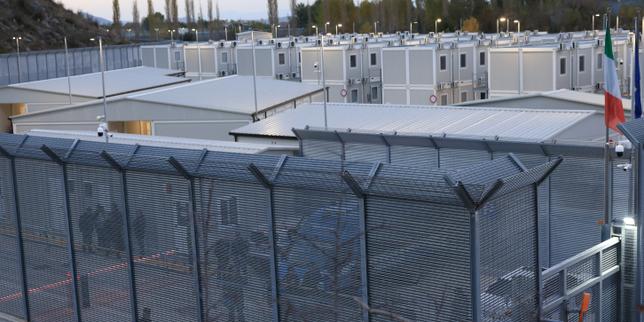
The operational model underpinning the Italy-Albania migration protocol represents a shift toward jurisdictional outsourcing. By establishing facilities on foreign soil that remain under Italian legal authority, the framework attempts to decouple administrative processing from the domestic constraints of the Italian judicial system. This strategy creates a specific friction point: the gap between state-mandated detention and the practical availability of due process.
The Mechanics of Jurisdictional Outsourcing
At its functional core, the agreement seeks to streamline the migration management cycle by relocating the initial screening and detention phases outside the European Union’s immediate administrative geography. The objective is clear: to accelerate the classification of asylum seekers, particularly those originating from countries classified by the Italian government as "safe." Read more on a similar topic: this related article.
This arrangement relies on two primary mechanisms:
- Administrative Containment: Individuals intercepted by Italian maritime assets are rerouted to facilities in Gjadër, Albania. This maintains the legal fiction of Italian jurisdiction while imposing a physical distance from domestic courts and legal aid networks.
- Procedural Fast-Tracking: The use of "safe country of origin" lists allows for a compressed evaluation process. By reducing the complexity of the asylum claim, the state theoretically increases the throughput of repatriation orders.
The structural weakness of this model is not merely a question of human rights; it is a failure of operational efficiency. By forcing asylum seekers into a geographically isolated environment, the state introduces a latency in the judicial pipeline. When legal counsel cannot meet clients in a timely manner, and when digital or remote hearings are constrained by logistics, the entire administrative process suffers from degraded quality. Further analysis by BBC News highlights similar perspectives on this issue.
The Breakdown of Judicial Review
The European Court of Justice (ECJ) recently identified a critical flaw in this logic: the reliance on "safe country of origin" designations that lack rigorous, transparent, and accessible judicial oversight.
For a detention system to function within the parameters of international law, the legality of confinement must be contestable. The Italy-Albania model complicates this by:
- Information Asymmetry: Applicants are often required to prove that a "safe" country is, in fact, unsafe for them personally. When the individual is isolated in an offshore facility with limited access to external evidence or legal resources, the probability of an accurate, non-arbitrary ruling diminishes.
- Procedural Bottlenecks: The logistical burden of coordinating across borders creates an environment where legal representation is frequently pro forma rather than substantive. Evidence of hearings consisting of monosyllabic responses suggests that the speed of the process has compromised the integrity of the fact-finding mission.
This is a classic case of system-induced bias. When the performance metrics of a detention system are weighted toward "throughput" and "deterrence," the judicial apparatus is pressured to prioritize administrative finality over individual due process.
The Economic and Operational Cost
Italy has reportedly allocated over €670 million for the operation of these facilities through 2028. This expenditure must be weighed against the functional outcomes of the policy.
If the primary goal is deterrence, the efficacy of offshore processing remains unproven. Historical data on border management consistently shows that containment strategies often drive migration flows toward more dangerous, unregulated routes rather than eliminating the underlying demand for passage. Furthermore, the legal instability created by conflicting rulings from the ECJ and the domestic courts introduces significant operational risk.
The strategy creates three distinct, high-cost liabilities:
- Legal Jeopardy: Ongoing litigation regarding the compatibility of these centers with EU law suggests that the infrastructure remains vulnerable to sudden injunctions.
- Reputational Friction: The disconnect between European human rights standards and the physical reality of the offshore facilities generates continuous diplomatic friction, which can disrupt broader migration cooperation frameworks.
- Human Capital Depletion: The psychological and health-related costs for detainees, as noted in observational reports, imply a long-term burden on the medical and social support systems of the host or destination state.
Strategic Implications for Migration Governance
The current approach attempts to solve a geopolitical problem through a localized, logistical adjustment. This is inherently limited. The reliance on extraterritoriality creates a perpetual state of legal ambiguity that undermines the predictability of the asylum system.
A more effective institutional approach requires a transition from offshore containment to upstream integration and processing reform. The blueprint for a stable system involves three structural adjustments:
- Judicial Integration: Standardize asylum procedures across the union to ensure that any "safe country" designation is subject to a unified, rigorous, and evidence-based review process that is independent of national political cycles.
- Digital Verification: Replace the physical containment model with a decentralized verification system that uses secure, accessible digital platforms for initial screening, thereby removing the necessity for physical relocation during the initial assessment phase.
- Pathway Diversification: Shift the budgetary focus from detention infrastructure to the expansion of legal, predictable, and regulated entry channels. This reduces the pressure on the maritime search-and-rescue apparatus and diminishes the reliance on the hazardous interception-detention loop.
The Italian strategy in Albania demonstrates the limitations of attempting to bypass fundamental due process requirements through geographical distancing. Any future framework must prioritize transparency and legal clarity to avoid the recursive failures inherent in current offshore detention models.