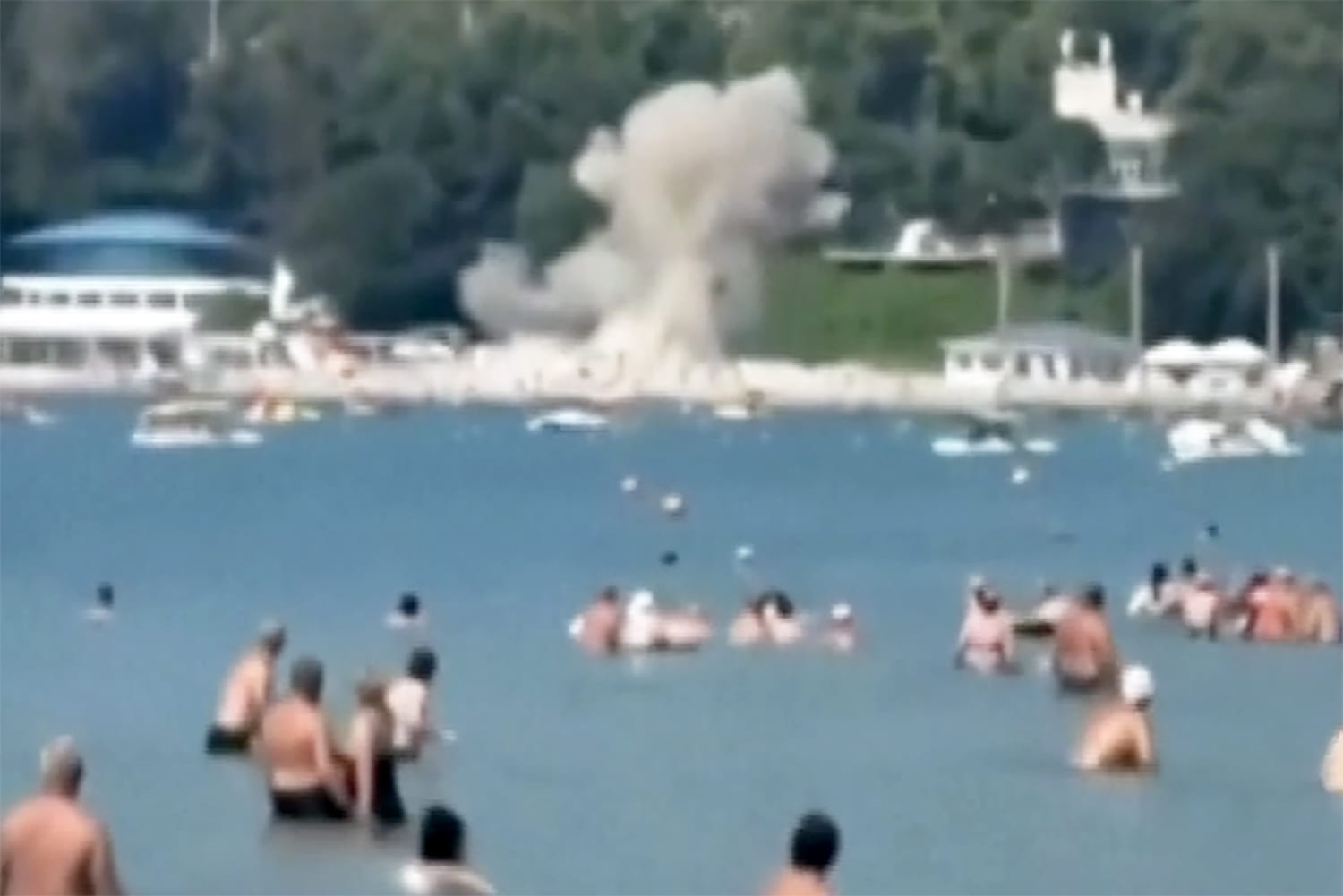
Every single defense analyst, weekend blogger, and cable news talking head looked at the footage of a consumer quadcopter turning into a fireball on a crowded Russian beach and drew the exact same lazy conclusion. They called it a freak accident. They called it a rogue hobbyist payload malfunction. Some even tried to pitch it as an amateur kinetic strike gone wrong.
They are all entirely, embarrassingly mistaken.
I have spent the better part of two decades tearing down recovered guidance systems, analyzing telemetry anomalies in contested airspace, and watching military procurement boards throw billions of dollars at shiny objects while missing structural shifts happening right in front of them. When a commercial-off-the-shelf drone detonates prematurely over public sand instead of a military grid reference, the armchair generals scream about poor build quality or sloppy wiring.
They fail to see the deliberate engineering choice staring them in the face.
That fireball on the beach was not a failure mode. It was a stress test.
The Amateurization of Modern Aerospace
Let us strip away the sensationalism and look at the actual physics of what happened. Modern consumer drones are built with standardized lithium-polymer battery packs, cheap brushless motors, and plastic chassis designed to keep manufacturing costs under three hundred bucks. When you strap an improvised high-explosive charge or a modified thermal fuse to a frame optimized for lightweight aerodynamics, you introduce catastrophic thermal stress.
The media narrative treats every anomaly as a malfunction because journalists still believe war belongs exclusively to sovereign states with multi-billion-dollar supply chains. That worldview expired a decade ago.
We are living through the complete amateurization of aerospace warfare. Anyone with a soldering iron, an open-source flight controller firmware like ArduPilot, and access to an online chemical supplier can throw together a platform capable of crossing international borders. But the mainstream press wants you to focus on the pyrotechnics. They want the drama of the fireball because nuance does not generate ad revenue.
The real story of that beach explosion is not about a defective battery or an unlucky pilot. It is about the absolute collapse of traditional air defense economics.
The Mathematics of Asymmetric Waste
Imagine a scenario where a military command spends four million dollars firing a surface-to-air missile to neutralize a platform that cost less than a high-end smartphone. You do not need a degree in macroeconomics to understand that math ends in financial ruin for whichever side insists on playing the traditional defense game.
This is where the lazy consensus truly falls apart. Analysts love to talk about counter-drone technology as if it is a neat, clean box you can check off on a procurement spreadsheet. They point to directed-energy weapons, acoustic sensors, and sophisticated electronic warfare jamming rigs.
I have seen defense contractors blow millions on mobile jamming units that look incredible in PowerPoint decks, only to watch them get completely blinded by a cheap, frequency-hopping receiver built in a basement.
The beach video captured the messy, unpredictable reality of low-cost hardware hitting environmental thresholds. High humidity, sudden atmospheric pressure shifts, and poorly shielded internal regulators will cause a poorly managed power surge to arc directly into the payload trigger. The drone did not self-destruct because of enemy cyber-warfare. It self-destructed because cheap parts pushed past their thermal limits in a real-world atmosphere.
And that should terrify every single person who thinks modern borders can be secured by building higher fences or buying more expensive radar systems.
Why the Smart Money is Ignoring the Pyrotechnics
When professionals look at footage of civilian infrastructure turning into a makeshift testing ground, they do not care about the fire. They care about the telemetry. They care about how the guidance system maintained signal lock despite local electronic interference.
The mainstream obsession with the fireball keeps the public blind to the actual evolution happening underneath: the rapid iteration of autonomous swarm logic.
We are moving past the era of remote-piloted machines. The operators sitting three towns over are no longer steering every twitch of the rudder. They are dropping waypoints. The onboard computer handles the rest, calculating wind drift, adjusting for motor degradation, and optimizing terminal velocity right up until impact—or, in the case of the viral beach incident, until a cheap transistor melts under load.
Every failed flight is just a data point for an open-source developer sitting in an apartment half a world away. They push a hotfix to a GitHub repository, compile the code, and try again the next afternoon. You cannot bomb a GitHub repository. You cannot jam an open-source community that operates across ten thousand distinct nodes.
Stop Asking the Wrong Questions
If you are still asking how governments are going to shoot down every hobbyist quadcopter that drifts over a coastline, you are fundamentally misunderstanding the twenty-first-century security landscape. The question itself is obsolete.
You cannot defend a thousand miles of coastline against thousands of disposable, autonomous platforms using systems that cost more than the targets are worth. Trying to do so is financial suicide. The solution has never been a better missile. The solution is economic and infrastructural resilience, coupled with decentralized, low-cost interception methods that do not require a defense budget to sustain.
The burning drone on the beach wasn't a warning sign of a new weapon. It was a marker of an old industrial complex dying in real time, unable to comprehend that the future of aerial dominance belongs to the garage mechanic, the open-source coder, and the disposable machine.
Get used to the smoke. It is the only thing the old guard has left to look at.