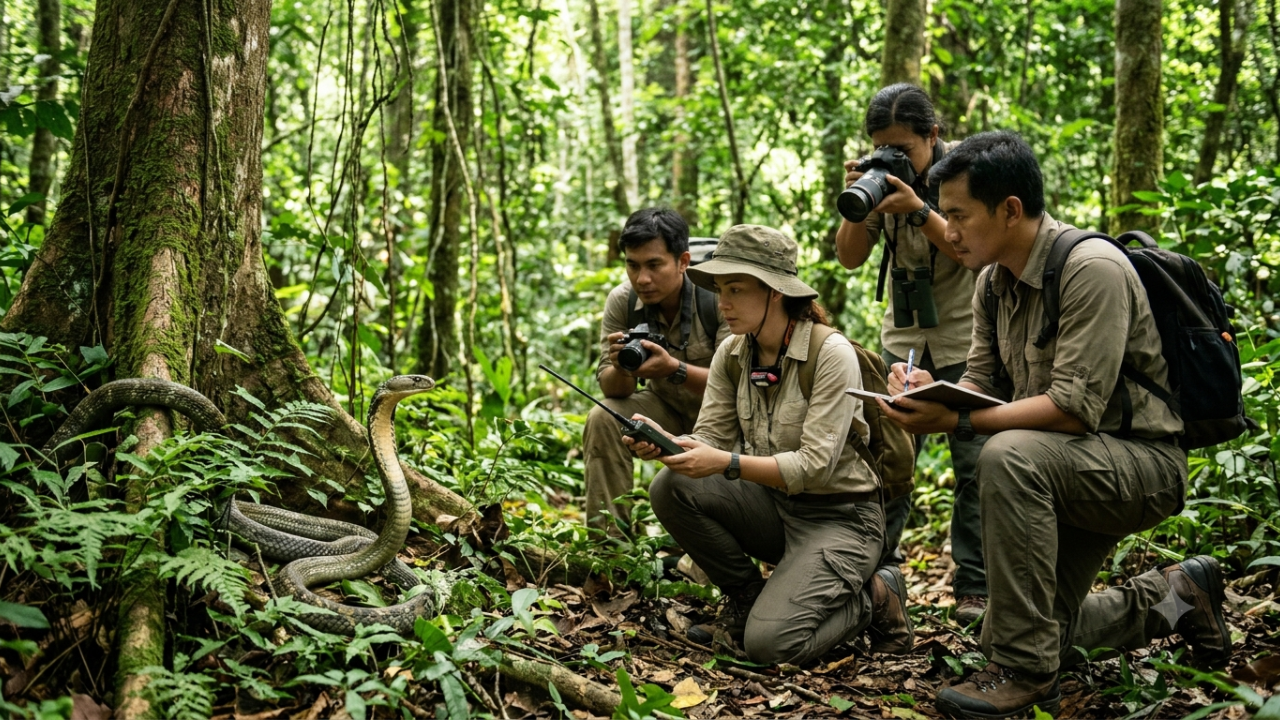
Stop believing the wildlife documentaries.
Every time a mainstream nature outlet publishes a piece about king cobras in Thailand, they recycle the exact same lazy script. They paint Ophiophagus hannah as an aggressive, hyper-territorial apex predator lurking in untouched jungle canopies, waiting to strike anything that moves. Then, when radio-telemetry data out of places like the Sakaerat Biosphere Reserve reveals that these snakes actually spend massive amounts of time hiding in agricultural ditches, raiding village chicken coops for pythons, and actively avoiding confrontation, the headlines act shocked. "Scientists uncover a little-known side of king cobra behavior," they gasp.
That isn't a hidden side of the animal. That is the animal.
The shock comes entirely from decades of terrible conservation storytelling. By romanticizing the king cobra as a pristine wilderness ghost, wildlife media and poorly run eco-tourism outfits have completely distorted how both locals and researchers interact with the world's longest venomous snake. When you base conservation policy and human safety protocols on Hollywood tropes instead of actual spatial ecology, people get bitten, snakes get hacked to death with machetes, and millions of dollars in habitat funding go straight into the wrong pockets.
The Myth of the Aggressive Jungle Monarch
Let's dismantle the biggest lie first. The king cobra is not aggressive. It is intensely defensive, extraordinarily energy-conservative, and deeply reliant on human-altered environments.
For years, the prevailing assumption in herpetology—driven mostly by anecdotal encounters with cornered snakes—was that male king cobras aggressively patrol massive, exclusive territories deep inside primary forests. Field researchers working in Northeast Thailand, particularly the long-term telemetry teams operating out of Sakaerat, blew that assumption wide open. When you actually implant radio transmitters into wild cobras and track them daily over years rather than relying on chance sightings, a completely different animal emerges.
King cobras do not patrol borders like wolves or tigers. They have overlapping home ranges that stretch across dozens of square kilometers. More importantly, they show a massive preference for edge habitats—the messy, fragmented buffer zones where agricultural land, cassava plantations, irrigation canals, and rural villages slam into secondary forest.
Why? Because snakes are cold-blooded calculators of caloric return on investment.
An adult king cobra can easily exceed four meters in length. Fueling a body that size requires a steady, high-calorie diet of other snakes—specifically rat snakes (Ptyas species) and reticulated pythons. Where do rat snakes and pythons congregate in massive numbers? Not in the sterile, shaded floor of a dense old-growth dipterocarp forest. They congregate in rice paddies, sugarcane fields, and the edges of human settlements where rodents breed by the thousands.
The king cobra isn't invading human territory out of desperation or habitat loss alone. It is following the buffet. By treating agricultural margins as unnatural "danger zones" rather than core foraging habitat, traditional conservation models completely miss where these snakes actually live and hunt.
Why Telemetry Exposed Decades of Bad Fieldwork
If you have ever spent time trudging through Thai scrubland in ninety-five-degree heat with a Yagi antenna, you know how humbling real fieldwork is. You stand ten feet from a bamboo thicket, your receiver screaming at maximum gain, and you still cannot see a fourteen-foot reptile staring right at you.
Before continuous radio-telemetry became standard practice in Southeast Asia, our understanding of king cobra behavior suffered from extreme observation bias. Think about when humans actually see a king cobra in the wild. You see them when they are crossing a paved road, when a farmer accidentally uncovers a nest in a pile of bamboo leaves, or when a snake gets trapped inside a concrete drainage pipe behind a house.
In every single one of those scenarios, the snake is terrified, exposed, and cornered. Naturally, it rears up, spreads its narrow hood, and lets out that iconic, low-frequency growl—a sound produced by tracheal diverticula resonating like an organ pipe.
Observers documented that defensive display and projected it onto the entire species' daily existence. They mistook a panic response for a baseline personality trait.
When researchers like Colin Strine, Matt Goode, and the team at Sakaerat began tracking individuals around the clock, the narrative collapsed. Those same "terrifying" apex predators spent upwards of seventy to eighty percent of their lives completely motionless, tucked inside underground burrows, termite mounds, or dense tangles of dead bamboo. They didn't chase people. In dozens of documented instances where tracked snakes were within meters of unsuspecting farmers, loggers, or researchers, the cobras froze, flattened themselves into the leaf litter, and let the humans walk right past without ever raising a hood.
The "little-known side" of king cobra behavior is simply what they do when we aren't cornering them with a camera crew.
The Maternal Care Blind Spot
If the territorial myth wasn't bad enough, look at how badly mainstream outlets butcher the science of king cobra reproduction.
Every article mentions that the female king cobra is the only snake in the world that builds a nest. They treat it like a quirky trivia fact—a cute evolutionary anomaly. They completely miss the physiological cost and the behavioral complexity that makes this trait so volatile.
Female king cobras don't just scrape together a pile of leaves. Using loops of their own body like a bulldozer, they spend days gathering dry bamboo and leaf litter into a two-tiered mound. They lay between twenty and forty eggs in the bottom chamber, then coil inside the upper chamber to guard the clutch for roughly two to three months.
During this entire incubation period, the female does not eat. Think about that metabolic reality. She is maintaining high vigilance in tropical heat while burning through her own fat reserves and muscle mass, all while staying hydrated enough to keep her eggs from desiccating.
Here is where the conventional safety advice gets people killed. Standard snake-safety brochures tell people that king cobras are fiercest when guarding a nest. While true, that advice misses the critical timeline. Telemetry and nest-monitoring data show that the female abandons the nest just before the eggs hatch.
Why? Because she is an obligate ophiophage—a snake-eater. Her prey drive is hardwired to target anything long, slender, and moving. If she stays at the nest when those thirty hatchlings emerge, her starving, post-fasting feeding response risks overriding her maternal instinct. She leaves to avoid eating her own offspring.
Yet, when local villagers or poorly trained rescue teams find a nest, they assume the threat disappears the moment they capture and relocate the adult female. They leave the nest intact or move the eggs without realizing that weeks later, thirty fully venomous, hyper-defensive hatchlings will disperse directly into the surrounding village perimeter. Furthermore, relocating a nesting female away from her chosen microclimate almost always destroys her reproductive output for the year and induces fatal stress-related behaviors as she desperately tries to navigate unfamiliar terrain to get back to her territory.
Stop Relocating Snakes (It Is a Death Sentence)
This brings us to the single most controversial truth in modern reptile conservation, and the one that will make well-meaning wildlife rescue groups furious: snake relocation is mostly a feel-good slaughter.
In Thailand, when a king cobra turns up in a kitchen or a chicken coop, the local rescue foundation arrives, bags the snake with impressive skill, films a heroic release video at the edge of a national park ten kilometers away, and posts it to social media. The public cheers. Everyone feels great.
And in a staggering number of cases, that snake is dead within six months.
Spatial ecology research across multiple viper and elapid species—including extensive work on king cobras in Thailand—proves that translocated snakes suffer catastrophic mortality rates compared to resident snakes. When you dump an adult king cobra into a "pristine" forest miles away from its home range, you aren't saving it. You are dropping an outsider into an unfamiliar landscape where it doesn't know the locations of seasonal water sources, thermal refuges, or reliable prey corridors.
Disoriented and stressed, translocated cobras abandon normal, energy-saving ambush behaviors. They begin moving erratically over massive distances, burning through their energy reserves at an unsustainable rate. This frantic movement forces them across major highways, through open agricultural fields during peak daytime heat, and straight into the paths of vehicles, domestic dogs, and panicked farmers who don't have a rescue team on speed dial.
Even worse, dumping a rescued cobra into a protected forest disrupts the existing social and spatial dynamics of the resident snakes already living there. You create artificial crowding, heighten competition for burrows, and increase the risk of disease transmission.
The uncomfortable reality is that translocation is designed to manage human anxiety, not to save snakes.
Rewriting the Playbook for Human-Snake Coexistence
If we actually care about keeping both Thai farmers and king cobras alive, we have to abandon the fantasy of separating them with imaginary lines on a map. King cobras are synanthropic—they thrive alongside human agriculture. Pretending they belong exclusively inside national park boundaries is ecological illiteracy.
What does a rational, data-backed approach look like? It starts with dismantling the questions people usually ask about these animals.
"Are king cobras becoming more aggressive because of deforestation?"
No. Their behavior hasn't changed; human encroachment has simply compressed the buffer zones. When you clear secondary scrub to plant monoculture rubber or cassava, you eliminate the dense bamboo thickets and underground root systems that cobras use to hide during the day. The snakes aren't attacking more frequently because they are angry about habitat loss. They are getting spotted more often because they have nowhere left to hide while hunting the rodents and pythons drawn to the crops.
"How far away do you need to move a king cobra so it won't come back?"
You shouldn't be moving it kilometers away at all. If you want a snake to survive, short-distance translocation—moving the animal a few hundred meters to the nearest dense cover within its existing home range—is vastly superior to long-distance dumping. The snake retains its spatial map, knows where its burrows are, and immediately settles back into low-risk, sedentary behavior.
"What is the biggest threat to king cobras in Thailand right now?"
It isn't venom harvesting, and it isn't the exotic pet trade. It is road mortality and habitat fragmentation combined with well-intentioned but poorly executed human intervention. Every time a paved road bisects an agricultural corridor, it creates a thermal trap. Cobras use asphalt to thermoregulate at night, and because they rely on stillness as their primary defense mechanism, they freeze in the headlights of oncoming trucks rather than fleeing.
The Hard Truth About Conservation Funding
The wildlife media ecosystem thrives on mystery and danger. Calling a snake's normal daily routine a "newly uncovered secret" generates clicks. Framing a shy, burrow-dwelling predator as an unpredictable monster sells ad space.
But there is a massive downside to this contrarian reality, and we have to own it: nuance does not raise money.
If you tell donors that king cobras spend eighty percent of their time sleeping in rat holes next to cassava farms, and that the best way to save them is to stop "rescuing" them and instead pay farmers to leave messy brush piles along their property lines, the donations dry up. People want to fund dramatic helicopter releases into untouched jungles. They don't want to fund agricultural margin management and road-culvert engineering.
Yet, until conservation agencies and media outlets stop peddling the myth of the noble jungle monarch, they will continue pouring resources into feel-good theater while the actual population quietly bleeds out on rural highways and at the hands of terrified villagers.
The science out of Thailand didn't uncover a strange new quirk in king cobra behavior. It held up a mirror to our own ignorance. Stop treating the king cobra like a cinematic villain or a fragile wilderness ghost, and start managing the farmland it actually calls home.