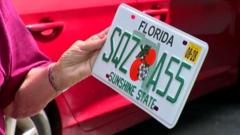
A seventy-year-old grandmother opens a paper envelope from the Department of Motor Vehicles, pulls out a fresh piece of stamped aluminum, and gasps. The random sequence of letters and numbers on her brand-new plate looks suspiciously like a crude anatomical joke or a piece of racy internet slang. Within hours, the local news station has a camera crew in her driveway. There are grave headshakes, dramatic close-ups of the offending metal, and anchors asking how such a profound administrative breakdown could ever occur.
It is a predictable, seasonal media farce.
The real scandal here is not that a senior citizen received a plate that accidentally reads like a late-night text. The real scandal is that we waste millions of dollars trying to keep state-issued metal rectangles PG-13 in an era when every schoolchild carries unrestricted access to the entire sum of human depravity in their front pocket.
The outraged consensus tells us that the DMV must protect the public square from offensive words. This consensus is wrong. The administrative state’s obsession with policing the letters on your bumper is a costly, legally indefensible exercise in subjective nanny-state moralizing. It is time to dismantle the entire license plate censorship apparatus.
The Administrative Black Hole of the Naughty Word Committee
Most people assume that license plates are generated by a quiet computer in a basement and shipped out without human intervention. That is only half-true. When the random generator spits out a sequence that triggers a basic alphanumeric filter, or when a citizen requests a custom vanity plate, a massive, highly expensive bureaucratic machine grindingly roars to life.
I have watched public agencies burn hundreds of thousands of dollars on administrative committees whose sole purpose is to sit in fluorescent-lit conference rooms and argue about whether a specific combination of letters is a hate crime, a dirty joke, or just a harmless typo. These are the state License Plate Review Boards.
These boards do not operate on objective science. They operate on vibes, outdated slang dictionaries, and pure panic.
Consider the mechanics of how a state agency handles these reviews. Typically, a team of three to five salaried state employees must review flagged submissions. They use resources like Urban Dictionary—a website written by teenagers—to determine if a specific letter combination has an offensive alternative meaning.
Think about the absurdity of this setup:
- The Cost: Salaried government workers spending billable hours researching obscure sexual slang.
- The Inconsistency: A plate approved in Maryland will be banned in Virginia because one reviewer on Tuesday was in a bad mood.
- The Backlog: Thousands of citizens wait months for simple registration renewals because the state is terrified that a plate might contain an accidental reference to a drug from the 1970s.
When we demand that the state "fix" the system so nobody ever gets a "shocking" plate, we are demanding more bureaucracy, more tax dollars thrown into the void, and more subjective censorship.
The First Amendment Nightmare the State Is Losing
The crusade to sanitize our bumpers is not just a waste of money; it is actively unconstitutional.
Over the last decade, federal courts have repeatedly taken a sledgehammer to the DMV’s censorship guidelines. The state wants you to believe that a license plate is purely government speech, meaning they can control whatever is printed on it. The courts are increasingly saying otherwise.
In California, a federal judge struck down the DMV’s ban on personalized plates that were deemed "offensive to good taste and decency." The court rightly pointed out that "good taste" is an entirely subjective standard that violates the First Amendment. In New Hampshire, the state Supreme Court ruled that a driver had every right to keep a plate that read "COPSLIE."
+-------------------------------------------------------------------------+
|                      THE SLIPPERY SLOPE OF BUMPER CENSORSHIP             |
+-------------------------------------------------------------------------+
|  [Allowed]                                        [Banned by DMV]       |
|  "TRUST GOD"  <---------------------------------> "NO GOD"              |
|  "GUN LVR"    <---------------------------------> "ANTI GUN"            |
|  "MILF" (Some states) <-------------------------> "SXT"                 |
+-------------------------------------------------------------------------+
When a state agency decides what is "offensive," it inevitably discriminates based on viewpoint. A plate supporting a specific political movement is allowed, while a plate mocking it is flagged and banned. By forcing the DMV to act as a language gatekeeper, we are validating a system where unelected clerks decide which ideas are polite enough for public consumption.
If we actually care about constitutional integrity, we must accept that the price of living in a free society is occasionally seeing a sequence of letters on a Toyota Prius that makes us roll our eyes.
The Slang Inflation Problem
The state cannot win the war against dirty words because language evolves faster than any government database can update.
Decades ago, a censorship filter only had to look out for a handful of classic Anglo-Saxon four-letter words. Today, internet culture generates new slang, double entendres, and acronyms on a weekly basis. A string of characters that is completely innocent today could become a viral meme denoting something incredibly vulgar tomorrow.
To keep up, the DMV would need to hire a full-time staff of teenage online culture consultants.
- Acronym Inflation: Standard phrases like "DTF" or "AF" mean nothing to a seventy-year-old bureaucrat but are instantly recognizable to anyone under thirty.
- Visual Substitutions: Using numbers for letters ($5$ for $S$, $8$ for $B$, $1$ for $I$) creates an almost infinite number of workarounds.
- Multilingual Slang: A word that is perfectly innocent in English might be a profound insult in Spanish, Vietnamese, or Arabic. Does the state hire translators for all 6,000 languages spoken globally to vet seven letters?
The system is fundamentally broken because the goal is impossible. Trying to patch the software to catch every possible offensive combination is like trying to empty the ocean with a fork.
The Real Solution: Complete Deregulation
We need to stop treating the accidental appearance of a suggestive word on a license plate like a civil emergency.
The solution is incredibly simple, highly cost-effective, and entirely logical: Complete deregulation of sequential and vanity plate text, excluding direct, explicit incitement to violence.
If a random algorithm spits out "FKBY" or "VAG" or "SXT" on a standard-issue plate, let it slide. The driver can either laugh and mount it on their car, or if they are genuinely distressed, they can pay a nominal ten-dollar fee to exchange it for another random sequence. We do not need a multi-million-dollar state apparatus to prevent a grandmother from experiencing a brief moment of mild surprise.
For personalized plates, the state should step out of the morality business entirely. If a driver wants to pay extra money to put something ridiculous, tacky, or mildly offensive on their car, let them. It serves as a highly efficient public warning system. It tells the rest of us exactly who we are dealing with on the highway before they even merge into our lane.
The current hysteria over "racy" plates is a symptom of a larger cultural sickness: the belief that the government's primary role is to protect our delicate sensibilities from the minor frictions of everyday life. A bad word on a license plate will not cause a multi-car pileup. It will not corrupt the youth. It will just remind us that language is messy, humans are immature, and state bureaucracy is entirely incapable of policing either.
Strip the funding from the censorship boards. Fire the language police. Let the aluminum tell the truth.