Most people think Pompeii died in a sudden flash of lava. They picture a peaceful Roman town going about its morning business, only to be instantly frozen in time by a rogue volcano.
It didn't happen that way.
The destruction of Pompeii was a slow, agonizing, 24-hour psychological horror story. It was a series of terrible decisions, miscalculated risks, and environmental warnings that people ignored until it was too late. If you visit the ruins today near modern Naples, you aren't looking at a town caught by surprise. You're looking at the remnants of a failed evacuation.
When Mount Vesuvius erupted in 79 AD, it altered the landscape of Campania forever. But the real story isn't just the geology. It's the human behavior.
The Deadly Delays of Mount Vesuvius
People in Pompeii knew the earth was angry. A massive earthquake shattered the town in 62 AD, just 17 years prior. In fact, when the volcano finally blew, Pompeii was still a noisy, chaotic construction zone. Workers were actively rebuilding temples and fixing broken water pipes from recent tremors.
They just didn't know Vesuvius was a volcano. To the Romans, it was just a lovely, green mountain covered in prestigious vineyards.
When the mountain cracked open around noon on that late summer or autumn day, it didn't spew red lava down the slopes. Instead, it shot a massive column of superheated rock and ash 20 miles into the stratosphere.
Pliny the Younger, an 18-year-old watching from across the Bay of Naples, described it as looking like a giant pine tree. His eyewitness accounts, preserved in letters to the historian Tacitus, give us the exact timeline.
For the first few hours, the danger felt distant. Then the debris started falling.
This first phase was the pumice fall. White and grey volcanic stones, light but relentless, began burying the streets. This is where the fatal choices happened. Many residents looked outside, saw the stones falling, and decided to shelter indoors. They thought their heavy tiled roofs would protect them.
That was a terrible mistake.
Pumice accumulates fast. It piled up at a rate of several inches per hour. Soon, the weight on the roofs became unbearable. Heavy wooden beams snapped, collapsing ceilings and crushing the people hiding beneath them.
Realities of the Roman Rescue Mission
While hundreds were getting trapped in their homes, a massive rescue operation was brewing across the bay at Misenum. This wasn't a disorganized panic. It was a military response.
Pliny the Elder—the uncle of the younger Pliny—was the admiral of the Roman fleet. He was a scientist, an author, and a veteran commander. When he saw the cloud, his instinct was to investigate. When he received a frantic message from a friend named Rectina, whose villa sat at the foot of the volcano, his mission changed from exploration to evacuation.
He launched the Roman navy's heavy warships, called quadriremes.
The plan was brilliant but dangerous. He wanted to use the ships to pull people off the coast. But as the fleet neared the shore near Herculaneum, thick ash, hot pumice, and blackened stones rained down on the decks. The sea floor was shifting wildly due to the volcanic activity, creating sudden shallow waters.
"Fortune favors the brave!" the admiral shouted, according to his nephew's records.
He couldn't land at Herculaneum, so he redirected the fleet south to Stabiae, a few miles from Pompeii. He managed to land and meet his friend Pomponianus. To calm his terrified friends, the admiral took a bath, ate dinner, and went to sleep. He snored loudly while the courtyard outside his room filled with ash.
By morning, the situation turned apocalyptic.
The Final Waves That Sealed Their Fate
If you survived the collapsing roofs on day one, you died on day two.
Early the next morning, the massive column of ash above Vesuvius grew too heavy. It collapsed. Instead of shooting upward, a boiling mixture of gas, ash, and rock raced down the mountain slopes.
These are pyroclastic surges. They move at over 60 miles per hour. Their temperatures reach upwards of 500°F (about 260°C).
The first few surges missed Pompeii but completely buried the neighboring beach town of Herculaneum. The fourth surge, however, hit Pompeii with full force. It didn't matter if you were inside a house, a temple, or running through the fields. The toxic gas choked the remaining population instantly, while the searing heat caused thermal shock.
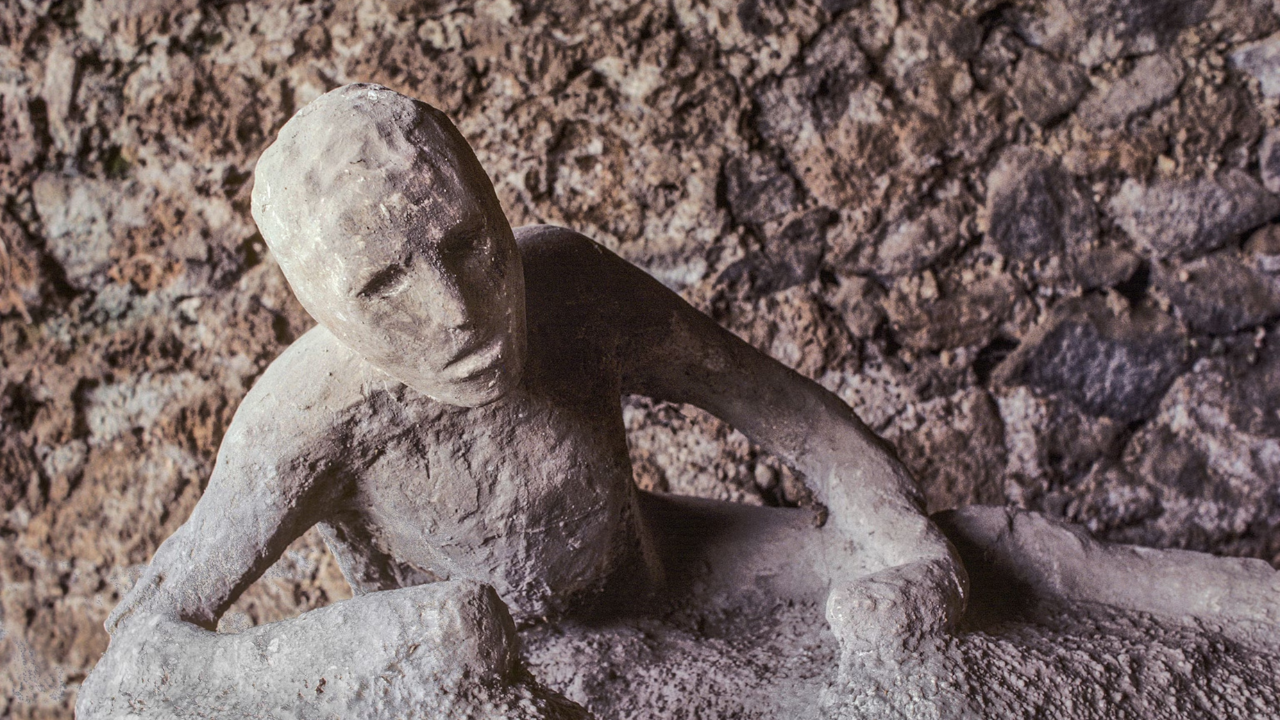
That's what killed the people who stayed. The famous plaster casts you see today aren't actually bodies. They are the hollow spaces left behind by decomposed flesh, preserved inside the hardened ash matrix. Italian archaeologist Giuseppe Fiorelli figured out in the 19th century that pumping plaster into these cavities revealed the exact, agonizing final postures of the victims.
You can see a mother holding her child. You can see a dog contorted on its back. You can see people covering their faces.
Modern Discoveries Changing the Timeline
For centuries, historians agreed that Pompeii fell on August 24, 79 AD. That date came from standard translations of Pliny's letters.
Except it's probably wrong.
Recent excavations by the Parco Archeologico di Pompei have turned up clues that point to an autumn date, likely October 24.
First, archaeologists found a charcoal inscription on a wall in a house being renovated. It was dated "the sixteenth day before the kalends of November," which translates to October 17. A worker wrote that just days before the eruption.
The physical evidence matches the October theory. Excavators found remnants of autumn fruits like pomegranates and chestnuts in the ruins. The victims were wearing heavy, woolen clothing that makes zero sense for a blistering Italian August. Wine fermenting jars were already sealed up, an activity that happened after the autumn grape harvest.
This changes how we view the tragedy. It wasn't a summer holiday crowd caught out in the open. It was a population preparing for winter.
How to Experience the Real Pompeii Without the Tourist Traps
If you want to understand this history, you need to see it correctly. Don't just book a generic tour bus from Rome that rushes you through the site for two hours. Pompeii is massive—it's an entire city of 160 acres.
Take the Circumvesuviana train from Naples or Sorrento and get off at the Pompei Scavi station. Buy your tickets directly from the official gate.
Skip the crowded main streets near the entrance and head straight for the newer excavations in Regio V. This is where the freshest discoveries are happening. You'll see vibrant frescoes that haven't been faded by decades of tourist breath and sunlight.
Walk down the Via dell'Abbondanza and look at the deep ruts in the stone streets carved by ancient wagon wheels. Look at the political graffiti painted on the walls. Step into the ancient fast-food joints, called thermopolia, where you can still see the round holes in the counters where jars of hot food sat.
When you stand in the middle of the forum, look up at Vesuvius. It looks quiet today. But it's still an active volcano, and millions of people live in its shadow right now. The tragedy of Pompeii isn't just an ancient story. It's a blueprint for what happens when nature moves faster than human decisions.