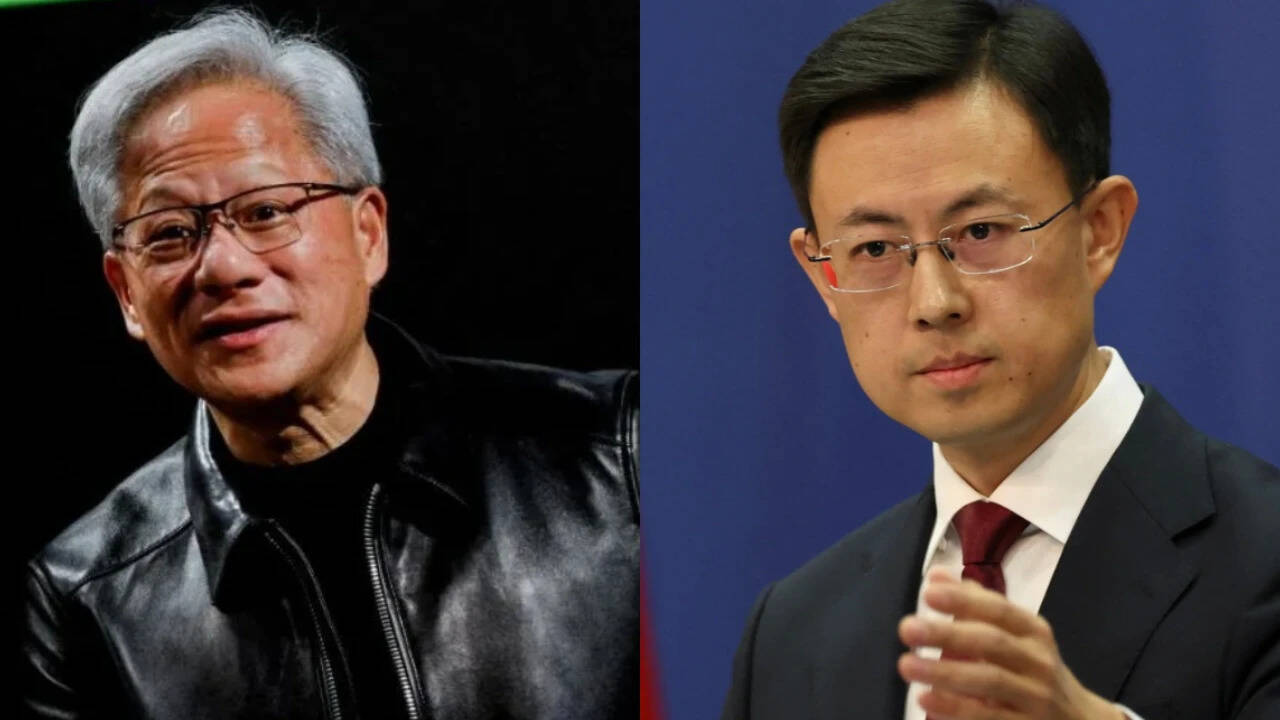
Beijing didn't just deny the rumors. They came out swinging.
When allegations surfaced claiming a sophisticated espionage plot involving Nvidia CEO Jensen Huang, China's Foreign Ministry wasted zero time labeling the entire narrative a coordinated smear campaign. If you've been watching the semiconductor wars unfold over the past few years, this reaction shouldn't surprise you at all. Every single movement by an American chip executive in East Asia is now treated like a high-stakes intelligence operation.
Let's cut through the noise. You're looking at a massive geopolitical collision where business diplomacy gets deliberately weaponized for headlines.
Why China Called the Jensen Huang Spy Allegations a Smear Campaign
To understand Beijing's aggressive pushback, you have to look at the timing and the stakes. China's Foreign Ministry spokesperson flatly rejected the claims, arguing that Western media outlets and political hawks are fabricating national security threats to justify stricter export controls.
Honestly, they have a point about the political timing.
Whenever Nvidia tries to maintain legitimate commercial ties with Chinese tech giants—or when Jensen Huang travels to the region to meet with local engineers and supply chain partners—speculation explodes. Critics in Washington immediately question whether proprietary American artificial intelligence technology is leaking across the Pacific. Meanwhile, Beijing views these spy plot accusations as an intentional effort to poison business confidence and force a total decoupling of the global tech supply chain.
It's a classic diplomatic trap. If China stays quiet, the rumor hardens into accepted truth in Western policy circles. If they speak up, hawks point to their defensiveness as proof of guilt.
The Reality of Jensen Huang's Balancing Act
Anyone who actually follows the semiconductor industry knows Jensen Huang walks a razor-thin tightrope every single day. Nvidia isn't some rogue agency running covert ops. It's a publicly traded multi-trillion-dollar company trying to protect its market share while obeying strict U.S. Department of Commerce regulations.
Think about what Huang actually deals with. On one side, the U.S. government keeps tightening the screws on advanced AI chips like the H100 and Blackwell architectures, banning their sale to Chinese entities. On the other side, China historically accounted for roughly 20% to 25% of Nvidia's data center revenue. You don't just walk away from a market that size without trying to navigate the legal boundaries.
When Nvidia designs modified, lower-bandwidth chips specifically to comply with American export laws, politicians accuse them of undermining national security. When Huang visits Taiwan or mainland China to check on manufacturing partners like TSMC or Foxconn, conspiracy theories about espionage plots inevitably follow.
How Tech Diplomacy Gets Twisted Into Espionage Narratives
If you've ever worked in international tech supply chains, you know that face-to-face meetings are non-negotiable. You can't manage complex silicon packaging, wafer allocation, and server assembly entirely over Zoom.
Yet in the current political climate, routine executive travel gets reframed as cloak-and-dagger intrigue. Here is how a standard corporate trip turns into a viral spy rumor:
- Routine Supply Chain Audits: Executives visit regional offices and manufacturing hubs to inspect production timelines and quality control.
- Closed-Door Policy Briefings: Tech leaders meet with local regulators to understand shifting compliance rules so their products don't get banned overnight.
- Information Vacuum: Because corporate security teams keep executive itineraries confidential for physical safety reasons, outsiders start guessing who is meeting whom.
- Geopolitical Amplification: Political commentators and anonymous sources fill that vacuum with worst-case espionage scenarios, forcing official government denials.
Beijing's dismissal of the spy plot claims targets this exact cycle. From their perspective, turning routine commercial engagement into an intelligence scandal is a deliberate tactic used to intimidate foreign executives out of doing business in China.
What People Miss About Semiconductor Security
There is a massive misconception among casual observers about how chip technology actually moves around the world. People imagine an executive carrying a briefcase full of secret blueprints across a border, like something out of a 1980s Cold War thriller.
That isn't how modern chipmaking works. Not even close.
Advanced AI hardware relies on an extraordinarily complex ecosystem of extreme ultraviolet lithography machines, proprietary software stacks like Nvidia's CUDA, and tens of thousands of specialized engineers. You can't steal that in a secret meeting, and a CEO certainly isn't acting as a field operative. The real battles over semiconductor dominance happen in patent courts, export licensing offices, and multi-billion-dollar fabrication plants—not in shadowy hotel lobbies.
When governments trade accusations about spy plots, they're usually fighting a public relations war aimed at domestic audiences. Washington wants to look tough on national security. Beijing wants to look like a rational, victimized defender of free trade.
What This Means for the Global Chip Market
If you invest in tech stocks, manage IT procurement, or build AI infrastructure, you need to learn how to filter out geopolitical theater from actual policy shifts. Rumors of espionage plots move markets for about forty-eight hours, and then reality sets back in.
Watch the actual regulatory filings instead of the sensational headlines. Pay attention to official updates from the U.S. Bureau of Industry and Security (BIS) regarding export thresholds, and track Nvidia's quarterly earnings reports to see how their regional revenue splits actually shift over time. Those documents tell the real story of where the hardware is going.
Don't let viral political finger-pointing dictate how you evaluate the semiconductor sector. Follow the supply chain data, ignore the noise, and verify every explosive claim against official regulatory actions before making your next move.