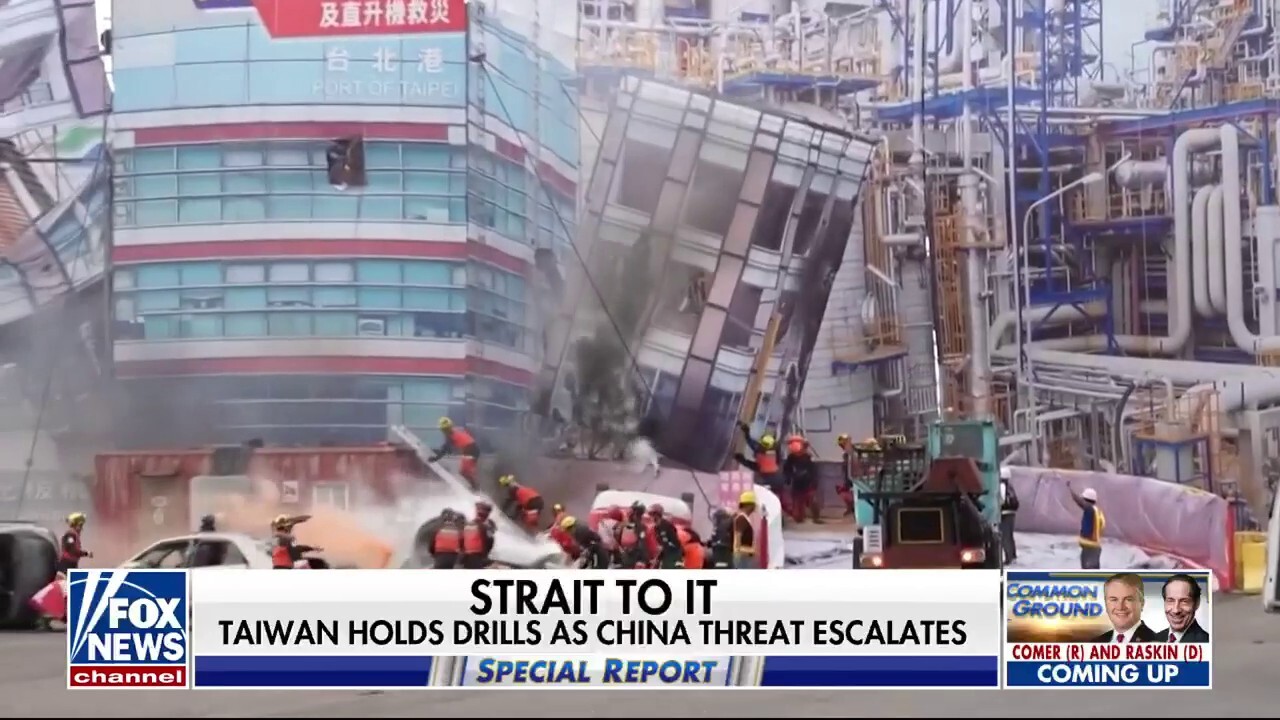
Another day, another breathless bulletin about a single aircraft and nine naval hulls skirting Taiwan. The wire services treat these numbers like tea leaves. Analysts on cable news furrow their brows, point at colored maps, and hyperventilate about escalation ladders, crossing red lines, and imminent amphibious assault fleets crawling over the horizon.
It is security theater at its finest, designed to generate clicks, satisfy defense contractor lobbyists, and keep the Washington-Taipei-Beijing pundit industrial complex well-fed.
The lazy consensus says we are watching a slow-motion countdown to a hot war, measured daily by counting hulls and wings.
That interpretation is dangerously wrong.
Beijing is not counting down to an invasion day on a wall calendar. They are executing an attritional erosion campaign that renders traditional military metrics utterly obsolete. While Western analysts obsess over troop counts and sortie rates, Beijing treats sovereignty like a balance sheet, slowly buying up the company through administrative foreclosure while the board members scream about a hostile takeover that never quite arrives in the form they expected.
The Mirage of the Invasion Clock
For decades, the standard playbook of strategic deterrence relied on a binary model. Peace reigned until a threshold was crossed, mobilization occurred, and an armada crossed the strait. Every time a patrol crosses the median line, analysts reach for their historical analogies, muttering darkly about 1938 or 1950.
This is intellectual laziness born of historical nostalgia. Modern kinetic warfare is expensive, messy, and devastating to supply chains that even superpowers depend on. Why launch an amphibious landing that risks catastrophic naval attrition in the first forty-eight hours when you can achieve the exact same geopolitical objective through administrative saturation?
Think of it as a permanent bureaucratic siege. By maintaining a constant, low-level operational presence around the island, Beijing achieves three distinct goals that a traditional invasion threat could never secure.
First, they bankrupt the adversary through defensive readiness. Scrambling interceptors against routine patrols wears out airframes, burns through flight-hour budgets, and exhausts flight crews. Taiwan’s defense ministry spends a staggering percentage of its GDP playing high-stakes whack-a-mole with maritime and aerial shadowboxes. Every single patrol forces Taipei to burn resources responding to a threat that requires zero permanent escalation from the other side. It is fiscal exhaustion by a thousand paper cuts.
Second, they redraw jurisdictional reality through sheer repetition. International law is not carved in stone tablets; it is established by precedent and acquiescence. When patrols cross traditional boundaries week after week, month after month, those boundaries cease to exist in practice. The median line of the Taiwan Strait used to mean something. Now it is a historical footnote. By normalizing continuous presence, Beijing establishes a new baseline of operational control without firing a single shot.
Third, they train their own forces in real-world conditions at zero cost. You cannot simulate the electronic intelligence-gathering, radar-mapping, and communications coordination of a live operational theater in a computer lab. Every mission provides terabytes of telemetry data on how Taiwan and its allies react, where their blind spots are, and how their command structures handle sustained ambiguity.
The Obsolescence of the Static Defense Paradigm
Military budgets in Taipei and Washington remain heavily weighted toward hardware designed for the wrong century. Billions flow into main battle tanks, heavy artillery, and traditional capital ships. This is the equivalent of preparing to fight a knight with a better shield while your opponent has quietly invented gunpowder.
The asymmetrical reality of the strait means that static defenses are sitting ducks. If a conflict ever turns kinetic, concentrated military assets within range of modern precision strike systems will not survive the opening hours. Yet defense planners cling to these legacy platforms because procurement lobbies love steel and concrete.
The real theater of operations is not the water surface; it is the gray zone between peace and war where rules are malleable and public attention spans are short. Western media treats a fluctuation from one aircraft to nine ships as a significant data point. In reality, it is background noise in an unremitting campaign of psychological and operational normalization.
When you look at nine vessels, you are looking at customs enforcement, coast guard integration, and maritime militia units practicing administrative control. They are establishing a quarantine in slow motion. They are teaching regional shipping companies to check in with alternative authorities. They are rewriting the operational map while everyone else is looking for an invasion fleet.
Dismantling the Deterrence Myth
We are told that deterrence holds if the cost of aggression outweighs the benefit. But that equation assumes both sides are playing the same game with the same definition of victory.
If victory means a sudden, dramatic amphibious landing on a Tuesday morning, then deterrence is about naval batteries and anti-ship missiles. But if victory means the quiet, uncontested absorption of administrative functions until independence is a legal fiction rather than a political reality, then traditional deterrence is entirely irrelevant.
You cannot deter an opponent who refuses to declare war while systematically dismantling your sovereignty piece by piece.
The obsession with single-day patrol counts blinds us to the cumulative weight of the strategy. It allows policymakers to pretend that everything is fine as long as no shots are fired, confusing the absence of a loud explosion with the presence of stability.
Stop counting aircraft. Stop looking for the invasion date that will never appear on your calendar. Look instead at the erosion of jurisdictional boundaries, the normalization of routine enforcement actions by external authorities, and the steady, grinding exhaustion of economic and military readiness.
The strait is not being crossed by an armada. It is being erased by a filing cabinet.