The Mechanics of Maritime Escalation
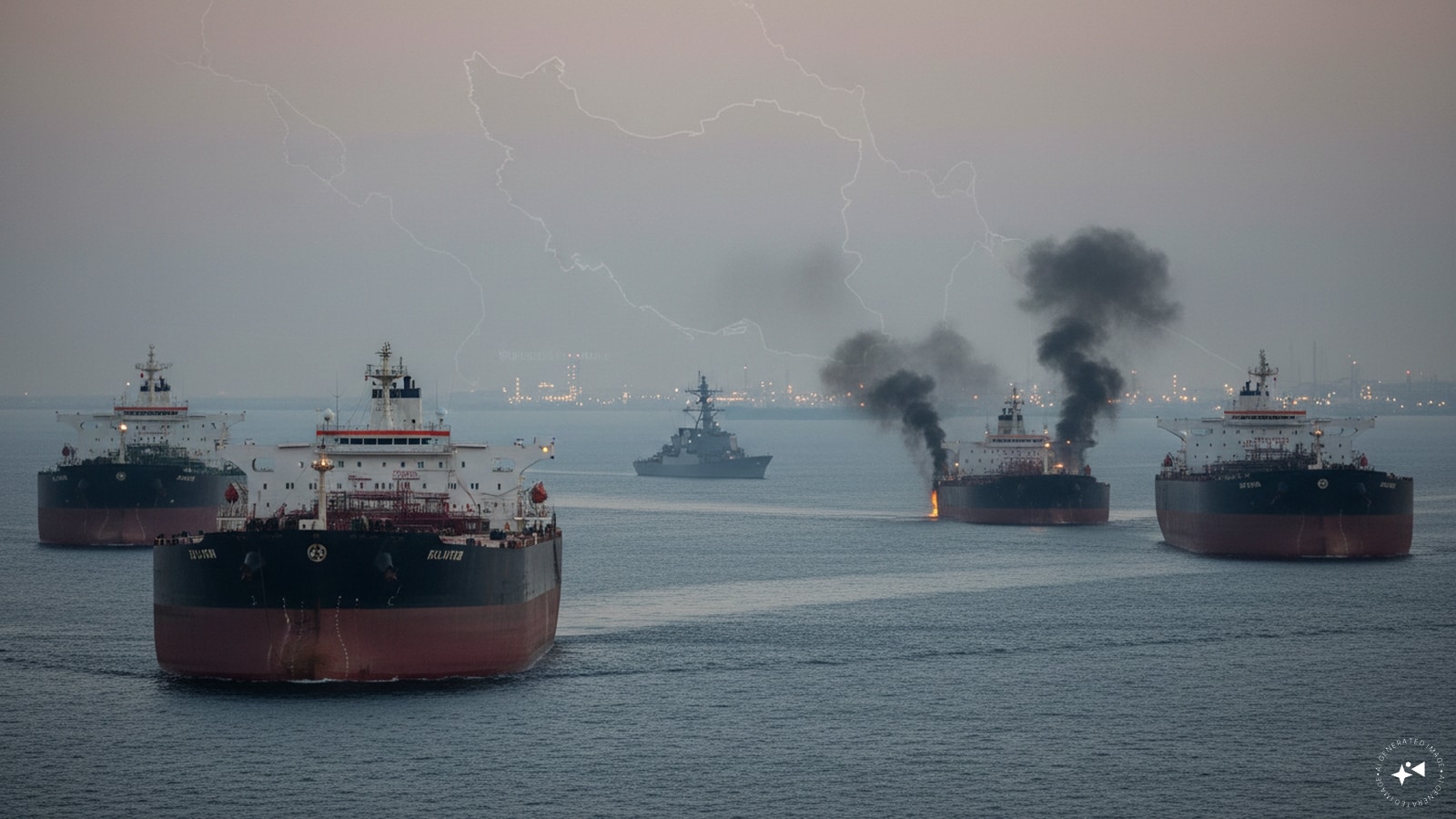
When naval forces exchange kinetic fire in restricted maritime corridors, the immediate casualty is physical infrastructure, but the secondary casualty is market predictability. The recent engagement involving United States military strikes against five Iranian oil tankers following repeated Islamic Revolutionary Guard Corps targeting of a Navy warship represents a critical inflection point in Gulf security architecture. Media narratives frequently reduce such events to isolated tactical exchanges or emotional retaliatory cycles. This perspective ignores the underlying structural incentives, the economic calculus governing maritime trade lanes, and the escalatory ladder that dictates modern naval engagement rules.
To understand why a localized naval skirmish triggers global economic recalibration, one must dissect the incident through three distinct analytical lenses: the operational friction points within the Strait of Hormuz, the cost function of asymmetrical naval warfare, and the systemic vulnerabilities inherent in contemporary energy supply chains. Naval conflict in confined waters does not happen in a vacuum. It is the friction point where geopolitical posturing meets strict logistics.
The Operational Anatomy of Gulf Engagements
Operating surface combatants within confined geographical bottlenecks creates inherent tactical disadvantages. The Persian Gulf and its primary outlet, the Strait of Hormuz, operate as a constrained maritime geography where reaction times are measured in minutes rather than hours. When the Islamic Revolutionary Guard Corps Navy employs fast attack craft and coastal anti-ship missile batteries against United States naval assets, they are exploiting the defensive geometry of narrow waterways.
Large surface combatants, despite their advanced sensor suites and layered air defense systems, face severe maneuverability constraints when operating within close proximity to littoral waters. The calculus of asymmetric naval warfare relies heavily on this spatial limitation. Small, fast, maneuverable vessels operating near friendly coastlines can dictate the initiation phase of an engagement, forcing larger warships into reactive defensive postures.
However, the retaliatory response by United States forces—specifically targeting and neutralizing five oil tankers associated with state-backed logistics networks—introduces a strategic shift from tactical self-defense to economic asset denial. By shifting the target set from active military combatants to logistical nodes, naval doctrine shifts toward disrupting the revenue generation supporting the adversary's asymmetric capabilities. Tankers are not merely civilian or commercial vessels when integrated into state-sponsored projection of force; they function as the financial lifeblood and logistical arteries of the irregular naval apparatus.
The Cost Function of Maritime Disruption
Evaluating the impact of this escalation requires examining the cost function borne by global markets versus the localized cost absorbed by the belligerent states. The global economy operates on a just-in-time delivery model for hydrocarbons. Approximately one-fifth of the world's petroleum consumption passes through the Strait of Hormuz daily. Any credible threat to this corridor imposes an immediate risk premium on global energy futures, regardless of whether physical supply is permanently destroyed.
The economic variables governing this dynamic can be categorized into three distinct layers:
Direct physical losses encompass the hull value, cargo destruction, and immediate infrastructure remediation costs associated with struck tankers and damaged warships. While significant in absolute terms, these figures represent a fraction of the total economic impact.
Insurance and freight rate volatility represent the second layer. Following kinetic engagements in the Gulf, marine underwriters immediately reassess war risk premiums. Hull and machinery war risk insurance rates spike exponentially for voyages entering the Persian Gulf. Shipowners demand higher charter rates to compensate for crew hazard pay and potential asset forfeiture, translating into millions of dollars of added friction per cargo transit.
Strategic reserve deployment and macroeconomic hedging constitute the final layer. Central banks and energy ministries are forced to reevaluate baseline inflation forecasts driven by petroleum price volatility. This creates a hidden tax on industrial production across importing nations, disproportionately punishing economies reliant on Middle Eastern energy imports without a diversified supply matrix.
Conversely, the targeted state faces a different cost function. The loss of five oil tankers restricts export volume and constrains foreign currency acquisition. Yet, state-backed asymmetric actors often operate under a different discount rate, prioritizing strategic deterrence and political signaling over short-term commercial optimization. This asymmetry in objectives creates a dangerous bargaining environment where conventional deterrence signals are frequently misread or discounted.
The Escalatory Ladder and Strategic Thresholds
Escalation control relies on maintaining clear thresholds between political signaling, tactical defense, and strategic punishment. When a naval warship is targeted twice, the doctrine of proportional response faces operational stress. A purely defensive posture—such as intercepting incoming projectiles without addressing the source or the supporting network—invites attrition. The adversary learns that repeated probes carry minimal systemic cost.
Conversely, aggressive counter-battery fire or asset destruction alters the risk matrix, signaling a willingness to escalate up the ladder of conflict. The decision to strike five oil tankers crosses a threshold from tactical defense to strategic economic interdiction. This move communicates that maritime harassment will be met with systemic economic penalties. However, it also compresses the decision-making cycle for future engagements. When commercial shipping assets are treated as legitimate military targets due to their operational integration with hostile state actors, the boundary between civilian commerce and military logistics dissolves.
This blurring of lines introduces systemic instability. If commercial operators conclude that operating in the Gulf exposes them to uninsurable risks, traffic patterns will shift. Alternative pipelines, such as those bypassing the Strait of Hormuz via overland routes to the Red Sea, operate at limited capacity and cannot absorb the total volume of maritime crude exports. Consequently, any prolonged disruption forces a permanent recalibration of global supply chain redundancies.
Strategic Realignment and Forward Risk Mitigation
Navigating the aftermath of multi-vessel engagements in critical maritime chokepoints demands a departure from reactive crisis management. Military planners and energy market participants must account for the reality that the Strait of Hormuz is no longer just a trade route, but a contested zone where economic vulnerability is weaponized.
Future stability in these corridors depends on establishing automated de-escalation protocols, hardening commercial asset tracking to prevent dual-use logistics integration, and diversifying maritime transit chokepoints. Until structural redundancies are engineered into global energy distribution networks, localized naval skirmishes will retain the capacity to transmit systemic shocks across global markets. The margin for tactical error remains razor-thin, and the financial penalty for miscalculating the adversary's intent continues to scale with every kinetic exchange.