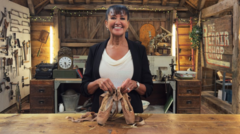
The physical restoration of a pair of satin ballet shoes on a popular television program serves as a blunt reminder of how easily British history sheds the stories of those who built it. When the BBC’s The Repair Shop took on the task of reviving the footwear of Brenda Garratt-Glassman, the first Black ballerina to perform with a major British company, they were not just fixing silk and leather. They were attempting to patch a gaping hole in the United Kingdom’s cultural memory.
Brenda Garratt-Glassman broke the color barrier in British ballet during the mid-20th century, a feat that required navigating a landscape of overt exclusion and systemic indifference. While the visual of a craftsman meticulously sewing a worn-out shoe makes for compelling television, the narrative usually stops at the sentimentality of the object. It ignores the uncomfortable reality that these shoes were worn down by a woman who had to fight for the right to stand on a stage that was curated to remain white. The restoration of the shoes is a beautiful gesture, but it is a hollow one if we do not examine why a pioneer of her stature was nearly relegated to a footnote in dance history.
The Myth of the Level Playing Field in British Arts
British ballet has long maintained a veneer of meritocracy that masks a rigid, often exclusionary history. For decades, the prevailing logic in the industry was that certain bodies simply did not "fit" the aesthetic of classical ballet. This wasn't just about talent. It was about a specific, Eurocentric vision of lines, grace, and uniformity. When Garratt-Glassman entered this world, she wasn't just competing against other dancers; she was competing against a centuries-old definition of beauty that explicitly excluded her.
The struggle for Black dancers in the UK was not a lack of interest or skill. It was a lack of institutional will. Even as Garratt-Glassman paved the way, the progress that followed was agonizingly slow. We often talk about "firsts" as if they are the beginning of a rapid wave of change. In reality, being the first often means being the only one for a very long time. The "first" is a lightning rod, absorbing the strikes of a hostile environment so that those who follow might find the ground slightly less charred.
The Fragility of Black History in the Archives
The fact that these shoes needed a televised intervention to be preserved highlights a systemic failure in how we archive Black British achievement. Historically, the preservation of Black history in the UK has been left to families and private individuals rather than the state-funded institutions that claim to be the custodians of national heritage.
Museums and archives have a history of "passive collection." They wait for items to be donated rather than actively seeking out the stories of marginalized pioneers. If Brenda Garratt-Glassman’s daughter hadn't kept those shoes, if she hadn't recognized their value, that physical link to Britain’s first Black ballerina would have been lost to a landfill. We cannot rely on the luck of family sentimentality to protect the history of the nation.
The Burden of the Object
There is a specific weight to artifacts belonging to Black pioneers. For a white ballerina of the same era, her shoes might be a charming memento of a successful career. For Garratt-Glassman, those shoes are evidence. They are proof of presence in a space that tried to deny her existence. When an object carries that much weight, its decay feels like a second erasure.
The technical challenge of the restoration—dealing with sweat-rotted silk and crumbling supports—is a metaphor for the state of Black British history. It is fragile. It has been weathered by neglect. It requires specialized care to survive. But more importantly, it requires a public that understands why it matters in the first place.
Beyond the Sentimental Lens
Television programs like The Repair Shop operate on a formula of emotional catharsis. A broken item is brought in, a story is told, the item is fixed, and tears are shed. It is a powerful format, but it risks turning structural history into a personal drama. By focusing on the emotional bond between a daughter and her mother's shoes, the broader political and social implications of Garratt-Glassman’s career are softened.
We should be asking why it took a reality show to bring this story to a mass audience. Why isn't Brenda Garratt-Glassman a name taught in primary schools alongside other British icons? Why has the dance world been so slow to acknowledge its own history of segregation? Fixing the shoes is the easy part. Fixing the historical record requires a much more difficult kind of labor.
The Aesthetic of Exclusion
Ballet is an art form obsessed with perfection. In the mid-20th century, that perfection was synonymous with whiteness. Dancers were expected to look identical in the corps de ballet. This "uniformity" was used as a weapon to keep Black dancers off the stage. They were told their muscles were "too athletic" or that their skin would "break the line" of the performance.
Garratt-Glassman had to navigate these critiques while maintaining a level of excellence that left no room for error. A Black dancer in that era couldn't just be good; they had to be undeniable. The wear and tear on her shoes represents thousands of hours of effort spent proving she belonged in a room that didn't want her there.
The Economic Barrier to Preservation
Professional ballet is an expensive pursuit. The cost of shoes alone is a significant barrier for many young dancers. A single pair of pointes can cost $80 to $120 and may only last for a few performances or a week of heavy training. For a pioneer like Garratt-Glassman, the financial strain was compounded by the lack of scholarships and support systems available to Black families at the time.
When we look at her shoes, we are looking at a significant financial investment made by a family that believed in a dream despite the odds. The preservation of these items today is also an economic issue. Private conservation is prohibitively expensive for most people. By bringing these shoes to a televised workshop, the family bypassed a financial hurdle that keeps many important historical artifacts hidden in attics or rotting in basements.
A Legacy Refurbished But Not Finished
The dance world today likes to point to stars like Misty Copeland or Francesca Hayward as proof that the industry has moved on. While there is more diversity on stage now than in the 1950s, the underlying structures haven't changed as much as we’d like to believe. Leadership in major dance companies remains overwhelmingly white. The "aesthetic" of the ballet body is still narrowly defined.
Brenda Garratt-Glassman’s story is not a "feel-good" tale about how far we've come. It is a cautionary tale about how much we almost lost. If we only celebrate Black history when it is presented in a polished, restored, and televised package, we are failing to engage with the reality of the Black experience in Britain.
The Role of Public Institutions
The BBC and other public broadcasters have a responsibility to do more than just "fix" things. They must use their platforms to interrogate the reasons why these things were broken or forgotten in the first place. The restoration of the shoes should have been the starting point for a national conversation about the lack of Black representation in the Royal Academy of Dance’s historical archives.
We need a dedicated effort to map the contributions of Black artists across all disciplines, not just when their descendants happen to apply for a spot on a craft show. This requires funding for community archives, oral history projects, and a radical rethinking of what constitutes "national importance."
The Physicality of the Struggle
There is something visceral about a ballet shoe. It is an instrument of torture disguised as an object of beauty. It forces the foot into an unnatural shape, bleeding and bruising the wearer in the pursuit of an ethereal image. For Garratt-Glassman, that physical pain was coupled with the psychological pain of being an outsider.
The repairs made to the shoes—the internal bracing, the cleaning of the satin—cannot erase the history of the feet that were inside them. Those feet walked through stage doors where they were unwelcome. They stood on stages where the audience might have been hostile. They carried the weight of a community's aspirations.
Redefining the British Icon
Britain has a habit of claiming "firsts" only once they have been safely tucked into the past. We celebrate the Windrush generation now, but we ignore the systemic racism that many of them still face today. We celebrate Brenda Garratt-Glassman’s shoes, but we don't talk about the Black girls today who are told their hair is "unprofessional" for a ballet exam.
True restoration isn't about making an old object look new. It is about restoring the truth to the narrative. It is about acknowledging that Brenda Garratt-Glassman was a pioneer not because she wanted to be a hero, but because she wanted to dance and the world told her she couldn't. Her shoes are not just a relic of the 1950s; they are a challenge to the 2020s.
The next time a pair of shoes like this emerges from a dusty box, we shouldn't need a TV crew to tell us they are important. We should already know. The fact that we don't is the real problem that needs fixing.
Institutional memory is a choice. We choose what to remember and what to let fade. For too long, the contributions of Black Britons have been treated as optional extras in the national story. If we want to honor Garratt-Glassman, we don't just look at her shoes; we look at the barriers she broke and ask ourselves why those barriers were there in the first place, and which ones we are still building today.
Stop looking at the satin and start looking at the path she had to walk. That path was not paved with silk; it was paved with resistance.
Ensure that the next pioneer doesn't have to wait sixty years for a television show to validate their existence.