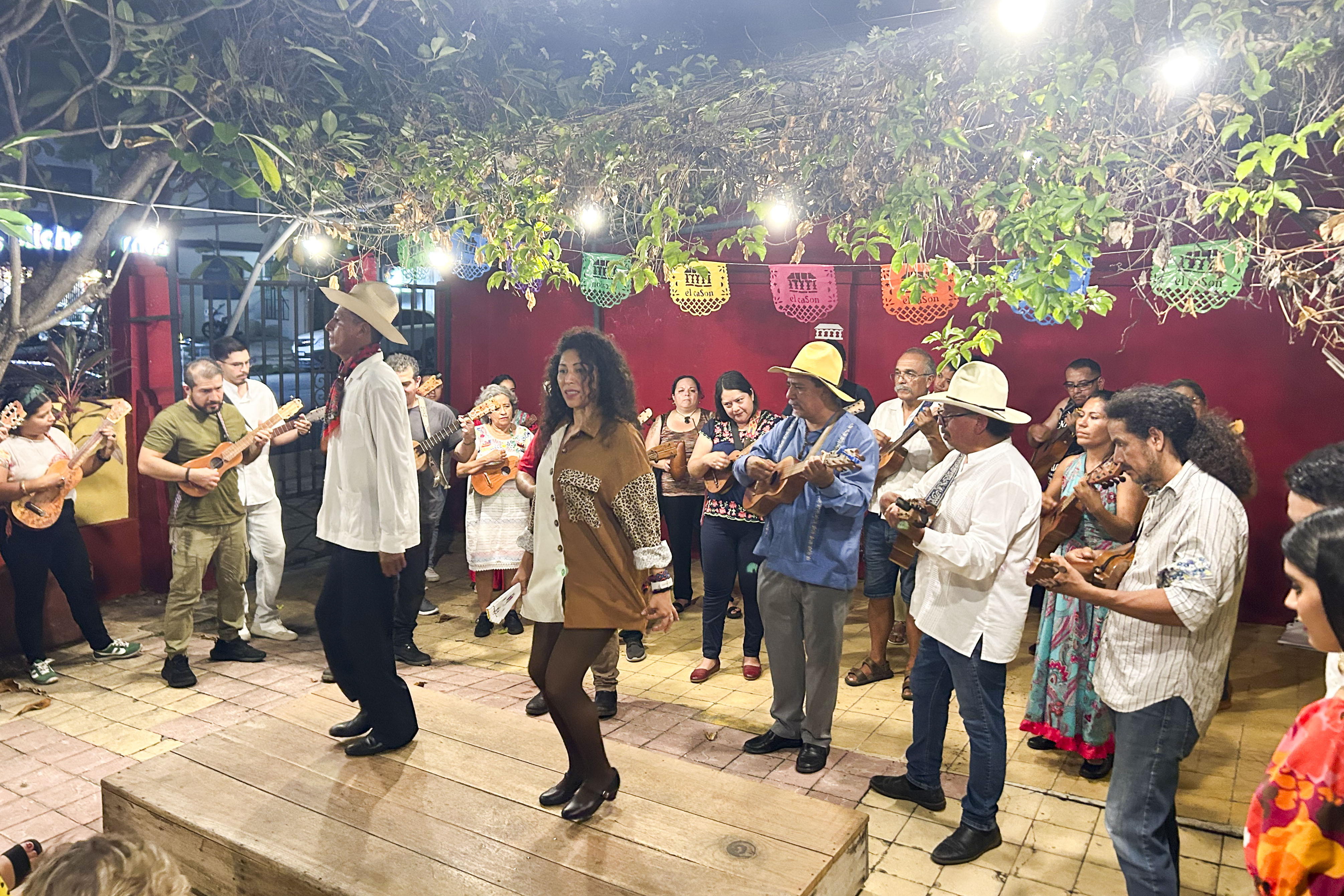
Playing 'La Bamba' for an hour straight isn't just a quirky stunt or a stamina test for a wedding band. It is the beating heart of a traditional Mexican fandango.
Most people know the tune from Ritchie Valens' 1958 rock and roll hit, or perhaps Los Lobos' fiery 1987 cover. But strip away the electric guitars and the commercial pop gloss, and you find a communal ritual rooted in the state of Veracruz. In its natural habitat, a fandango isn't a performance you sit back and watch. It is an immersive, all-night participatory event where musicians, dancers, and poets trade verses until the sun comes up.
If you have ever stumbled onto a live son jarocho jam, you know the music operates on a completely different frequency from modern radio edits. Songs stretch endlessly, morphing and breathing with the crowd. Let us look at what actually happens during these marathon sessions and why that relentless repetition matters.
The Roots of Son Jarocho and the Tarima
To understand why a single song can last for an hour, you have to look at son jarocho, the traditional folk music style of rural Veracruz. This regional sound blends Spanish, Indigenous, and African musical influences into a driving, rhythmic force.
The instrumentation creates an acoustic wall of sound. You have the jarana, a small eight-string guitar that provides the syncopated rhythm. You have the requinto, a smaller plucked lead guitar that improvises soaring melodic lines. You often hear the leona, a large bass guitar that anchors the low end, and sometimes a quijada, an instrument made from the jawbone of a horse or donkey.
At the center of it all sits the tarima. This is a wooden platform placed directly on the ground or over a hollow space to act as a giant percussion box.
Dancers—known as parejas—step onto the tarima wearing hard-soled shoes. They strike the wood with ferocious precision, turning their feet into percussion instruments that lock in with the strumming of the jaranas.
When you combine the rapid-fire strumming, the chanting of verses, and the thunderous clatter of dancers hitting the wood, time loses its grip. An hour passes in what feels like minutes because the groove is hypnotic.
Why the Music Stretches On For Hours
Pop songs clock in at three minutes because of radio formatting. Fandangos do not care about radio formats. They care about community endurance and creative expression.
Musicians don't play a fixed arrangement of "La Bamba." Instead, they play the harmonic progression and rhythmic cycle, plugging in different versos—four-line stanzas of poetry—on the fly. A lead singer might belt out a traditional verse about love, politics, or local gossip. Then, another musician steps up to the microphone to answer with a counter-verse.
This call-and-response structure is called contrapunto. Because there is an endless reservoir of traditional and improvised verses, the song keeps rolling.
As fatigue sets in, something remarkable happens. The collective energy shifts. People clear their minds, dancers find a deeper lock with the rhythm, and the music becomes a trance state. That hour-long stretch of "La Bamba" isn't tedious; it's a vehicle for collective catharsis.
The Misconceptions About Traditional Mexican Music
A lot of casual listeners assume that traditional folk music is static, museum-bound stuff preserved behind glass. Nothing could be further from the truth.
Son jarocho is fiercely alive, evolving, and political. In recent decades, musicians have fused traditional jarocho instrumentation with jazz, hip-hop, and punk rock. Yet, the core engine remains the fandango circle, known as the fregata or siquisiri.
Another common myth is that "La Bamba" is just a cheerful party tune. While it is celebratory, the lyrics traditionally touch on hardships, migration, identity, and the struggles of working-class life in the coastal plains of Veracruz. The famous refrain—“Para bailar la bamba se necesita una poca de gracia” (To dance the bamba, you need a little grace)—is an invitation, a challenge, and a humbling reminder that you cannot fake your way through the rhythm. You have to earn your place on the platform.
How to Experience the Real Tradition Yourself
If you want to move beyond the commercial radio versions and experience the genuine article, you don't need to book a flight to Tlacotalpan immediately—though you certainly should if you get the chance.
Start by seeking out authentic son jarocho ensembles. Look for groups like Los Cojolites or Mono Blanco, who have spent decades preserving and revitalizing the genre while touring globally. Listen to live field recordings rather than sterile studio albums to catch the raw acoustics of wooden instruments and stomping feet.
If you live in a major city with a vibrant cultural center or Mexican diaspora community, keep an eye out for local fandangos abiertos or community jam sessions. Many of these gatherings welcome newcomers with open arms. You might not know how to dance on the tarima yet, but someone will gladly hand you a jarana, show you the basic down-up strum pattern, and invite you to join the circle.
Step into the rhythm, listen to the poetry, and let the music run for as long as it takes.


