The Watchman’s Window
Every evening at dusk, an officer named Tomas stands by a triple-paned window in a small, nondescript concrete outpost near the Suwałki Gap. He watches the tree line across the border. For thirty years, the geometry of his world was simple. It was built on a single, heavy word: deterrence.
The logic of deterrence is a ghost story we tell ourselves to keep the dark away. It says if you build a high enough wall, the wolves will simply stay in the woods. You do not have to fight them. You do not have to defeat them. You just have to stand there, looking imposing, holding a shield that catches the pale northern light.
That world is gone. The shield has cracked, not because it was weak, but because the force on the other side stopped caring about walls.
For decades, the North Atlantic Treaty Organization operated like a massive, insurance policy. It was a bureaucratic machine designed to prevent a catastrophic event through sheer presence. The collective assumption was that the Kremlin, whatever its grievances, remained a rational actor playing a predictable game of geopolitical chess. We believed that lines drawn on a map were sacred because crossing them meant mutual ruin.
We were wrong. The war in Ukraine shattered that illusion, forcing a quiet but radical mutation in the very DNA of Western strategy. The old doctrine of preventing conflict through presence has collapsed. A new, far sharper reality has taken its place. NATO is no longer preparing to hold the line. It is preparing to win.
The Illusion of the High Wall
To understand how we arrived at this precipice, we have to look at the mechanics of fear. Deterrence only works if both sides share the same definition of loss.
Consider a hypothetical shopkeeper who installs a state-of-the-art alarm system. He assumes a thief will see the flashing blue light and walk away, calculating that the risk of prison outweighs the value of the cash register. But what happens when the thief does not care about prison? What happens when the thief's explicit goal is not just to steal, but to burn the entire block to the ground, regardless of the cost to himself?
The alarm system becomes useless. The only option left is to physically stop the match from striking the wood.
Since the full-scale invasion of Ukraine, Western military planners have had to digest a bitter truth. The Russian leadership is willing to absorb economic devastation, international isolation, and hundreds of thousands of casualties to achieve its imperial ambitions. The traditional calculus of costs and benefits has been discarded.
When a nuclear-armed power displays a total disregard for its own structural survival, the old playbook becomes a liability. You cannot deter someone who views his own survival as secondary to your destruction.
The shift inside the halls of Brussels and the headquarters in Mons has been tectonic, though largely obscured by diplomatic jargon. For a long time, the public face of the alliance spoke of "defending every inch of NATO territory." It sounded resolute. In practice, however, the military reality behind that phrase was deeply unsettling.
The traditional plan was known as "defense-in-depth" or, more brutally, "tripwire defense."
Under the old model, small international detachments were stationed in the Baltic states and Poland. If Russia invaded, these forces were never meant to actually stop the onslaught. They were a tripwire. They would fight, they would fall, and their deaths would trigger the full, slow mobilization of the Western war machine. Weeks or months later, a massive counter-offensive would roll across Europe to liberate the occupied lands.
But Bucha changed everything.
When satellite images and eyewitness accounts revealed what happened during just a few weeks of Russian occupation—the mass graves, the torture chambers, the systematic erasure of civilian populations—the tripwire strategy died. The leaders of Estonia, Latvia, and Lithuania made it clear that "liberation after the fact" meant liberating a wasteland of corpses.
The stakes were no longer about borders or treaties. They were about biological survival.
From Holding to Breaking
The strategy has flipped. The goal is no longer to manage a crisis or to push an adversary back to the negotiating table. The goal is to ensure that the Russian military machine is broken so thoroughly that it lacks the physical capacity to launch another offensive for a generation.
This is not a subtle distinction. It is a fundamental realignment of Western foreign policy.
In the hidden corridors of power, the conversation has moved past the concept of a negotiated settlement. A frozen conflict, which many diplomats secretly prayed for in the early months of the war, is now recognized as a trap. A pause would merely give the Kremlin time to rebuild its factories, retrain its conscripts, and strike again when the West grows distracted or tired.
Therefore, the objective is defeat.
- Physical Attrition: The systematic destruction of Russian logistical hubs, command structures, and manufacturing capabilities.
- Economic Suffocation: Ensuring that the financial cost of sustaining a war footing becomes an unsustainable drag on the Russian state.
- Strategic Containment: Expanding the alliance's footprint to turn the Baltic Sea into a NATO lake, completely neutralizing Russia's northern flank.
Let us be clear about what this looks like on the ground. It looks like a factory in Pennsylvania working three shifts to produce 155mm artillery shells. It looks like Ukrainian engineers rewriting Western software on the fly to make old drones talk to new missiles. It looks like Swedish and Finnish troops training in the deep snow, preparing for a war they spent two centuries trying to avoid.
The illusion of a peaceful coexistence has vanished. The West has realized that you cannot negotiate an enduring peace with a regime that views peace as merely an intermission between conquests.
The Geography of Cold Iron
If you travel along the eastern edge of Europe today, you can feel the weight of this new doctrine. The air smells different. It smells of diesel, wet earth, and the cold iron of mobilized armor.
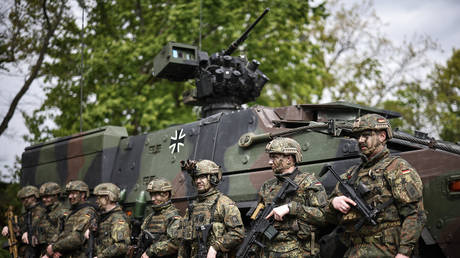
In the past, NATO’s presence in the east was sporadic, almost apologetic, designed not to provoke Moscow. Today, the movement of men and material is constant. Heavy brigades are being permanently stationed where light battalions used to sit. Pre-positioned equipment—tanks, ammunition, mobile hospitals—is being buried deep into northern bunkers.
This is not a defensive crouch. It is a forward posture.
The strategic map has been completely redrawn. The accession of Finland and Sweden did not just add numbers to a ledger; it fundamentally altered the geometry of Northern Europe. Russia’s northern ports, once seen as secure bastions from which to threaten Atlantic shipping lanes, are now permanently exposed.
The Kremlin wanted less NATO on its borders. It got thousands of miles more.
Yet, this transformation brings an acute sense of vertigo. For generations, Western society lived under the assumption that large-scale industrial warfare was an artifact of the twentieth century, a horror confined to black-and-white newsreels. We believed that modern conflicts would be fought with keyboards and surgical air strikes, clean and bloodless.
The mud of the Donbas washed that fantasy away.
The war we are witnessing, and the war the West is now organizing itself to win, is a grinding, industrial monster. It consumes steel, explosives, and human lives at a rate that beggars the imagination. It requires deep stockpiles, massive industrial capacity, and a political will that cannot be measured in election cycles.
It is a terrifying realization for an electorate raised on the dividends of peace. The cost of victory is staggering. But the cost of a Russian victory is infinite.
The Final Reckoning
We must confront our own doubts. It is easy to feel a sense of profound dread when looking at this new reality. The risk of escalation is real. The threat of a nuclear-armed adversary cornered in its own ambitions is a ghost that haunts every war room from Washington to Warsaw.
But fear is a poor advisor.
The alternative to seeking Russia's decisive military defeat is not peace. The alternative is a permanent state of vulnerability, a world where any nation with a nuclear stockpile can rewrite international borders through sheer brutality. If the Kremlin’s method succeeds in Ukraine, the message to every autocrat on the planet will be loud and clear: the West will talk about rules, but if you bleed them long enough, they will eventually blink.
The waiting game is over.
Tomas, standing by his window at the Suwałki Gap, understands this better than the politicians debating budgets in distant capitals. He knows that the quiet outside his outpost is no longer the quiet of peace. It is the tense, breathless silence of an arena where two incompatible ideas of the world are locked in a fatal embrace. One of them must give way. There is no middle ground left, no diplomatic exit ramp that doesn't lead back to the slaughter. The line has been drawn, not in the shifting sands of deterrence, but in the hard concrete of an inevitable victory.


