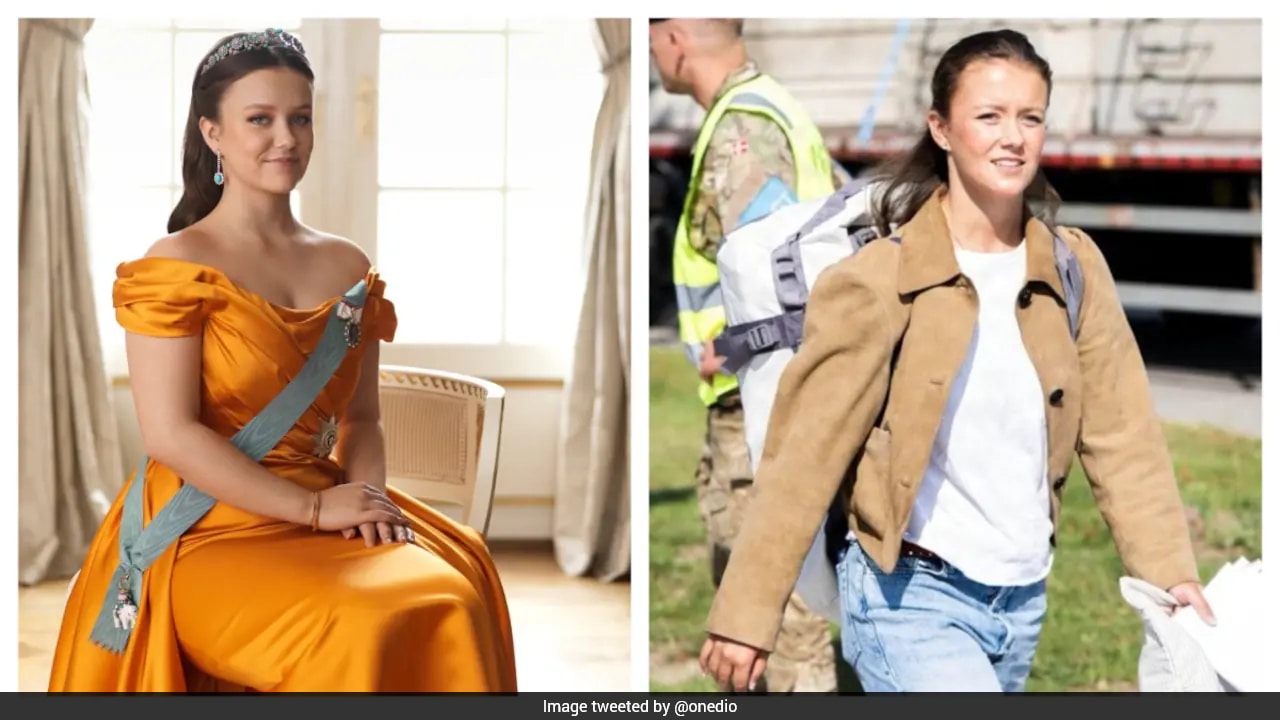
Heavy wool scratches. Anyone who has ever pulled on a standard-issue uniform knows the exact texture of that institutional gray-green cloth. It smells faintly of laundry detergent bought in industrial drums, floor wax, and the cold metal of lockers that never quite shut properly.
Princess Isabella knows that smell now.
When she stepped into the barracks to begin her military service, she did not arrive surrounded by a phalanx of security or shielded by the soft padding of court privilege. She carried her own bag. She walked at the same pace as nineteen-year-old recruits from Jutland and Copenhagen who had spent the previous week worrying about math exams and whether their boots were shined enough to pass a sergeant's inspection.
History often arrives quietly. We look for fireworks, trumpets, and grand decrees signed with gold-nibbed pens. Instead, history sometimes looks like a young woman standing in a line of conscripts, listening to a non-commissioned officer explain how to clean a rifle bolt with an oily rag.
Denmark watched with a strange mixture of relief and recognition. For centuries, the royal ledger was written in predictable ink. Princes went to the barracks because tradition demanded a brief, ornamental brush with the armed forces before they sat on thrones or represented the state at ribbon-cuttings. Daughters of the crown, however, occupied a different administrative category. They attended universities, patronized the arts, cut ribbons of their own, and married into neighboring lineages.
Isabella broke that mold. Not with a speech, but with an enlistment form.
To understand why this matters, you have to look past the palace gates and into the quiet kitchens of ordinary Danish homes where teenagers sit around tables discussing duty. In Denmark, the concept of public service is not just an abstract civic textbook chapter; it is an active contract between the citizen and the state. When a royal heir—and a young woman, for the first time in the modern history of the Danish monarchy—voluntarily steps into the exact same grinding routine as her peers, the social contract shifts.
Consider what happens next. A nineteen-year-old mechanic from Odense looks at the front page of his morning paper. He sees the future queen of his country sitting on the floor of a transport truck, eating a cold ration pack out of a plastic pouch. The invisible wall separating the institution of the crown from the reality of daily citizenship cracks just a little bit more.
There is another detail, small on paper but heavy in symbolic weight. She declined her salary.
Every recruit in the Danish armed forces receives a basic allowance. It is not a fortune, but it covers minor expenses, toothpaste, weekend train tickets, and the occasional canteen coffee. Isabella chose to forgo hers. Critics might dismiss this as a gesture made easy by a trust fund and a royal allowance, a clever public relations maneuver designed by advisors in sharp suits.
That cynicism misses the human core of the choice.
Money in the military is not just about survival; it is about equality of effort. When everyone receives the same modest stipend, it binds the unit together. It says: we are doing the same job, enduring the same blisters, and earning the same salt. By declining the pay, Isabella walked a delicate tightrope. She risked separating herself from the financial reality of her peers, yet her underlying motivation was clear to anyone who has ever watched young people try to prove themselves. She wanted the labor to be purely about the work. She wanted to earn the respect of her squad mates through sweat, not status.
Imagine being the sergeant who has to yell at her.
That is the delicious, human absurdity of constitutional monarchies in the twenty-first century. Drill instructors do not care about genealogical tables when a recruit is out of step. The sergeant’s job is to break down an individual and rebuild them as a collective gear in a defensive machine. In that crucible, lineage is irrelevant. Mud is the great equalizer. When rain turns the training ground into a soup of gray clay, the crown on a princess's forehead is completely invisible under a layer of grime.
This is where the true narrative value of her service lies. It is not about military strategy. Denmark is a small nation nestled in a complex geopolitical neighborhood, but Isabella is not training to command battalions in active combat. Her uniform is an education in empathy.
Look back at the monarchs who shaped modern Europe. The best of them understood their people not through demographic reports or filtered briefings, but through shared discomfort. You cannot understand the weight of state decisions until you have carried a heavy rucksack up a steep hill in the freezing rain while your shoulders scream for relief. You cannot comprehend the value of peace until you have lived, even briefly, under the strict, absolute discipline that exists solely to wage war if necessary.
The royal house announced the decision without fanfare. There were no dramatic television specials, no exclusive magazine spreads with soft-focus lighting. Just a concise statement and a few official photographs showing a young woman looking remarkably ordinary in camouflage.
That ordinariness was radical.
For generations, the upper echelons of society insulated their children from the rough edges of public institutions. Private schools led to private clubs, which led to boardrooms and ceremonial posts where mistakes carried no real consequences. By choosing the military, Isabella opted into a world where failure is public, measurable, and entirely uncurated. If she cannot scale the wall, she stays at the bottom with the rest of them. If she falls behind on a five-mile march, her squad waits or carries her slack.
That interdependence changes a person.
When you spend weeks sleeping four to a room with people whose politics, backgrounds, and regional accents are entirely different from your own, the polished veneer of court life peels away. You learn how to listen to the quiet kid from the provinces. You learn how to share a single tube of blister cream. You learn that leadership is not about giving orders from a high balcony; it is about making sure the person to your left has their boots tied properly before you step out into the freezing dawn.
The public reaction was immediate, though it took time to settle into the national consciousness. At first, it was treated as a novelty. Talk show hosts made lighthearted jokes about royal kitchen duty and saluting drill sergeants. Newspapers printed the obligatory biographical sketches, tracing her lineage back through generations of kings and queens who would have found the idea of a female royal in combat boots utterly incomprehensible.
Then the novelty faded. The daily grind of training took over. The press cycles moved on to other crises, other political scandals, other economic forecasts.
And Isabella stayed in the barracks.
That is the quiet part of the story that reporters rarely capture. The glamour of day one vanishes by week three. The excitement of the new uniform wears off the moment it gets soaked through with autumn rain and refuses to dry overnight. The physical exhaustion sets into the bones. Muscles ache in places people did not know they had muscles. The sheer monotony of inspection prep, rifle cleaning, and tactical drills replaces the initial rush of adrenaline.
This is where character is actually forged. Not in the bright lights of the initial announcement, but in the gray, unglamorous middle of the deployment, when nobody is watching, when the cameras are gone, and when the only thing keeping a young person moving forward is the stubborn refusal to quit.
Denmark did not just gain a soldier that day. The monarchy secured its future relevance.
Institutions survive not by divine right, but by demonstrating that they understand the pulse of the people they represent. When a royal family insists on living behind glass, untouched by the struggles and duties of ordinary citizens, they eventually become relics—museum pieces maintained at public expense. But when they step out of the glass, pull on the rough wool, and stand in the rain with everyone else, something remarkable happens.
They become human.
The boots sit by the door now. Every morning, before the sun clears the horizon over the Danish straits, they are picked up again. The laces are pulled tight. The straps are adjusted. And another day begins in the quiet, unrelenting school of service, where a princess learns what it truly means to stand shoulder-to-shoulder with her country.