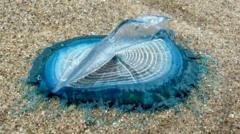
You walk down to the shore on a crisp spring morning, expecting empty sand. Instead, the tide line is painted an intense, vibrating cobalt blue. Millions of tiny, oval-shaped discs with miniature transparent sails crunch underfoot or form a squishy, jelly-like mat stretching for miles.
It looks like an alien invasion. It smells like a rotting fish market.
These mass strandings happen along the Pacific coast from California up to Washington with startling regularity, turning favorite walking beaches into neon-blue graveyards. Most beachgoers spot them and immediately shout, "Jellyfish!"
They are wrong.
The Truth About By-the-Wind Sailors
Those vibrant blue blobs are Velella velella, commonly known as by-the-wind sailors. They aren't true jellyfish. They belong to a class of tiny predatory marine organisms called hydrozoans, making them closer cousins to the Portuguese man o' war than to a standard moon jelly.
Each individual disc is actually a floating colony of thousands of specialized animals called zooids. They divide labor to survive. Some polyps catch prey with tiny stinging tentacles, others digest the food, and a separate group handles reproduction.
That stiff, triangular sail on top isn't for swimming. Velella have zero control over their propulsion. They live entirely at the mercy of surface winds and ocean currents.
Why They Wash Up En Masse
You won't find them on the beach during every season. Their arrival is a brutal mix of atmospheric physics and oceanography.
When spring arrives, offshore conditions often trigger massive plankton blooms. Velella population numbers explode in the open ocean. They sit right at the surface layer, exposing that stiff sail to the air.
If strong westerly or onshore winds kick up during these high-density blooms, the outcome is sealed. The wind catches their sails, pushing trillions of them straight toward the coast.
Marine ecologist Julia Parrish from the University of Washington notes that these strandings don't trickle in slowly. They hit all at once because immense mats of the organisms get trapped by shoreward gales. Once they hit the sand, their fate is sealed. They dry out within hours, turning into translucent, crinkly sheets that look like discarded plastic wrappers.
Are They Dangerous to Touch?
Short answer: No, but use common sense.
Their tentacles contain nematocysts—stinging cells designed to paralyze tiny copepods and plankton. Against human skin, those toxins are usually too weak to cause major damage.
You can pick one up without an ambulance ride. However, skip the amateur science experiment if you have sensitive skin. Touching a Velella and then rubbing your eyes or mouth will trigger a painful, burning irritation. Keep your dogs and small children away from the dense piles too. Walking barefoot through a decaying mass of thousands of dead hydrozoans is a fast track to blisters, slippery footing, and a lingering fishy stench that clings to your shoes for days.
The Darker Side of the Blue Wave
When these massive blue pulses hit the beach, they trigger an immediate feeding frenzy in the local marine food web.
Giant ocean sunfish, known as Mola mola, cruise up to the surface blooms and gorge themselves, treating the dense mats like floating snacks. You might also spot rare blue dragon sea slugs (Glaucus atlanticus) or violet sea snails washing ashore alongside them.
The blue dragon is a ruthless predator. It floats upside down, feeds directly on Velella, and steals their stinging cells to use as its own defense mechanism. If you see a tiny, intricately patterned blue and silver slug near the Velella piles, do not touch it. The blue dragon packs a much more concentrated and painful sting than the sailors it eats.
As the mass strandings dry out, terrestrial scavengers mostly ignore them. Gulls might peck at a fresh one, but older, crisped-up Velella are like chewing on fingernails. They eventually break down, returning vital nutrients and carbon back into the coastal ecosystem.
If you spot a blue-tinted tide line on your next coastal walk, don't panic. Take a close look at the tiny sailors, appreciate the bizarre mechanics of colonial marine life, keep your fingers away from your face, and let nature clear them out over the next few tide cycles.