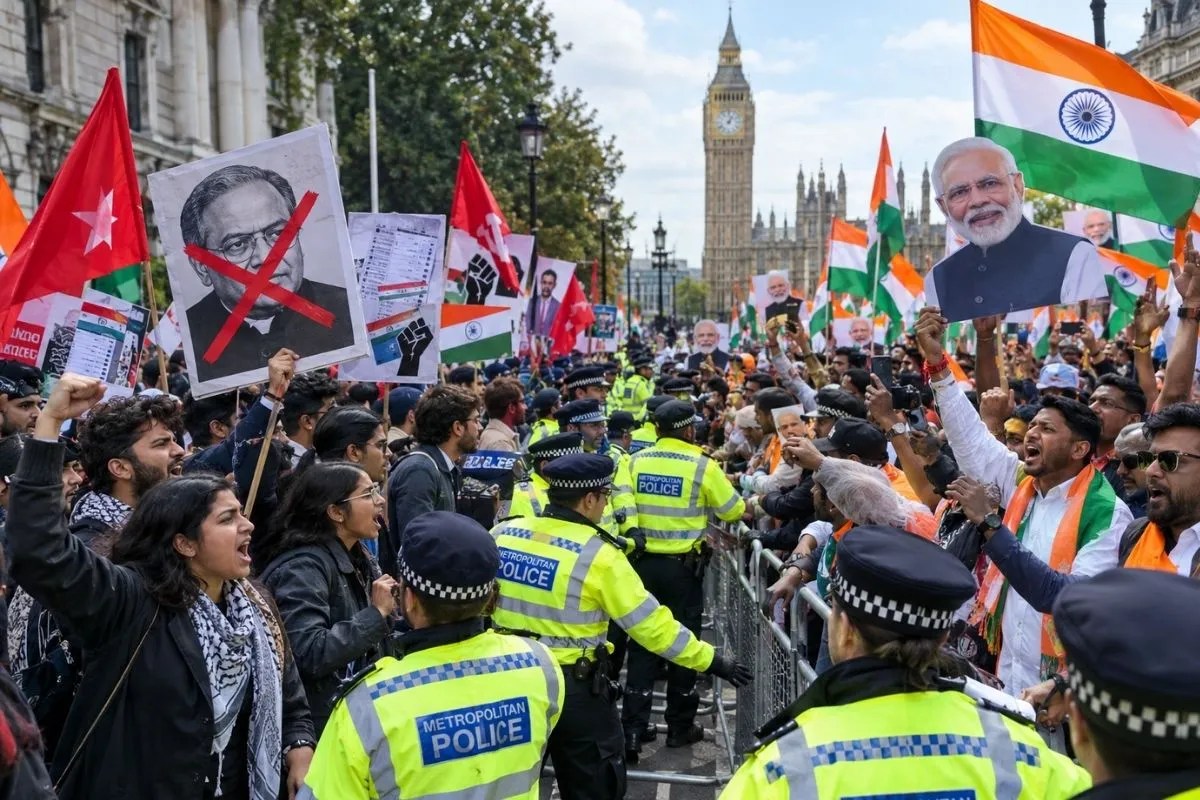
Demonstrations in London over India's Special Intensive Revision (SIR) of electoral rolls expose a structural collision between administrative roll-cleaning and perceived voter disenfranchisement. When protesters rallied against Chief Election Commissioner (CEC) Gyanesh Kumar and pro-government demonstrators answered with chants supporting Prime Minister Narendra Modi, the dispute moved domestic electoral friction onto an international stage.
Standard breaking-news accounts treat street confrontations and counter-slogans as self-contained spectacles. That framing misses the causal chain linking database deletions in Indian states, legal filings before the Supreme Court, and political mobilization among overseas Indians. A rigorous breakdown requires separating verified institutional events from competing political hypotheses, mapping the operational incentives of each actor, and evaluating why diaspora flashpoints amplify domestic legitimacy battles.
Deconstructing Competitor Framing and Fact Versus Hypothesis
Tabloid-style headlines on the London demonstrations compress a multi-layered institutional conflict into a binary street fight: anti-SIR protesters versus pro-Modi counter-protesters. That narrative captures visible street dynamics—crowd chants, placards, and policing around London landmarks or diplomatic sites—but leaves three critical analytical gaps:
- Cause-and-effect compression: Street opposition in London is treated as an isolated reaction to an official's visit or appearance rather than an extension of domestic litigation, state-level roll revisions, and opposition campaigns.
- Conflation of audit mechanics with partisan intent: Mass roll deletions are often reported either as routine cleanup or as deliberate manipulation without specifying how administrative error rates interact with electoral outcomes.
- Overlooking diaspora signaling: Counter-protests and open letters from overseas groups are framed merely as loyalty displays rather than coordinated efforts to contest international reputational framing.
To maintain analytical discipline, known facts must be separated from educated hypotheses.
Known facts establish the core institutional timeline. The Election Commission of India (ECI) has conducted a Special Intensive Revision of electoral rolls that began in Bihar ahead of local elections and expanded across states and union territories. Reports surrounding the exercise have cited large-scale deletions—including roughly 9 million names, or about 12% of the electorate, in West Bengal ahead of state polls, and figures exceeding 130 million removals across broader revision phases noted in reporting on the protests. Opposition leaders and petitioners have challenged the SIR and portal or form changes in the Supreme Court, seeking sworn answers and interrogatories from the poll panel. Simultaneously, demonstrations opposing CEC Gyanesh Kumar and the SIR—alongside pro-Modi and pro-CEC counter-demonstrations and diaspora statements—have taken place in London.
Educated hypotheses explain the strategic motivations behind these moves. One hypothesis holds that aggressive roll revisions carry asymmetric political risk when administrative verification outpaces citizen re-registration, disproportionately affecting mobile, low-income, or marginalized voters even in the absence of centralized partisan rigging. A competing hypothesis argues that opposition parties and aligned activists internationalize domestic disputes in capitals like London to generate global media coverage and pressure constitutional bodies when domestic street protests alone have not halted administrative rollouts. A third hypothesis suggests that counter-protesters and diaspora collectives mobilize to neutralize narratives of democratic backsliding before foreign audiences, treating overseas street presence as a defensive reputation asset.
The Three Pillars of the Electoral Roll Dispute
Analyzing the SIR controversy requires examining three interdependent pillars: roll integrity, administrative friction, and institutional trust.
Roll Integrity and Exclusion Risk
Every electoral management body faces a trade-off between two types of registration error. Type I exclusion error occurs when eligible citizens are omitted or deleted from the voter roll. Type II inclusion error occurs when deceased individuals, duplicate entries, or non-eligible persons remain on the roll.
Large-scale intensive revisions target Type II errors by purging outdated or unverified records. Yet in high-population democracies with substantial internal migration, seasonal labor movement, and inconsistent civil documentation, aggressive purges inevitably increase Type I exclusion risk if verification rules are strict or field enumeration is compressed. When deletion tallies reach millions in a single state, voters who discover their names missing on polling day experience immediate disenfranchisement regardless of whether the underlying intent was administrative hygiene.
Procedural Transparency and Judicial Scrutiny
An electoral audit's legitimacy depends not only on final accuracy but on auditable rules. Critics and petitioners in the SIR dispute have focused on authorization chains, online portal modifications such as changes to Form 6, and internal deliberations within the multi-member Election Commission. When opposition parties seek court-sanctioned interrogatories to compel detailed answers on who ordered revisions and how objections were handled, the conflict shifts from administrative execution to procedural accountability.
From a governance standpoint, opacity around rule changes or objection handling creates an information vacuum. Even if officials act within statutory authority, delayed or high-level responses encourage speculation that administrative discretion is being exercised without sufficient checks.
Partisan Polarity and Slogan Warfare
Electoral administration is designed to sit above partisan competition, yet perception often tracks political alignment. When opposition movements frame roll revisions as "vote theft" and link them directly to ruling-party electoral gains, neutral administrative procedures become politicized symbols. Counter-demonstrators chanting pro-Modi slogans or backing the CEC invert that framing: they treat attacks on the commission and the government as coordinated political warfare against a popularly mandated leadership.
Once slogans replace technical debate in public squares, both sides optimize for emotional solidarity rather than granular audit metrics.
The Cost Function of Diaspora Contestation
Why do domestic Indian voter-roll mechanics trigger rallies and counter-rallies in London? Overseas demonstrations operate through a distinct cost function shaped by geography, media visibility, and symbolic leverage.
| Cost or Benefit Dimension | Domestic Street & Legal Action | Overseas London Demonstrations |
|---|---|---|
| Direct Electoral Impact | High; directly contests state rolls, local mobilization, and court orders | Low directly; overseas residents generally do not alter domestic roll counts in the same way |
| Media & Diplomatic Amplification | High volume in domestic outlets; routine coverage fatigue possible | High international & diaspora visibility; visual clashes attract cross-border clips |
| Organizing & Participation Cost | Lower per-capita travel cost; higher local friction or legal exposure | Higher individual time/travel cost; concentrated among active diaspora networks |
| Narrative Risk | Seen as standard partisan or civic contention | Risk of being framed by rivals as foreign interference or anti-national grandstanding |
For opposition organizers and overseas student or activist groups, rallying in a global media hub like London lowers the barrier to catching international news desks and digital audiences. A single confrontation or speech outside a prominent square or diplomatic mission can circulate widely across social platforms.
At the same time, this strategy carries a clear counter-cost. Pro-government supporters and diaspora associations can rapidly counter-mobilize or issue collective letters, arguing that taking domestic electoral grievances abroad undermines the country's global standing. Instead of settling the factual dispute over voter deletions, London protests turn the electoral roll into a proxy battle over national prestige.
Operational Playbook for Institutions, Campaigns, and Observers
Resolving disputes over massive voter-roll revisions requires operational rigor rather than rhetorical escalation. A practical four-step framework applies across stakeholders:
- Publish granular, disaggregated audit telemetry. Electoral authorities should release state- and constituency-level figures separating deletions by cause (such as confirmed death, permanent relocation, duplicate entry, or non-response) alongside re-inclusion rates during appeals. Aggregate deletion numbers alone fuel worst-case interpretations.
- Audit digital form workflows and authorization logs. When petitioners question changes to online registration forms or portal upgrades, independent technical and legal documentation of version histories, approval timestamps, and fallback offline verification reduces suspicion of silent rule shifts.
- Separate contested rolls from immediate election windows. Conducting intensive revisions well ahead of major polls—with dedicated curing windows and proactive field verification for flagged households—lowers the probability that legitimate voters are turned away at the booth.
- Anchor advocacy in verifiable case files rather than abroad rallies. Political actors seeking institutional remedies gain more traction in courts and oversight forums by presenting audited sample error rates and documented wrongful removals than by staging overseas protests that invite tit-for-tat counter-rallies.
Limitations and Failure Modes
No administrative or political playbook eliminates friction in a polarized environment. Publishing detailed roll data will not convince partisans who view the referee itself as compromised, and opposition groups face incentives to keep pressure high when trust is low. Conversely, institutional transparency can backfire operationally if raw, uncleaned datasets are released without clear explanatory context, creating new fodder for cherry-picked claims.
Strategic Recommendation
Election administrators and policy leaders should treat the SIR backlash as a trust and verification crisis, not merely a communications problem. The decisive strategic move for the Election Commission is to pair every state-level revision report with a public, district-by-district reconciliation ledger showing how many flagged voters were deleted, how many appealed, and how many were restored prior to polling—backed by clear documentation of portal and procedural rules. Until verifiable reconciliation data is standard and easily inspectable at the local level, street protests in cities from domestic capitals to London will continue to treat administrative roll-cleaning as political exclusion.