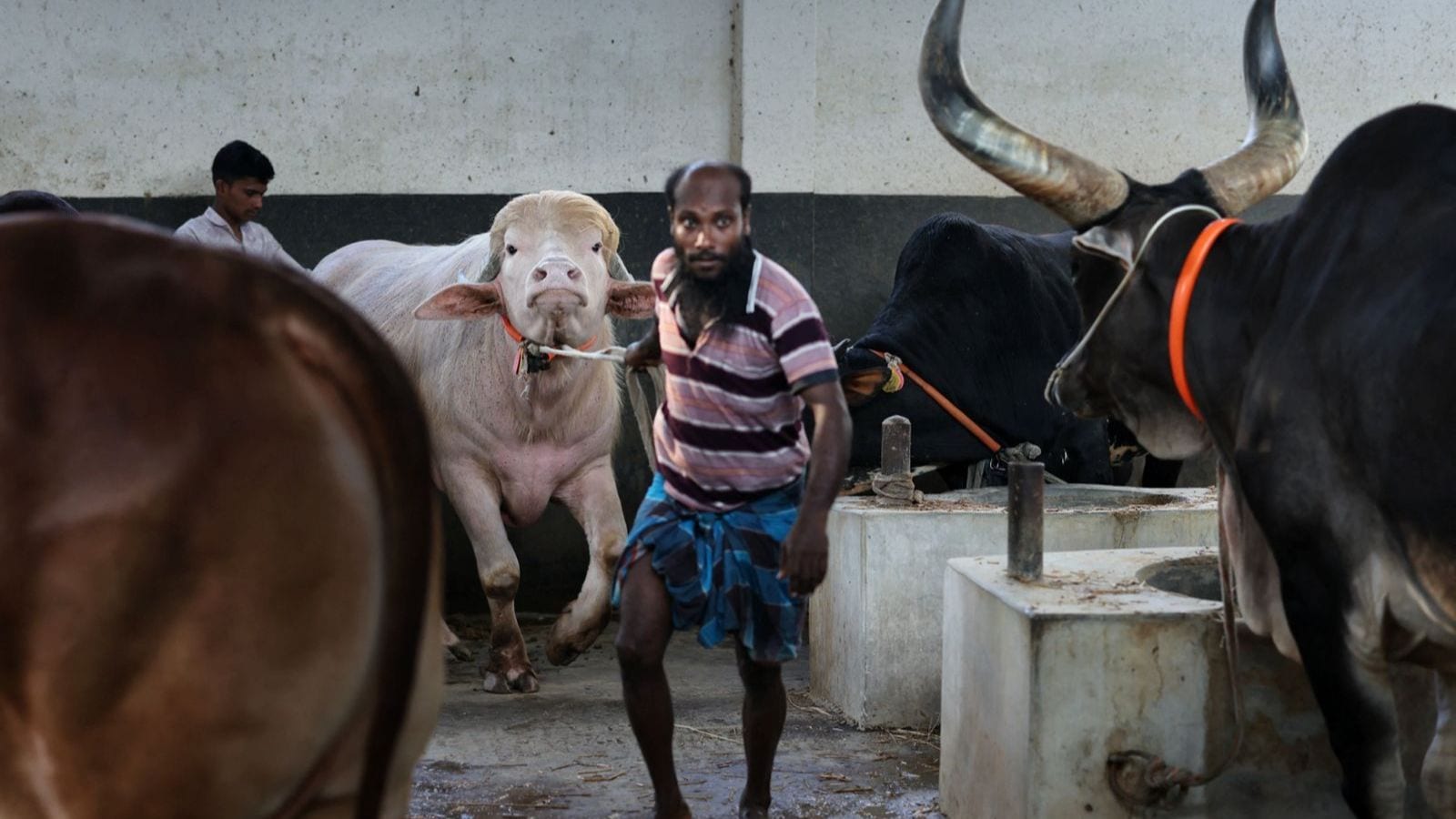
The hyper-premium livestock market in Bangladesh during Eid al-Adha operates outside standard commodity pricing models. While the base value of cattle is fundamentally tied to meat yield, bone-to-mass ratios, and local feed conversion metrics, a volatile parallel market emerges annually driven by asymmetric information and culturally contextual novelty assets. The viral phenomenon of a specific 1,100-kilogram Bhutani cross-breed buffalo—nominally dubbed "Donald Trump" due to its distinctive golden-blond coat—serves as a case study in how novelty premiums disrupt standard agrarian supply chains and distort traditional consumer utility functions.
Understanding this market anomaly requires a strict decoupling of commodity utility from speculative novelty valuation. In standard livestock transactions, the price ceiling is constrained by the wholesale value of the consumable end-product. In the premium novelty sector, the price is dictated by a multi-variable premium asset function. This analysis establishes the mechanics governing these transactions, maps the drivers of virality to capital allocation, and evaluates the structural risks inherent to the novelty livestock trade. Expanding on this topic, you can find more in: Why Chinas Two Year Offshore Brokerage Ban Is a Wakeup Call for Global Markets.
The Two-Tiered Valuation Framework for Sacrificial Livestock
To quantify how an animal commands a price multiple several times higher than its structural baseline, the total asset valuation ($V_T$) must be broken down into two distinct economic components:
$$V_T = V_C + V_N$$ Experts at Harvard Business Review have provided expertise on this trend.
Where $V_C$ represents the Commodity Value (intrinsic physical yield) and $V_N$ represents the Novelty Premium (extrinsic speculative value).
1. Intrinsic Commodity Value Mechanics ($V_C$)
The baseline economic value of the animal is calculated through measurable agricultural outputs. The primary determinants include:
- Live Weight and Dress-Out Percentage: For a mature cross-breed buffalo, the dress-out percentage—the ratio of the carcass weight to the live weight—typically fluctuates between 50% and 55%. For an 1,100-kilogram animal, this yields a maximum estimate of 605 kilograms of consumable meat.
- Feed Conversion Efficiency (FCE): The marginal cost of maintaining a mega-bovine increases non-linearly during the final 90 days before sale. High-protein diets required to maintain mass without excessive fat deposition shift the marginal cost curve upward, establishing a high floor price for the producer.
- Local Market Parity: Base pricing tracks the prevailing per-kilogram rate of quality meat in urban centers like Dhaka and Chittagong.
2. Extrinsic Novelty Premium Factors ($V_N$)
When $V_N$ eclipses $V_C$, the animal transitions from an agricultural commodity to an alternative luxury asset. The premium is driven by three distinct variables:
- Genetic Anomalies as Positional Goods: The golden-blond coloration of the "Donald Trump" buffalo represents a rare phenotypic expression in Bubalus bubalis, which typically exhibits dark grey or black pigmentation. In a saturated marketplace, this visual differentiation creates an immediate positional good, offering high social utility to the buyer within the context of sacrificial traditions.
- Digital Arbitrage and Viral Distribution: The transition from a localized farm asset in the boundary areas of Bangladesh to a nationally recognized entity is accelerated by algorithmic curation on social video platforms. The viral loop creates a temporary regional monopoly for the seller. Digital visibility acts as a multiplier on foot traffic, reducing the seller’s customer acquisition cost (CAC) to zero and shifting the demand curve violently to the right.
- Anthropomorphic Naming Strategies: Assigning high-profile, polarizing geopolitical names to livestock is a calculated marketing mechanism employed by Bangladeshi traders to capture media attention. This linguistic branding anchors the asset in public discourse, generating earned media value that complements the physical asset.
Supply Chain Dynamics and Information Asymmetry
The seasonal nature of the Eid al-Adha market compresses annual livestock revenue into a tight 10-to-14-day window. This temporal compression creates severe logistical bottlenecks and exaggerates market inefficiencies, particularly for high-value assets.
The Urban-Rural Sourcing Disconnect
The production of premium mega-livestock occurs almost exclusively in rural agricultural hubs or border regions where land and forage costs are low. However, the purchasing power is concentrated in dense metropolitan centers. The logistics chain introduces significant capital risk:
- Weight Depreciation Transit Shocks: Large bovines frequently suffer from transport stress, leading to dehydration and acute muscle atrophy during transit. An animal can lose 3% to 5% of its total body mass during a single long-haul journey in sub-optimal transport vehicles, directly eroding its intrinsic commodity value before it reaches the sales floor.
- Holding Cost Escalation: Once deployed to urban pop-up markets (haats), daily maintenance costs scale linearly while the time horizon to liquidate the asset shrinks. This gives buyers growing leverage as the holiday approaches, creating a high-stakes game theory scenario between sellers holding out for a novelty premium and buyers waiting for distressed commodity pricing.
Information Asymmetry in the Digital Haat
Traditionally, livestock valuation was determined via physical inspection at local markets, where buyers evaluated the animal’s health, teeth configuration (to verify age), and muscle tone. The digitization of the market via social media creates a layer of information asymmetry.
Online promotional materials emphasize scale through strategic camera angles and selective editing, masking potential structural defects, underlying metabolic issues, or behavioral instabilities. When buyers rely on digital signaling to initiate negotiations for high-value livestock, the variance between digital perception and physical reality introduces transaction frictions that can collapse high-value deals at the point of delivery.
Risk Profiles and Structural Pitfalls of High-Value Agrarian Investments
For producers and specialized fattening operations, scaling operations to produce ultra-heavy, high-novelty livestock carries immense systemic risks that are rarely accounted for in popular media narratives.
Metabolic and Physiological Constraints
Bovines engineered or fed to exceed 1,000 kilograms face severe physiological thresholds.
- Thermoregulation Failures: Bangladesh’s high ambient humidity and heat index conflict directly with the metabolic heat generated by an oversized ruminant. The risk of heat stroke or acute respiratory distress requires continuous mitigation via mechanical cooling, specialized housing, and dietary interventions, driving up fixed overhead costs.
- Skeletal Leverage Limitations: Standard bovine bone density is not evolutionary optimized for sustained mass exceeding one metric ton. Joint inflammation, hoof lesions, and structural lameness are common. A single structural injury in the weeks leading up to Eid al-Adha reduces the asset value to near-zero, as lame animals are frequently disqualified from premium sacrificial markets based on traditional perfection criteria.
The Illicit Cross-Border Influx Variable
The Bangladeshi livestock market operates under the constant shadow of informal supply shocks. Fluctuations in cross-border trade enforcement change local supply elasticities overnight.
- A sudden influx of large cattle or buffaloes from neighboring regional markets can instantly saturate the premium segment, diluting the scarcity value of domestically reared mega-animals. While unique phenotypic anomalies like distinct blond coats offer some insulation against supply shocks, a macro-level supply glut depresses aggregate purchasing budgets, forcing novelty sellers to compromise on their expected margins.
Strategic Playbook for High-Yield Livestock Capitalization
To transition from speculative, luck-dependent viral marketing to a predictable, high-margin livestock enterprise, producers must operationalize their marketing and risk-management strategies.
Institutionalize the Novelty Pipeline
Relying on random genetic mutations for unique coat colors is statistically unviable for long-term business models. Operations must shift toward deliberate genetic selection and lineage tracking.
- Selective Cross-Breeding: Source and stabilize bloodlines that reliably express specific phenotypic traits—such as the lighter coats of certain Bhutani variations or the distinct horn structures of premium breeds—while maintaining the high-growth capacity of local cross-breeds.
- Verifiable Age and Health Documentation: Differentiate assets in the marketplace by providing digital, verifiable records of vaccination, feed composition, and age tracking. This transparency addresses information asymmetry head-on, validating the premium tier to institutional or high-net-worth buyers.
De-risk Through Forward Contracting
The current spot-market model utilized at pop-up markets exposes producers to extreme pricing volatility and physical asset jeopardy during transit.
- Direct B2B and B2C Pre-Sales: High-value assets should be marketed and sold directly from the production facility weeks before the seasonal market opens. Utilizing digital catalogs with clear volumetric data and weight verifications allows producers to lock in premium pricing without entering volatile urban markets.
- Down-Payment Mechanics: Implement non-refundable deposit structures (minimum 25-30%) to secure purchases. This shifts the holding and transit risk partially to the buyer and ensures that the capital intensive final feeding phase is fully capitalized.
Optimize Digital Arbitrage Infrastructure
Instead of waiting for organic virality to occur close to the sale date, producers must build structured digital funnels.
- Early-Stage Narrative Building: Document the growth cycle of potential flagship animals over a six-to-nine-month horizon. This creates brand equity, establishes asset authenticity, and builds anticipation among a curated pool of affluent buyers.
- Targeted Geographic Distribution: Deploy localized, platform-specific advertising campaigns targeting high-income urban districts rather than generalized broad-spectrum broadcasting. This aligns the visibility of a high-value novelty asset directly with the consumer segments possessing the liquidity required to clear premium pricing thresholds.