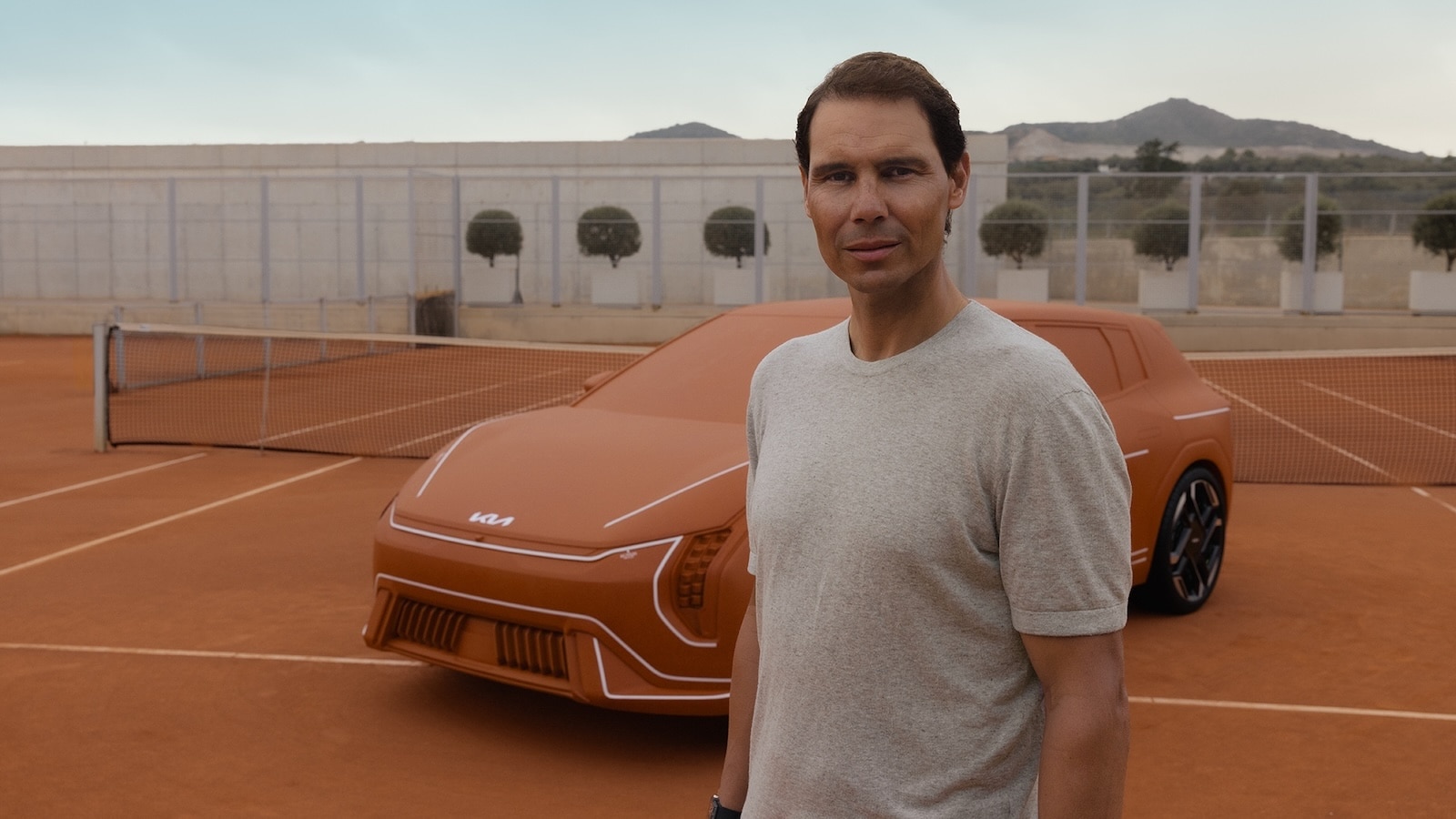
Sports sponsorships typically suffer from diminishing marginal returns because corporate logos fail to establish a causal link between the athlete’s physical achievement and the sponsor’s engineering output. Kia’s commissioning of a one-off electric vehicle incorporating crushed brick clay from the specific courts where Rafael Nadal secured 63 career titles attempts to solve this attribution problem through physical provenance. Rather than relying on standard logo placement or generic celebrity endorsements, this campaign uses material scarcity and engineered symbolism to anchor an electric vehicle platform to an undisputed historical record.
To understand the commercial mechanics of this activation, one must separate the emotional narrative from the industrial reality. A standard automotive marketing campaign treats athlete partnerships as media buys, exchanging capital for impression volume. By integrating actual court surface material into a custom-built EV, Kia converts an intangible legacy into a non-fungible physical asset. This shift changes the marketing function from passive brand awareness to active artifact creation, forcing earned media channels to cover the engineering narrative alongside the sports milestone. For another view, check out: this related article.
The Architecture of Provenance Marketing
Provenance marketing operates on the economic principle of contagion theory—the consumer perception that an object acquires permanent value through direct physical contact with a high-status individual or historic event. In high-ticket manufacturing, raw materials are usually commodities differentiated only by chemical purity, tensile strength, or cost per metric ton. Crushed red brick dust—specifically the pulverized limestone and red brick topping used on European clay courts—possesses near-zero intrinsic commodity value. Its value in this context is entirely derived from its spatial and historical origin.
The campaign’s structural logic relies on three distinct operational mechanisms: Further coverage on this trend has been published by Forbes.
- Physical Verification of Tenure: Rafael Nadal’s 63 clay-court titles represent an extreme statistical outlier in professional tennis. By sourcing clay directly from the specific venues of those victories, the material acts as a physical ledger of his career. Every gram of clay serves as a verifiable proxy for a specific tournament win, eliminating the abstraction inherent in standard commemorative plaques or special-edition paint codes.
- Scarcity Engineering: Mass-market automotive brands struggle to project exclusivity because their core business model depends on high-volume assembly lines. Producing a single unit—a true one-off—eliminates supply entirely. When supply equals one, traditional price elasticity curves break down, and the asset transitions from a consumer durable into a museum-grade trophy.
- Cross-Domain Transfer: Electric vehicles often face consumer skepticism regarding emotional resonance, frequently perceived as sterile appliances compared to internal combustion vehicles. Binding an EV platform to the visceral, high-friction, dust-heavy environment of clay-court tennis transfers the sensory grit of the sport onto a silent, zero-emission powertrain.
The limitation of this mechanism lies in its lack of direct product scalability. Because the vehicle is a single prototype rather than a limited production run of 63 or 630 units, Kia cannot capture direct retail margin from the build. The return on investment must be harvested entirely through indirect channels: brand equity lift, search volume spikes for the underlying EV model, and dealer showroom traffic driven by halo-effect publicity.
Material Science Constraints in Bespoke Automotive Builds
Integrating organic or mineral sports surfaces into modern automotive architecture introduces severe engineering bottlenecks. Modern electric vehicles are optimized for aerodynamic efficiency, mass reduction, and strict crash-safety compliance. Crushed brick clay is abrasive, hygroscopic, and structurally brittle, making it fundamentally incompatible with standard automotive manufacturing tolerances.
When an automaker incorporates non-standard materials into a functional vehicle, engineers must isolate the symbolic material from load-bearing and high-wear zones. The integration generally follows a strict hierarchy of containment:
- Exterior Surface Coatings: Raw clay cannot be left exposed to atmospheric moisture or high-velocity airflow without eroding or damaging the clear coat. To achieve the visual texture and terracotta hue of a tennis court, paint technicians must either formulate custom pigments matched to the exact spectral reflectance of the clay or encapsulate micro-particles of the pulverized brick within a multi-stage clear polyurethane resin. This preserves the visual authenticity while maintaining the drag coefficient and corrosion resistance required for road operation.
- Interior Trim Encapsulation: Inside the cabin, direct contact with unsealed clay dust would ruin upholstery, clog HVAC filtration systems, and abrade electronic switchgear. Consequently, the actual court material must be stabilized—typically mixed into polymer matrices, pressed into composite inlays for the dashboard and center console, or sealed beneath hardened acrylic layers. This transforms loose particulate matter into an inert structural veneer.
- Acoustic and Thermal Isolation: Unlike carbon fiber or brushed aluminum, mineral-heavy composites exhibit different thermal expansion rates than the surrounding automotive plastics and metals. If the clay-infused resin expands or contracts at a different rate than the dashboard substrate under extreme cabin temperatures, delamination or cracking occurs. Engineers must introduce flexible elastomeric adhesives between the bespoke trim and the chassis mounting points to absorb thermal stress.
This engineering reality highlights a critical distinction between material presence and structural utility. The clay does not improve the vehicle’s range, battery thermal management, or torsional rigidity. In fact, adding bespoke composite inlays and specialized multi-layer paint finishes increases curb weight marginally and complicates repairability. The engineering effort is dedicated entirely to neutralizing the physical liabilities of the clay so that its symbolic value can be safely transported at highway speeds.
Evaluating the Halo Effect Against Capital Allocation
From a corporate finance and brand strategy perspective, commissioning a one-off bespoke vehicle represents a concentrated capital expenditure. Unlike a programmatic digital ad campaign, which can be paused, A/B tested, or reallocated in real time based on customer acquisition cost (CAC), a custom physical build locks up capital, specialized labor, and engineering hours months before a single impression is generated.
To justify this capital allocation, the campaign must outperform standard media buys across three specific performance vectors:
- Earned Media Multiplier: Standard press releases announcing contract extensions or retirement tributes generate minimal Tier-1 media pickup outside dedicated sports verticals. A physical vehicle constructed from historic court clay bridges two distinct editorial beats: automotive technology and international sports. This dual-hook structure lowers the barrier to entry for mainstream news outlets, generating earned media impressions that would otherwise require millions in paid media spend.
- Brand Attribute Shift: Kia has spent over a decade transitioning its market perception from a budget-oriented manufacturer to a design-led, electrification-focused automaker. Aligning its flagship EV architecture with an athlete defined by endurance, tactical precision, and longevity reinforces the exact product attributes consumers hesitate to trust in newer EV brands—specifically battery durability and long-term reliability.
- Asset Longevity: Digital campaigns vanish the moment media spend stops. A physical one-off vehicle retains permanent utility as a traveling brand asset. It can be deployed at Grand Slam hospitality suites, international auto shows, corporate headquarters, and museum exhibitions for years, amortizing its initial fabrication cost across dozens of physical experiential marketing events.
However, this strategy carries distinct execution risks. If the visual execution appears gimmicky—resembling a superficial vinyl wrap rather than an authentic material integration—the campaign triggers consumer cynicism. Audiences have grown adept at identifying synthetic authenticity. Furthermore, tying a specific EV model so tightly to a retiring or transitioning athlete risks anchoring the vehicle to nostalgia rather than forward-looking technological innovation.
The Structural Shift in Tier-1 Athlete Partnerships
The Kia-Nadal clay EV activation signals a broader structural evolution in how major industrial brands deploy tier-one athlete endorsements. For decades, the standard operating model relied on rented reach: a brand paid an athlete to wear a patch, appear in a 30-second broadcast spot, and pose beside a production vehicle. As media fragmentation eroded the reach of linear television and consumers developed blindness to traditional sponsorships, rented reach lost efficiency.
Modern high-capital sponsors are shifting toward co-engineered artifacts. Instead of treating the athlete as a billboard, brands treat the athlete’s career data and physical environment as raw inputs for industrial design. We see parallel mechanics in watchmaking (incorporating materials from historic spacecraft or race cars) and athletic footwear (mapping an athlete's exact biometric pressure points into 3D-printed midsoles).
This approach works because it forces the brand’s internal engineering and design teams to collaborate directly with the marketing department. When a marketing campaign requires actual material science to execute, the resulting artifact possesses inherent storytelling depth that copywriters cannot fabricate. The story is embedded in the bill of materials.
Strategic Execution Playbook for High-Value Brand Activations
Organizations seeking to replicate the commercial mechanics of provenance-based activations without wasting capital on superficial stunts must adhere to a strict operational framework:
- Audit Physical Provenance Early: Identify tangible byproducts of the partner’s core domain before signing the activation brief. Whether it is court clay, reclaimed stadium timber, carbon fiber from a championship chassis, or decommissioned aerospace components, secure verifiable chain-of-custody documentation. Without documented provenance, the material loses its contagion value.
- Isolate Symbolic Materials from Critical Systems: Never allow commemorative or non-standard materials to compromise the core functional performance of the product. Encapsulate, stabilize, and isolate the symbolic material within non-structural trim, surface coatings, or secondary interfaces so the flagship product’s engineering benchmarks remain intact.
- Design for Multi-Year Physical Tourability: Do not build a one-off asset for a single 48-hour press cycle. Engineer the build to withstand repeated shipping, climate fluctuations, and public display, ensuring the initial fabrication cost is amortized across a 24-to-36-month global exhibition schedule.
- Bridge the One-Off to Commercial Volume: Avoid leaving the halo effect stranded on an unbuyable prototype. Simultaneously release a commercially available trim package, software theme, or serialized accessory line that borrows the exact color palette or design language of the one-off build, giving retail consumers a direct transactional pathway to participate in the narrative.