Public exposure functions as a primary asset class for institutional entities seeking sustained relevance. When high profile figures occupy public venues, observers frequently misinterpret these events as spontaneous cultural moments. In practice, every appearance at high-density public spectacles operates as a carefully orchestrated logistical deployment designed to maximize audience capture and manage institutional depreciation. Evaluating the presence of senior members of the British monarchy at the Commonwealth Games requires a shift away from superficial commentary toward an operational analysis of public visibility economics, resource allocation, and attention capture mechanisms.
The Attention Economy of Institutional Appearances
Modern institutional survival relies on continuous attention capture within a saturated media ecosystem. Traditional authority models have degraded, forcing entities to rely on direct public engagement and broadcast amplification. Public appearances serve as high-frequency touchpoints that counter audience attrition.
[Institutional Asset] ---> (Logistical Deployment) ---> [Public Venue] ---> (Media Amplification) ---> [Attention Capture]
When family units within a prominent institution attend multi-sport events, the strategy operates on three distinct levels:
- Frequency Maintenance: Sustaining a baseline share of voice across global news cycles prevents brand stagnation.
- Demographic Diversification: Deploying younger members broadens the demographic reach of the broadcast output, capturing segments unengaged by traditional ceremonial duties.
- Message Control: Directly supplying high-resolution visual assets to international wire services crowds out unsolicited or critical commentary.
The cost function of such an operation involves substantial security overhead, schedule displacement, and broadcast negotiation. The return on investment cannot be measured in immediate financial yields; instead, it registers as institutional capital preservation and audience retention across younger cohorts.
Strategic Timing and Venue Selection
The selection of the specific operational window—the penultimate day of a major multi-sport competition—is a deliberate structural choice rather than an arbitrary scheduling byproduct.
The Saturation Curve
Early stages of major sporting fixtures suffer from high fragmentation of media attention. Broadcasters divide coverage across numerous simultaneous disciplines, and international audiences experience cognitive overload. By contrast, the penultimate day concentrates focus. The core narrative arcs of the competition reach their apex, viewer fatigue has cleared through routine, and media outlets actively seek human-interest angles to sustain engagement before the closing ceremonies.
Risk Mitigation Protocols
Deploying family units into unscripted environments introduces operational vulnerabilities. Major sporting stadia provide controlled access vectors, predictable spatial boundaries, and professional security frameworks. This environment allows the institution to project accessibility while retaining absolute control over exposure duration and physical proximity to the general populace.
Comparative Mechanics of Public Exposure
To evaluate the efficacy of such appearances, one must analyze the variables that dictate media conversion rates. The following parameters govern the utility of any public-facing institutional deployment:
- Spatial Density: High attendee concentration increases the volume of user-generated content, multiplying the organic reach beyond traditional broadcast feeds.
- Visual Alignment: Sporting contexts demand casual or semi-formal attire, lowering the perceived barrier between the institution and the observer, thereby altering sentiment metrics positively.
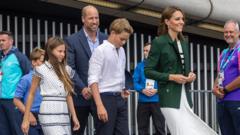
- Intergenerational Signaling: The inclusion of younger generations provides immediate visual data signaling continuity, stability, and generational succession to the viewing public.
These variables interact to determine the overall dwell time of the story within the global information architecture. When optimal conditions are met, a single three-hour appearance generates secondary and tertiary media cycles that persist for days after the physical event concludes.
The Logistics of Institutional Exposure
Executing a high-profile public appearance requires coordination across multiple distinct operational units. The process begins weeks prior to the event through security threat assessments managed by specialized protection commands. Concurrently, media accreditation teams negotiate optimal camera angles and broadcast pooling agreements with host-nation networks to ensure that framing aligns with institutional communication standards.
The physical arrival is timed to minimize disruption to the broader venue operations while maximizing visual impact for arrival photographers. Inside the venue, seating arrangements are pre-negotiated to position subjects within the primary sightlines of fixed stadium broadcast cameras, ensuring that passive observation translates directly into active broadcast currency.
Systemic Limitations and Vulnerabilities
Despite careful calibration, this methodology carries inherent risks and operational bottlenecks.
The primary vulnerability is message hijacking. In an open stadium environment, crowd behavior cannot be entirely scripted. Spontaneous reactions, localized protests, or unfavorable crowd sentiment can undermine the intended visual narrative, turning a controlled visibility asset into a liability.
Furthermore, over-exposure remains a persistent hazard. Frequent appearances risk diminishing the scarcity value of the institution's visual output. If public touchpoints become too common, audience fatigue sets in, leading to declining broadcast engagement and diminished returns on security and logistical investments.
Operational Deployment Protocol
To maintain institutional authority through public visibility without triggering audience saturation or security vulnerabilities, organizations must execute a disciplined deployment schedule.
- Audience Segmentation Mapping: Identify specific demographic cohorts exhibiting declining engagement trends and align future venue selections with those groups' cultural touchpoints.
- Frequency Capping: Limit high-visibility public appearances to critical inflection points within the annual calendar, preserving scarcity and maximizing media conversion rates per event.
- Channel Diversification: Shift reliance away from legacy broadcast partnerships toward direct-to-consumer digital touchpoints, retaining ownership of the visual narrative and minimizing editorial filtering by third-party media conglomerates.