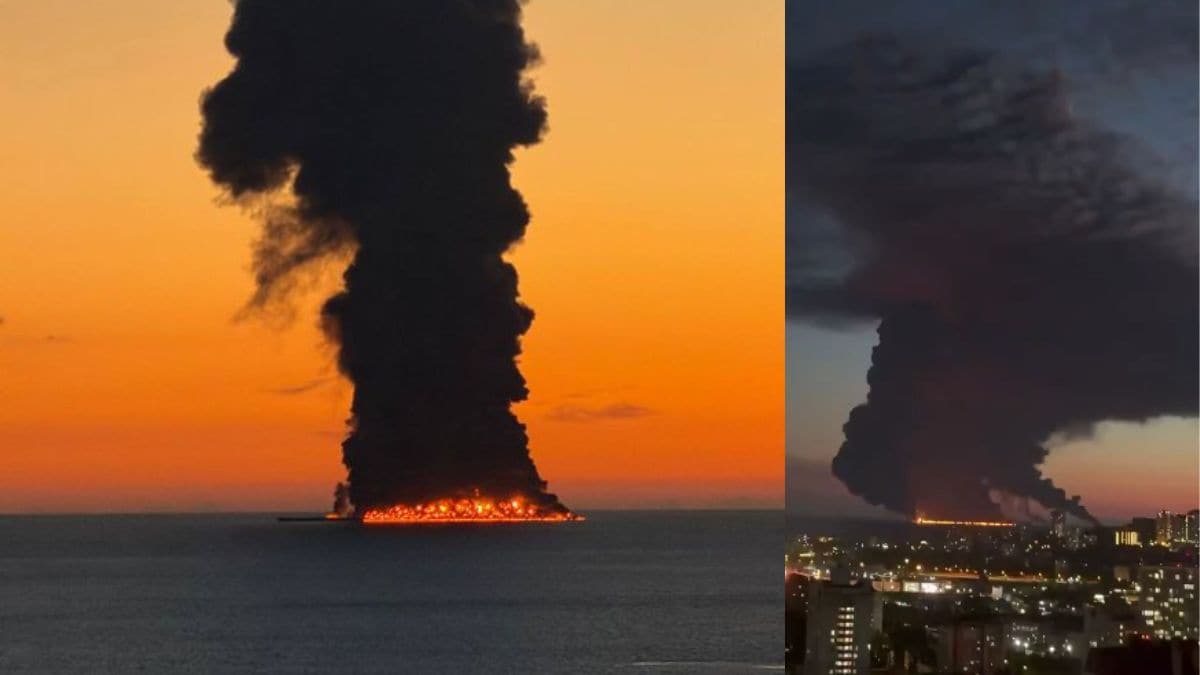
The kinetic expansion of maritime warfare into commercial shipping lanes requires a fundamental shift in how risk is priced, insured, and managed across global logistics nodes. When an unmanned surface vessel targeted a Liberian-flagged oil tanker carrying a complement of twenty-three Indian nationals off the coast of Sochi, the incident underscored a structural vulnerability in contemporary energy corridors rather than an isolated tactical strike.
The Cost Function of Asymmetric Naval Strikes
Traditional naval architecture and commercial shipping operations are optimized for economic efficiency, not survivability against asymmetric kinetic threats. Commercial tankers operate on thin margins where deadweight tonnage maximization dictates structural design.
[Unmanned Surface Vehicle] ---> [Target Acquisition via Starlink/Optical] ---> [Kinetic Impact on Hull/Cargo Boundary] ---> [Thermal Ignition of Hydrocarbon Vapor]
This dynamic introduces three critical variables to maritime risk management:
- Asymmetric Cost Disparity: The capital expenditure required to construct and deploy an uncrewed kamikaze drone is negligible compared to the replacement value of an Aframax tanker and its refined or crude cargo. Defenders face an economic exhaustion trap, expending high-cost interceptors against low-cost saturation vectors.
- Flag-of-Convenience Vulnerability: Operating under open registries shifts legal and administrative liabilities, but it complicates defensive coordination. Owners, operators, and flag states often maintain disjointed security protocols, leaving crews exposed to sudden theater escalation.
- Human Capital Risk Concentration: While hull and machinery insurance covers physical asset depreciation, the psychological and operational friction of maintaining crews in active conflict zones introduces severe labor supply constraints. The concentration of specific national labor pools—such as Indian seafarers manning a substantial portion of the global tanker fleet—creates localized diplomatic and economic pressures for labor-supplying nations.
The Black Sea Asymmetry Matrix
The Black Sea functions as a closed basin where land-based and sea-based autonomous systems achieve high operational persistence. Analyzing the operational theater requires mapping the interaction between commercial transit corridors and active denial zones.
+--------------------------+-------------------------------------------------+
| Operational Vector       | Commercial Impact Factor                        |
+--------------------------+-------------------------------------------------+
| Autonomous Surface Drones| High kinetic precision against unarmored hulls  |
| Air-to-Sea Surveillance  | Real-time transponder tracking and targeting    |
| Insurance Underwriting   | Immediate risk-premium spikes on hull policies  |
+--------------------------+-------------------------------------------------+
Underwriters react to these incidents by recalibrating war risk premiums. When naval drones penetrate coastal zones near major ports like Sochi, the geographical radius of classified high-risk areas expands. This expansion forces charterers to weigh the financial yield of Russian or regional crude against exponential increases in liability coverage.
Operational Adjustments for Fleet Management
To insulate supply chains from kinetic shocks in contested waters, maritime operators must transition from reactive evasion to structured defensive posture management.
Operators must implement dynamic routing algorithms that factor in real-time telemetry of uncrewed surface vessel activity rather than relying solely on historical maritime transit lanes. Furthermore, hardening the deck infrastructure against incendiary ignition and enforcing strict inert-gas system protocols during transits through high-risk zones can mitigate total asset loss even if the hull is breached.
Anchor operations in commercial logistics must adapt to an environment where civilian hulls are treated as strategic adjuncts to regional conflict. The strategic imperative moving forward is the decoupling of commercial transit schedules from the tactical timelines of state-level actors through mandatory exclusion zones and automated transponder auditing.
.jpg)