The collision of state authority, private equity, and executive power crystallized on June 6, 2026, when a federal lawsuit was filed to halt UFC Freedom 250—a mixed martial arts event scheduled for the White House South Lawn. Brought by the Public Integrity Project on behalf of two Virginia residents, the legal challenge targets the National Park Service and the Department of the Interior. While popular narratives frame this as a cultural or political flashpoint, a rigorous structural analysis reveals a complex intersection of three distinct systemic vulnerabilities: statutory property restrictions, constitutional separation of powers, and public-private financial alignment.
Understanding the trajectory of this litigation requires analyzing the operational mechanisms of federal land management, the mechanics of alternative regulatory oversight, and the commercial structure of the event.
The Three Pillars of the Statutory Challenge
The plaintiffs' case rests on a trio of distinct regulatory assertions, each targeted at a specific breakdown in standard executive procedure.
1. The Commercial Sporting Ban on Federal Parklands
Under National Park Service regulations, federal parklands are subject to strict zoning laws designed to protect public assets from commercial exploitation. The lawsuit asserts that the South Lawn and the adjacent Lincoln Memorial—slated for pre-fight weigh-ins—are legally classified as federal parklands. The core legal mechanism rests on an absolute prohibition against staging for-profit, commercial sporting events within these boundaries. The administration’s authorization of a private sports promotion to occupy these spaces constitutes the primary point of friction.
2. The Congressional Authorization Requirement for Temporary Infrastructure
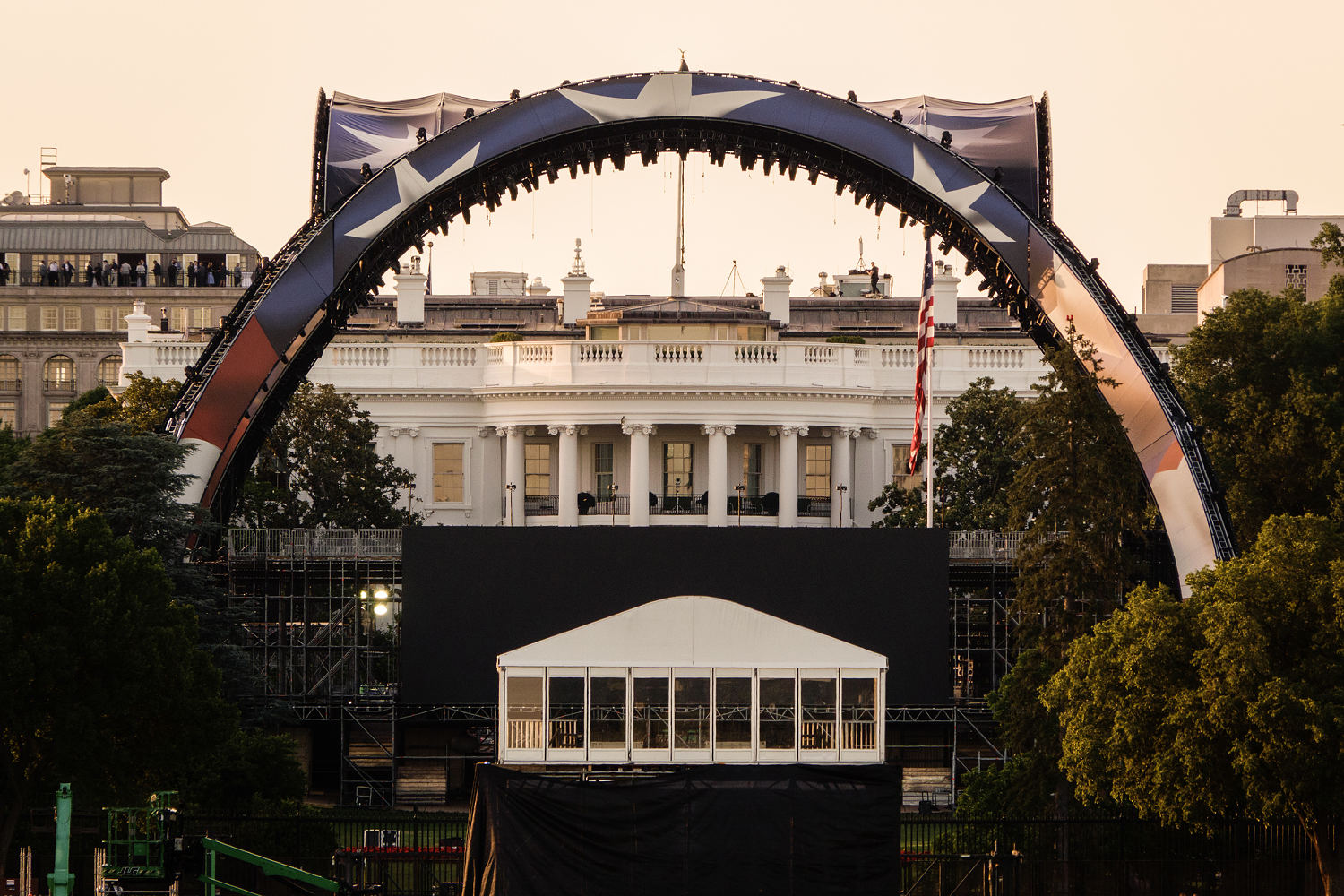
The physical infrastructure required to convert the South Lawn into a functional broadcast venue introduces a structural bottleneck. The event layout features a 5,000-seat outdoor arena and a massive structural archway known as "The Claw" overlooking the event space.
Under federal property laws, permanent or significant temporary structural alterations to historical national monuments require explicit legislative approval. The lawsuit alleges that the administration completely bypassed Congress, erecting heavy engineering assets on public grounds without statutory consent.
3. The National Environmental Policy Act (NEPA) Mandate
For projects of this magnitude on federal land, the National Environmental Policy Act mandates a formal environmental review to assess physical impact, waste generation, and structural risks to historical grounds. The UFC's projected budget for the event includes $700,000 earmarked specifically to restore the South Lawn turf post-fight. The presence of this line item establishes that physical degradation of the site is an expected consequence of operation. The plaintiffs use this to highlight the omission of a mandatory pre-construction environmental assessment.
Regulatory Arbitrage and Governance Structures
Staging a professional combat sports event requires strict regulatory compliance, typically managed by state athletic commissions to ensure fighter safety, medical compliance, and fair competition. The location of the White House introduces a unique jurisdictional vacuum.
[Federal Property Status]
       │
       ▼
[Exclusion of District of Columbia Combat Sports Commission]
       │
       ▼
[Jurisdictional Vacuum]
       │
       ▼
[Voluntary Oversight: Association of Boxing Commissions (ABC)]
Because the White House grounds are federal property, the District of Columbia Combat Sports Commission lacks legal jurisdiction to oversee the event. To mitigate the risks of operating completely outside standard regulatory channels, the UFC bypassed local authorities entirely. The promotion requested that the independent Association of Boxing Commissions step in to manage the selection of referees and judges.
The structural limitation here is that the involvement of the Association of Boxing Commissions is voluntary and contractual rather than statutory. This creates a regulatory precedent where a private entity, operating on federal land, determines its own oversight mechanism, removing the standard public accountability frameworks that govern professional sports in every other jurisdiction.
The Economics of Captured Marketing and Private Gain
The financial dimensions of UFC Freedom 250 differentiate it from historical uses of the White House for athletic exhibitions. While past administrations have hosted amateur sports clinics or collegiate championship receptions, this event operates as a highly commercialized, closed-loop revenue generator for a publicly traded corporation, TKO Group Holdings.
The financial architecture relies on an extreme high-margin ticketing model paired with mass public distribution at secondary sites:
- Premium VIP Packages: The promotion is retailing exclusive VIP hospitality packages priced at $1.5 million each.
- Mass Scale Public Spillover: While no public tickets are available for the South Lawn arena itself, the event utilizes the nearby Ellipse to house giant broadcast screens, supported by up to 85,000 free tickets distributed to spectators.
- Earned-Media Valuation: Internal communications from TKO executives describe the White House backdrop as an unprecedented earned-marketing tool. The broadcast is scheduled to stream live on Paramount+, with preliminary cards broadcast on CBS.
The lawsuit explicitly connects this commercial optimization to personal financial alignment. The filing highlights that the President purchased between $15,000 and $50,000 worth of TKO Group Holdings stock on March 25, 2026—weeks prior to the official finalization of the event. The legal argument posits that utilizing federal real estate to generate unprecedented earned media and direct revenue for a corporation in which the Chief Executive holds an active equity stake violates the foundational principles of public asset allocation.
Strategic Trajectory and Legal Remedies
The immediate timeline of the event dictates a highly compressed legal sequence. The plaintiffs are currently filing for a Temporary Restraining Order (TRO) to halt ongoing infrastructure assembly and freeze all operations on the South Lawn.
To secure a TRO, the Public Integrity Project must satisfy a rigorous four-factor legal framework:
- Likelihood of Success on the Merits: The court must find that the text of the National Park Service commercial sporting ban applies explicitly to the South Lawn, rendering the executive permit unlawful.
- Irreparable Harm: The plaintiffs must prove that allowing construction to continue will cause irreversible structural or environmental damage to historical grounds that cannot be remedied by financial compensation.
- Balance of Equities: The court must weigh the injury to the public interest against the financial losses the UFC and its broadcast partners will suffer if forced to cancel or relocate.
- The Public Interest: The legal team must demonstrate that upholding statutory compliance regarding federal land use outweighs the utility of a landmark national celebration.
The administration’s defense rests on executive discretion, categorizing the challenge as an obstructionist maneuver. The defense argues that the event falls within the historic scope of the executive branch's authority to host events on the South Lawn, comparing it to state dinners or national holiday celebrations.
The structural flaw in the defense’s analogy is the commercialized capitalization structure. State dinners do not retail million-dollar corporate sponsorships, nor do they generate subscription fee revenue for private media networks. If the federal court grants the TRO, it will establish a major precedent limiting the executive branch’s capacity to monetize federal property through private joint ventures, forcing the UFC to execute a costly, rapid relocation of its entire production apparatus to a conventional commercial arena.