Silence.
When six stories of wet concrete and rusted rebar surrender to gravity in the outskirts of Nairobi, the first thing survivors remember is not the thunderous roar of the collapse, nor the screaming of neighbors running into the muddy streets, but the sudden, suffocating absence of sound as grey dust swallows the morning air.
Six people died in that collapse near Kenya’s capital.
In standard news dispatches, a headline like that gets skimmed between coffee sips and traffic updates, reduced to a cold ledger of casualty counts, emergency response times, and boilerplate statements from municipal officials promising an investigation. We read the number six, feel a fleeting pang of sympathy, and scroll downward. Yet to reduce this tragedy to a single digit is to miss the slow-motion disaster unfolding across the rapidly expanding urban edges of East Africa, where the dream of upward mobility is routinely poured into substandard foundations.
The Architecture of a Compromise
To understand how a residential block becomes a tomb before the paint even dries, consider a hypothetical character named David, a composite drawn from the thousands of skilled artisans who build Nairobi’s commuter belt.
David is a mason with twenty years of calloused experience in towns like Ruaka, Kahawa West, and Kitengela—satellite settlements that have ballooned from quiet agricultural stretches into dense concrete forests over the last fifteen years. When David arrives at a construction site at dawn, he can tell within ten minutes whether a building will stand for fifty years or five. He knows by the color of the sand dumped near the road; river sand costs money, while quarry dust mixed with red soil is cheap and binds like dry flour. He knows by the spacing of the steel stirrups inside the columns, which are supposed to hug the vertical rods tightly to prevent buckling, yet often hang loose like oversized bracelets because someone wanted to save forty bars of iron.
On a Tuesday morning, David watches the foreman order a fresh slab poured on the fifth floor, even though the fourth-floor concrete below it has barely cured for a week. Normally, concrete requires twenty-eight days to reach its full structural design strength, curing slowly as water reacts chemically with cement to form microscopic crystals that lock the aggregate together. Pouring a massive new load onto green, immature concrete is like asking a teenager with unhealed broken legs to carry a refrigerator up a flight of stairs.
David speaks up. He points to a hairline fissure spider-webbing across a load-bearing column near the stairwell. The foreman waves him off, checking his phone, anxious to hit a milestone so the developer can collect the next tranche of rent deposits from eager tenants. If David refuses to mix the mortar, three other men waiting outside the corrugated iron gate will take his trowel before noon. So David mixes the cement, prays the columns hold until payday, and walks home each evening glancing backward over his shoulder.
This is not fiction for the sake of drama; it is the daily calculus of informal urban development in rapidly growing cities.
Why the Suburbs Are Sinking
Nairobi is bursting at its seams. Driven by rural-to-urban migration, a swelling young workforce, and an acute shortage of affordable housing within the city center, demand for cheap apartments has transformed peri-urban areas in Kiambu, Machakos, and Kajiado counties into relentless construction zones.
Where there was once coffee farmland or open scrubland just outside the capital’s administrative boundary, six- and seven-story apartment blocks now rise cheek by jowl, separated by alleys barely wide enough for a wheelbarrow. Land prices near major transit corridors—such as the Thika Superhighway, Mombasa Road, and the Southern Bypass—have skyrocketed. To recover the high cost of buying a tiny eighth-of-an-acre plot, developers face intense financial pressure to build upward rather than outward, stacking five, six, or seven floors onto footprints originally intended for a single-family bungalow.
Think of a building’s foundation like the roots of an ancient acacia tree. A wide canopy requires deep, sprawling roots anchored into solid bedrock to withstand wind and rain. When a developer buys a plot meant for a two-story house and decides mid-construction to add four more rental floors because demand is booming, the structure becomes a top-heavy giant balancing on toothpicks.
In the aftermath of the recent collapse near the capital, early observations echoed a grimly familiar pattern documented by Kenya’s National Construction Authority across dozens of previous failures. Buildings rarely fall because of a single catastrophic error; they fail because of a chain of quiet shortcuts:
- Bypassed approvals: Construction begins at night or over weekends before architectural and structural drawings are vetted by county engineers.
- Watered-down materials: Cement ratios are stretched thin, river sand is adulterated with silt that destroys bonding strength, and recycled or undersized steel bars are substituted for certified high-tensile rebar.
- Ghost supervision: Licensed structural engineers sign off on initial paperwork to satisfy regulatory checklists, then never visit the site again, leaving multi-story engineering decisions to uncertified foremen.
- Premature occupancy: Families move into the ground and first floors while welding sparks still rain down from active construction on the fifth and sixth stories above their heads.
When you walk past these half-finished towers in the evening, you see laundry hanging from balconies directly beneath exposed wooden scaffolding. Inside those ground-floor rooms, mothers cook supper over gas stoves while tons of wet, unverified concrete cure directly above their ceilings.
Inside the First Seventy-Two Hours
I have stood at the edge of collapsed concrete in East Africa before, and nothing prepares you for how small a six-story building becomes once it pancakes.
From a distance, it looks like a gray quarry slide—a jagged heap of fractured slabs stacked flat atop one another like dropped playing cards, separated by inches rather than rooms. Up close, the air tastes metallic and chalky, thick with pulverized lime that coats your tongue and stings the back of your throat. Shoes crunch over shattered window glass, splintered timber formwork, and twisted blue plastic water pipes that still hiss softly where the mains snapped.
In those initial hours, before heavy excavators from the national disaster response units can navigate the narrow, unpaved access roads choked with panicked crowds, rescue is entirely manual. Neighbors, boda-boda riders, and off-duty masons claw at chunks of masonry with bare hands, crowbars, and borrowed sledgehammers. Someone yells for silence—a sharp, desperate whistle that ripples across hundreds of onlookers—and suddenly the entire neighborhood holds its breath, ears pressed close to cracks in the concrete, listening for a tap, a muffled voice, or the ring of a buried mobile phone.
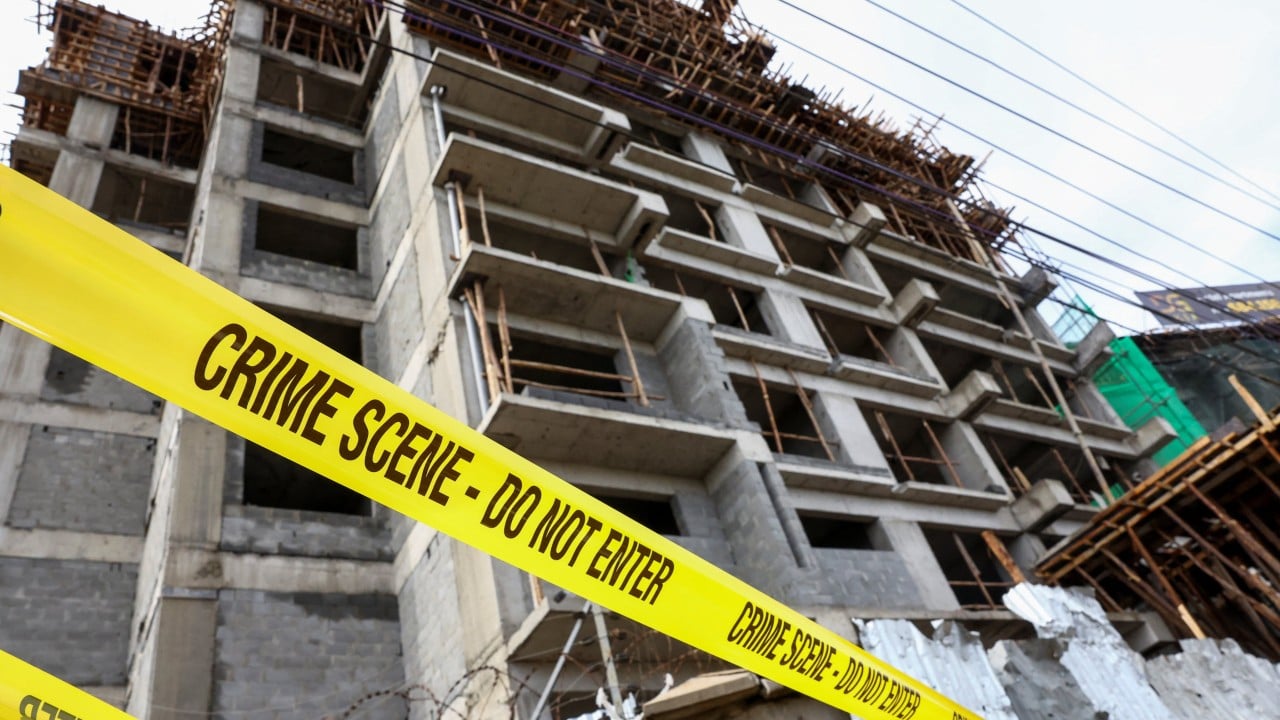
Waiting beside the yellow police tape is where the true weight of the number six settles into your chest.
Imagine a young mother—let us call her Faith, representing the families who rent these peri-urban units because three thousand shillings saved on monthly rent means school fees for a child—standing barefoot in the mud outside the perimeter. Her husband works night shifts at a warehouse along Mombasa Road; he had just laid down to sleep in their first-floor room twenty minutes before the walls groaned and folded inward. Every time rescue workers lift a concrete slab with hydraulic jacks, Faith leans forward, her knuckles white against the metal barricade, suspended between the agony of knowing and the terror of not knowing.
By the time the dust finally clears and the official tally stops at six dead, the emergency crews pack up their floodlights. Television cameras move on to the next political press conference. Yet for Faith, and for the families of the other five victims, the collapse did not end when the excavators turned off their engines; it simply moved indoors, into quiet rooms where a pair of work boots sits untouched by the door.
The Anatomy of Impunity
Why does this keep happening when everyone—from the mason mixing mortar to the cabinet secretary issuing statements at the podium—knows exactly why buildings fall?
Following major collapses in Huruma, Zimmerman, Kinoo, and Ruaka over the past decade, national audits of buildings across Nairobi and its surrounding counties revealed a staggering reality: hundreds of occupied residential structures were flagged as unsafe, structurally compromised, or built without proper permits, with dozens marked for immediate demolition.
Yet walk through those same neighborhoods six months after an audit, and you will see red "X" marks painted by city inspectors quietly scrubbed off exterior walls or painted over with fresh coats of cream emulsion.
The enforcement machinery breaks down at the intersection of bureaucratic fragmentation, corruption, and economic desperation. Oversight responsibilities frequently blur between county physical planning departments, the National Construction Authority, and environmental regulators, creating gaps where accountability evaporates. A stop-work order issued on a Friday afternoon is routinely ignored by Monday morning after a quiet phone call or an envelope passed across a desk. Even when developers or rogue contractors are arrested in the immediate glare of media coverage following fatal collapses, prosecutions drag through the courts for years, often stalling over lost files or uncooperative witnesses until public outrage fades.
There is also an uncomfortable truth that rarely makes it into official speeches: the market itself rewards speed over safety.
In an economy where borrowing rates from commercial banks remain steep, a developer financing an apartment block wants rental income flowing the exact month the roof goes on. Every week spent waiting for concrete to cure properly or waiting for a county structural engineer to inspect foundation trenches costs interest money. Meanwhile, low- and middle-income tenants, squeezed by inflation and long commutes, cannot afford to hire an independent structural engineer before signing a lease. They look at fresh tiles, modern kitchen cabinets, and a tiled bathroom, assuming—reasonably, in any functioning society—that if a building is standing and connected to the power grid, someone in authority verified it wouldn't kill them in their sleep.
That unspoken social contract is broken.
What Real Accountability Looks Like
Fixing this crisis does not require inventing new engineering laws; Kenya already possesses comprehensive building codes and qualified structural engineers capable of designing skyscrapers that withstand earthquakes. What is missing is consequence—visible, unavoidable, financial and criminal consequence before a building falls rather than after bodies are pulled from the rubble.
Consider what happens if we shift the point of friction from the aftermath to the foundation:
- Public digital registries: Every multi-story construction site should be required to display a weatherproof QR code on its perimeter fence linking directly to a public database showing the approved structural drawings, the licensed engineer of record, the maximum permitted floor count, and dated sign-offs for each poured slab. If a building is approved for four stories and a fifth appears, any neighbor or tenant can see the violation in ten seconds.
- Mandatory material testing at the pour: Rather than relying on paper receipts, county inspectors must take wet concrete cube samples directly from the mixer during critical pours and crush them in certified labs at seven and twenty-eight days, automatically halting upper-floor construction if strength thresholds fail.
- Personal liability for sign-offs: When a building collapses due to negligence, criminal culpability must attach not merely to a shell company that can be dissolved overnight, but directly to the property owner, the supervising engineer who lent their stamp without visiting the site, and the specific municipal inspector who cleared the structure for occupancy.
- Utility locks: Water and electricity providers must be legally barred from connecting meters to any multi-unit residential building that lacks a verified, digitally authenticated certificate of occupation. Without power or water, an unsafe building cannot generate rent.
None of these steps are radical. They are the bare minimum safeguards that allow millions of city dwellers around the world to go to sleep at night without wondering whether the ceiling above their bed was mixed with river sand or dirt.
The Weight of Six Lives
Near the outskirts of Nairobi, yellow caution tape still flutters around a jagged scar of broken concrete where a six-story home stood days ago.
Neighbors still walk past on their way to catch morning matatus, glancing briefly at the twisted iron rods jutting toward the sky like stripped ribs, before hurrying onward because work does not wait for grief. Next door, separated by barely ten feet of muddy footpath, another apartment block stands six stories high, built with the same sand, along the same timeline, with curtains fluttering in its windows.
Somewhere inside that neighboring building tonight, a light will switch off, a head will rest on a pillow, and someone will listen to the faint creak of cooling concrete in the dark, trusting that the floor beneath them will still be there at dawn.


