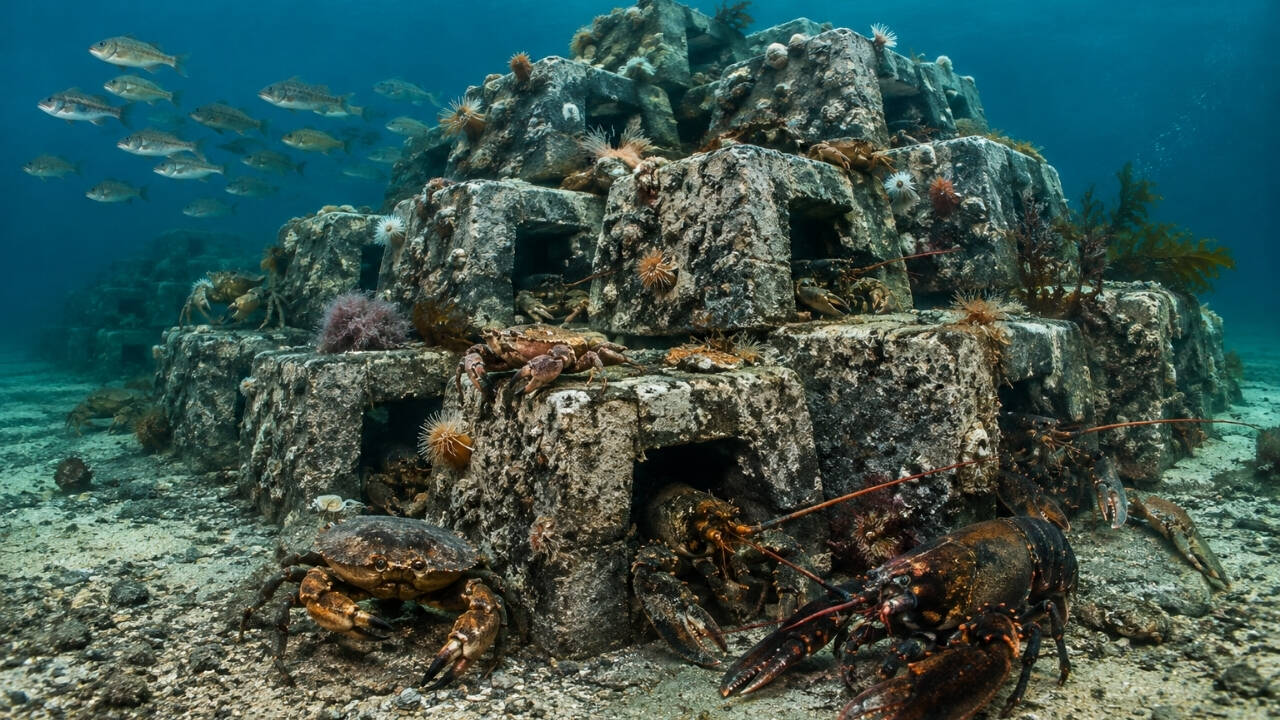
We've spent centuries treating industrial byproducts like trash to be hidden away, but sometimes the dirtiest waste streams hold surprising utility if you're willing to look at them differently. Think about coal waste. It sits around in massive piles, ruins local landscapes, and triggers endless environmental anxiety. But a team of UK researchers just turned fifty tonnes of this toxic-sounding material into a thriving artificial marine reef. And the ocean didn't just tolerate it. Life showed up within three weeks.
If you think pouring industrial ash into the sea sounds like a disaster waiting to happen, you aren't paying attention to the chemistry or the desperate state of our coastal ecosystems. Coral reefs are dying globally. Fish populations face continuous collapse. Traditional restoration projects take years to show any tangible progress, often bound by red tape and high costs. This coal waste project flips the script. It takes a massive liability and forces it to do heavy lifting where the biosphere needs it most.
The Reality of Industrial Substrates
People assume all industrial waste acts as instant poison for marine organisms. That assumption is flat-out wrong. When processed and stabilized correctly, certain mineral-heavy materials provide the exact structural anchor that drifting larvae crave.
Let's look at how marine colonization actually happens. Fish and shellfish don't care about the corporate origin of a rock. They care about texture, stability, and chemical neutrality. They need a surface where they can grip, hide from predators, and build colonies.
Fifty tonnes of stabilized coal combustion residues became that surface. Researchers molded the material into specific architectural designs meant to maximize surface area and water flow. Once dropped into the coastal test site, the structures went to work immediately. Algae latched on first. Barnacles and tubeworms followed quickly. By week three, mobile species arrived to feed on the new growth.
You won't hear about this in standard environmental panic loops because it challenges a clean narrative. We like our solutions neat, expensive, and derived from pristine organic sources. But nature is pragmatic. If you give a barren sandy seabed a hard structure, life moves in. Period.
Why Traditional Restoration Falls Short
Coastal protection schemes usually rely on quarried rock or manufactured concrete. Quarried rock destroys terrestrial habitats just to fix marine ones. Concrete production pumps staggering amounts of carbon dioxide into the atmosphere, which directly worsens ocean acidification.
Using stabilized coal waste bypasses both problems. It recycles a material that would otherwise sit in a landfill, and it avoids the carbon footprint of fresh cement production.
- Quarried Rock: Destroys terrestrial ecosystems at the quarry site.
- Fresh Concrete: High carbon emissions during the manufacturing phase.
- Stabilized Coal Residues: Diverts industrial waste from landfills with zero cement-manufacturing footprint.
Critics always point to heavy metal leaching. It is a fair concern. Nobody wants to poison the fish we eventually eat. But rigorous leaching tests and stabilization processes lock the toxic components inside a solid matrix. The physical blocks behave more like natural basalt than loose ash. The UK team monitored water quality closely throughout the trial, ensuring the chemical signature of the surrounding water remained entirely uncompromised.
The Speed of Ecological Recovery
Three weeks sounds impossibly fast for an ecosystem to claim an artificial structure. We are conditioned to think ecological repair takes decades of slow, agonizing growth.
That mindset misunderstands how opportunistic marine species operate. Millions of microscopic larvae drift through coastal waters at any given moment, starving for hard substrate. Most of them die because they hit sandy bottoms where they cannot attach. When you drop fifty tonnes of textured blocks into their path, you build an oasis in a desert.
Barnacles and hydrozoans colonized the surfaces almost overnight. Small crabs and juvenile fish moved into the crevices to escape larger predators. The speed of this turnaround proves that marine life is ready to bounce back if we simply give it the physical infrastructure to do so.
We need to scale this up. Coastal communities facing severe erosion and depleted fisheries cannot afford to wait twenty years for bureaucratic permitting on expensive concrete breakwaters. Turning industrial byproducts into marine habitats solves two massive problems at the exact same time. It clears out unwanted waste and rebuilds collapsing fish stocks.
Stop viewing industrial byproducts solely as an end-of-chain burden. When handled with engineering precision, today's waste stream is tomorrow's coral forest.
Check your local regulations regarding marine artificial reefs, consult with marine biologists before attempting any localized deployment, and start pushing your local municipal leaders to look at industrial recycling through a much wider lens.


