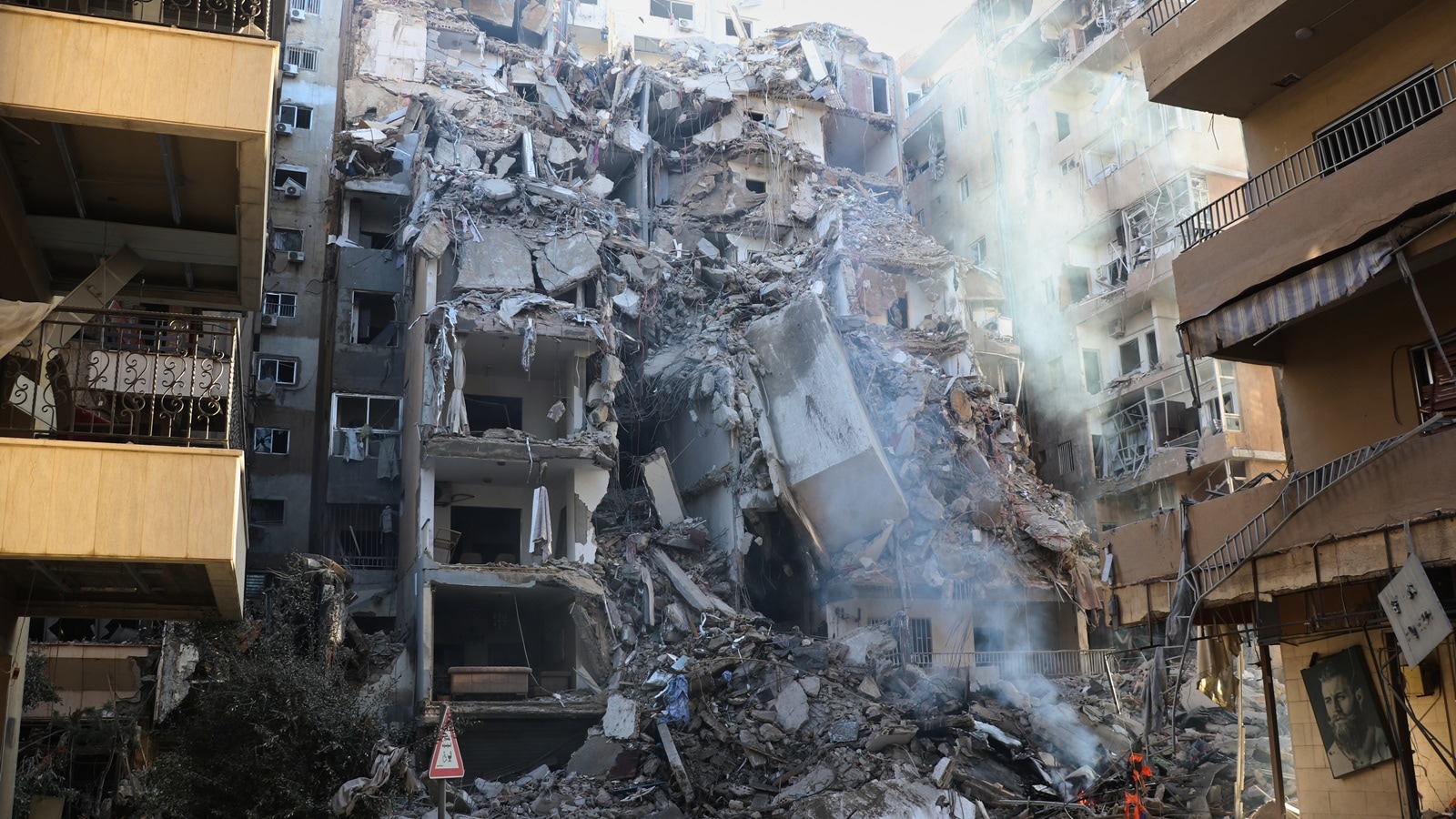
The ink on a diplomatic briefing possesses a strange, sterile quality. It reduces the shattering of concrete and the quiet calculations of statecraft into identical, bloodless font. On a single Tuesday afternoon, two entirely different realities unfold under the same geopolitical banner. In the soundproofed, air-conditioned corridors of Washington, D.C., men in tailored suits speak in the muted cadence of strategic ambiguity. Meanwhile, across the Mediterranean, the air above Lebanon thickens with the static hum of drones and the concussive thump of airstrikes.
This is the dual reality of modern warfare. It is a orchestrated paradox where a state can simultaneously reach for a pen and a trigger, opening two fronts that appear contradictory but are deeply, dangerously intertwined.
To understand the sheer friction of this moment, look away from the map for a second. Consider instead a hypothetical civilian named Farah, sitting in a kitchen in southern Lebanon. She is not a strategist. She does not read the translated transcripts of Pentagon press briefings. For Farah, the geopolitical reality is measured by the vibration of her kitchen windows and the calculation of whether a sudden, sharp crack in the distance means she has five minutes to load her children into a car, or none at all.
At the exact moment Farah watches the water in her glass tremble, thousands of miles away, Israeli Defense Minister Yoav Gallant walks into a secure room in Washington. The air smells of polished wood and stale coffee. The stakes are invisible but absolute. Gallant is there to secure the heavy machinery of war—precision-guided munitions, air defense interceptors, the raw material of security.
The contrast is jarring. It feels like a betrayal of logic. How can a nation engage in high-level talks aimed at managing a crisis while actively escalating the very same conflict on the ground?
The answer lies in the grim language of leverage.
In the theater of international relations, diplomacy is rarely an alternative to force. More often, it is its shadow. Israel’s simultaneous move—engaging Washington while striking Lebanon—is not an organizational mistake or a sign of internal division. It is a deliberate strategy of violent choreography. By intensifying airstrikes against Hezbollah positions, Israel attempts to alter the calculus on the ground, creating a reality that its diplomats can then exploit at the negotiating table.
But this strategy carries a terrifying mathematical vulnerability. When you play a game where the pieces are explosive and the board is populated by human beings, the margin for error disappears.
Consider the mechanics of an airstrike. A command is given in an underground bunker in Tel Aviv. A pilot ascends into the blinding blue sky over the Mediterranean. A target, identified by algorithms and intelligence feeds as a Hezbollah weapons depot, is locked. The missile is released.
But what happens when the intelligence is slightly old? What happens when a family, fleeing from a neighboring village, parks their car near that target to rest? The explosion does not differentiate between a missile launcher and a refugee. Every detonation sends a ripple effect through the social fabric of the region, hardening resolve, turning neutrals into adversaries, and transforming tactical victories into strategic disasters.
The Western world often views these escalations through a lens of clinical isolation. We analyze the troop movements. We count the sorties. We discuss the "ironclad" nature of the U.S.-Israel alliance as if it were a mathematical constant.
It is not.
The relationship between Washington and Jerusalem is a living, breathing friction point. Behind the public declarations of unity lies a fierce, exhausting tug-of-war. The Biden administration operates under the terrifying specter of a regional war—a conflagration that could drag American forces back into the Middle East mud, spike global oil prices, and derail domestic political agendas. When American officials sit across from their Israeli counterparts, they are trying to construct a cage around a fire that is already spreading.
They speak in a specialized dialect. They use words like "de-escalation" and "proportionality."
But these words lose their meaning when translated into the reality of a border town. For the residents of northern Israel, who have spent months living in hotels or cramped apartments after being evacuated under the threat of Hezbollah rockets, proportionality is an insult. They want to go home. They want the threat across the fence permanently dismantled. Their pressure on their own government is immense, democratic, and angry.
This domestic fury drives the airstrikes. It creates a political necessity for action that no amount of diplomatic caution from Washington can easily restrain.
Look closely at the architecture of Lebanon itself. The country is an exquisite, fragile mosaic that has been cracked for decades. It is a nation suffering under an economic collapse so severe that the World Bank ranked it among the worst since the mid-nineteenth century. The state infrastructure is a ghost. In this vacuum, Hezbollah operates not merely as a militia, but as a state within a state, possessing an arsenal that rivals many conventional armies.
When Israeli jets streak across the sky, they are not just targeting a militant group; they are striking a society already hovering on the brink of total failure. The psychological toll is a heavy, invisible weight. The constant buzz of surveillance drones overhead—a sound the locals call ayyar—becomes a permanent tinnitus of fear. It is an ambient terror that erodes the sanity of the population, one sleepless night at a time.
The danger of the current trajectory is the illusion of control.
Strategists believe they can calibrate violence. They think they can turn the heat up to ninety-nine degrees without bringing the water to a boil. They calculate that Hezbollah, wary of destroying its political standing within Lebanon, will absorb a certain amount of punishment without launching an all-out retaliation that would flatten Beirut and Tel Aviv alike.
This is a gamble played with millions of lives. History is littered with the graves of conflicts that no one wanted but everyone accelerated. A single miscalculated strike—a missile hitting a hospital instead of a hangar, a rocket hitting a school instead of a military base—can trigger an emotional and political cascade that overrides all rational restraint.
The two fronts—the diplomatic and the kinetic—are moving at different speeds. Washington moves at the pace of bureaucracy, of drafts and redrafts, of dinners and press communiqués. The bombs move at the speed of sound.
We are witnessing a profound breakdown of the post-war international order, a moment where the traditional tools of mediation are being treated as secondary to the argument of raw force. The meetings in Washington are essential, but they increasingly resemble a Greek chorus, commenting on a tragedy they are powerless to stop.
As night falls over the Levant, the diplomats in Washington return to their hotels, their briefcases packed with notes on how to contain the uncontainable.
Back in the southern suburbs of Beirut, the power goes out. The state electricity grid fails again, plunging whole neighborhoods into darkness. In that blackness, people do not look at their phones for news from America. They listen. They listen to the distant, rolling thunder of explosions, trying to judge by the depth of the sound whether the fire is moving closer, waiting for a dawn that offers no guarantees.