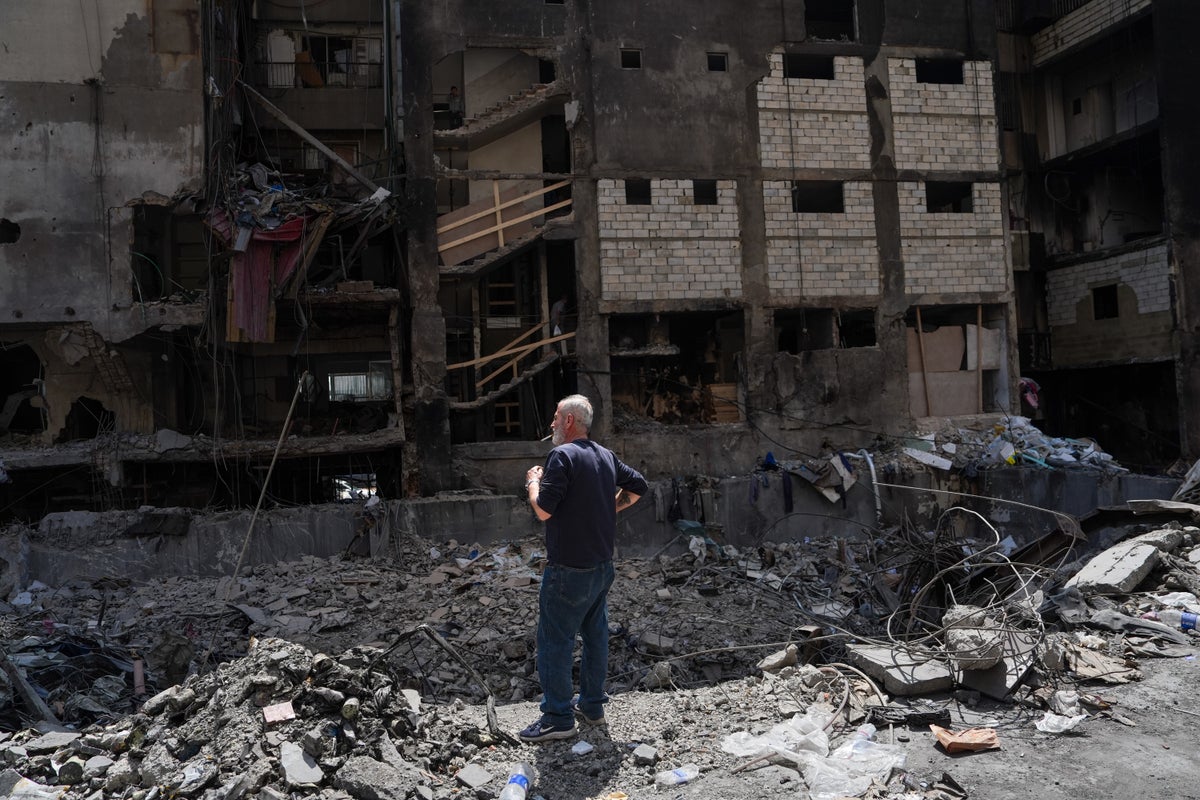
The headlines are screaming that Donald Trump has finally drawn a line in the Levantine sand. "Enough is enough," he declares, signaling a hard stop to Israeli kinetic operations in Lebanon. The media is treating this like a massive shift in American foreign policy—a sudden pivot toward restraint.
They are wrong.
This isn't a policy shift. It is a brand management exercise. If you think a verbal decree from a president-elect (or even a sitting one) fundamentally alters the security calculus of a nation facing 150,000 rockets on its northern border, you don't understand how power works. You are looking at the theater, not the engine room.
The Myth of the Puppet Master
The prevailing "lazy consensus" suggests that Israel is a client state that moves only when Washington pulls the strings. This narrative is comfortable for Western pundits because it centers the U.S. as the protagonist of every global drama. In reality, the relationship is a messy, high-stakes negotiation between two sovereign entities with divergent survival instincts.
When Trump says Israel is "not allowed" to bomb Lebanon, he isn't issuing a legal injunction. He is setting a stage for a "deal" where he can claim credit for a peace that was likely already trending toward a stalemate. The Israeli Defense Forces (IDF) do not check Truth Social before clearing a target list. They check their munitions stockpiles and their domestic polling.
Israel’s operations in Lebanon are driven by the "Campaign Between the Wars" doctrine—a strategy of proactive degradation. This isn't about "permission." It’s about a cold, hard assessment of $cost$ versus $benefit$.
Trump’s Middle East Strategy is a Leverage Play
Trump’s foreign policy has always been transactional, not ideological. By publicly "ordering" a halt, he creates a liability for Benjamin Netanyahu. If the bombing continues, Netanyahu looks defiant; if it stops, Trump looks like the ultimate closer.
But here is the nuance the mainstream outlets missed: Trump doesn't actually care about the bombing itself. He cares about the optics of instability. For an administration obsessed with "America First" and economic isolationism, a regional war that spikes oil prices and drags U.S. carriers into the Mediterranean is a distraction from the real goal: decoupling from China and fixing the domestic balance sheet.
He isn't protecting Lebanon. He is protecting his first 100 days from being hijacked by a Middle Eastern quagmire.
Why the "Ceasefire" is a Tactical Pause, Not Peace
The industry insiders know that "peace" in the Middle East is just a fancy word for "rearming."
- Degradation Cycles: Air campaigns have diminishing returns. Once the primary intelligence-vetted targets are gone, you’re just turning rubble into dust.
- Economic Exhaustion: Israel’s economy cannot sustain a multi-front, high-intensity conflict indefinitely. Reservists need to go back to their tech jobs.
- The Hezbollah Resupply: Any pause dictated by Washington gives Hezbollah the window it needs to move assets back south of the Litani River.
If Trump "forces" a stop now, he is merely freezing a conflict at its peak heat. He isn't solving the underlying structural issue: the presence of a non-state actor with a state-level arsenal on the border of a U.S. ally.
The Fallacy of "Not Allowed"
In the world of realpolitik, "allowed" is a fluid concept.
Consider the $Red Line$ of the Obama era. Or the "Don't" of the Biden era. Rhetoric is cheap. In the brutal logic of West Asian conflict, power is the only currency that trades at par. If the IDF perceives an imminent threat from a Radwan Force unit, they will strike. They will then apologize to the White House later, knowing full well that the U.S. cannot afford to truly abandon its only democratic foothold in the region.
The media portrays Trump’s statement as a radical departure from his previous "pro-Israel" stance. It’s not. It’s the same "America First" logic applied to a different phase of the moon. During his first term, he moved the embassy to Jerusalem because it cost him nothing and bought him evangelical support. Now, he’s calling for a halt because a prolonged war costs him political capital he’d rather spend on tariffs and border policy.
The Business of War vs. the Business of Peace
Let’s talk about the money. Defense contractors like Lockheed Martin and Raytheon thrive on the threat of war, but the global markets hate the uncertainty of active, expanding war.
Trump’s base isn't interested in "forever wars." The populist wing of the GOP has more in common with the anti-war left than it does with the neoconservatives of 2003. When Trump tells Israel to stop, he is speaking to the voter in Ohio who wonders why we are sending billions to Haifa while the bridge in their town is crumbling.
The "insider" truth? Trump is trying to de-risk the Middle East so he can focus on a trade war with the EU and China. Lebanon is a line item on a spreadsheet, not a humanitarian cause.
The Intelligence Gap
The competitor article ignores the reality of the ground war. Israel’s intelligence penetration of Hezbollah is currently at an all-time high. They have decapitated the leadership and disrupted the communications infrastructure.
From a military standpoint, this is the best time for Trump to call for a stop. Why? Because the "heavy lifting" is already done. He gets to walk into the room when the opponent is already staggering and claim he threw the knockout punch. It’s the ultimate branding play. He isn't stopping a war; he’s trying to whistle the end of a round where his side is already winning.
The Danger of This Rhetoric
There is a downside to this contrarian approach that even I have to admit: it creates a vacuum.
When the U.S. President-elect tells an ally they are "not allowed" to defend themselves as they see fit, it emboldens the Iranian proxies. They don't see a peacemaker; they see a crack in the alliance. They see a window to rebuild, regroup, and wait for the next cycle.
If you are an investor or a policy wonk, don't bet on a quiet 2026. Bet on a pressurized environment where the silence is just the sound of everyone reloading.
Stop Asking if Trump Can Stop the War
The question isn't "Will Israel listen to Trump?"
The question is "What does Trump want in exchange for Israel’s compliance?"
Netanyahu wants a green light on Iran’s nuclear program. Trump wants a quiet border so he can boast about his "Abraham Accords 2.0." This isn't about Lebanon’s sovereignty or civilian lives. It’s a trade.
Lebanon is the currency. Israel is the buyer. Trump is the broker.
Anyone telling you this is about "ending the violence" is selling you a fairytale. This is about clearing the deck for a different kind of conflict—one fought with bank accounts and trade quotas rather than JDAMs and Katyushas.
Trump didn't move the goalposts. He just realized the game was getting too expensive for his tastes. If Israel stops bombing, it won't be because they were "not allowed." It will be because they finished the job, and the price of the next bomb just went up.
Stop reading the teleprompter. Start watching the ledgers.



