The air smelled of morning dew and cut Bermuda grass. It was the kind of Florida Sunday that feels suspended in amber, where the humidity is a physical weight and the sunlight turns the palm fronds into sheets of beaten brass. On courses like these, hundreds of yards away from the public gaze, the game is usually measured in inches—a putt sliding past the cup, the gentle click of a wedge striking a clean lie.
Then came the rustle in the brush.
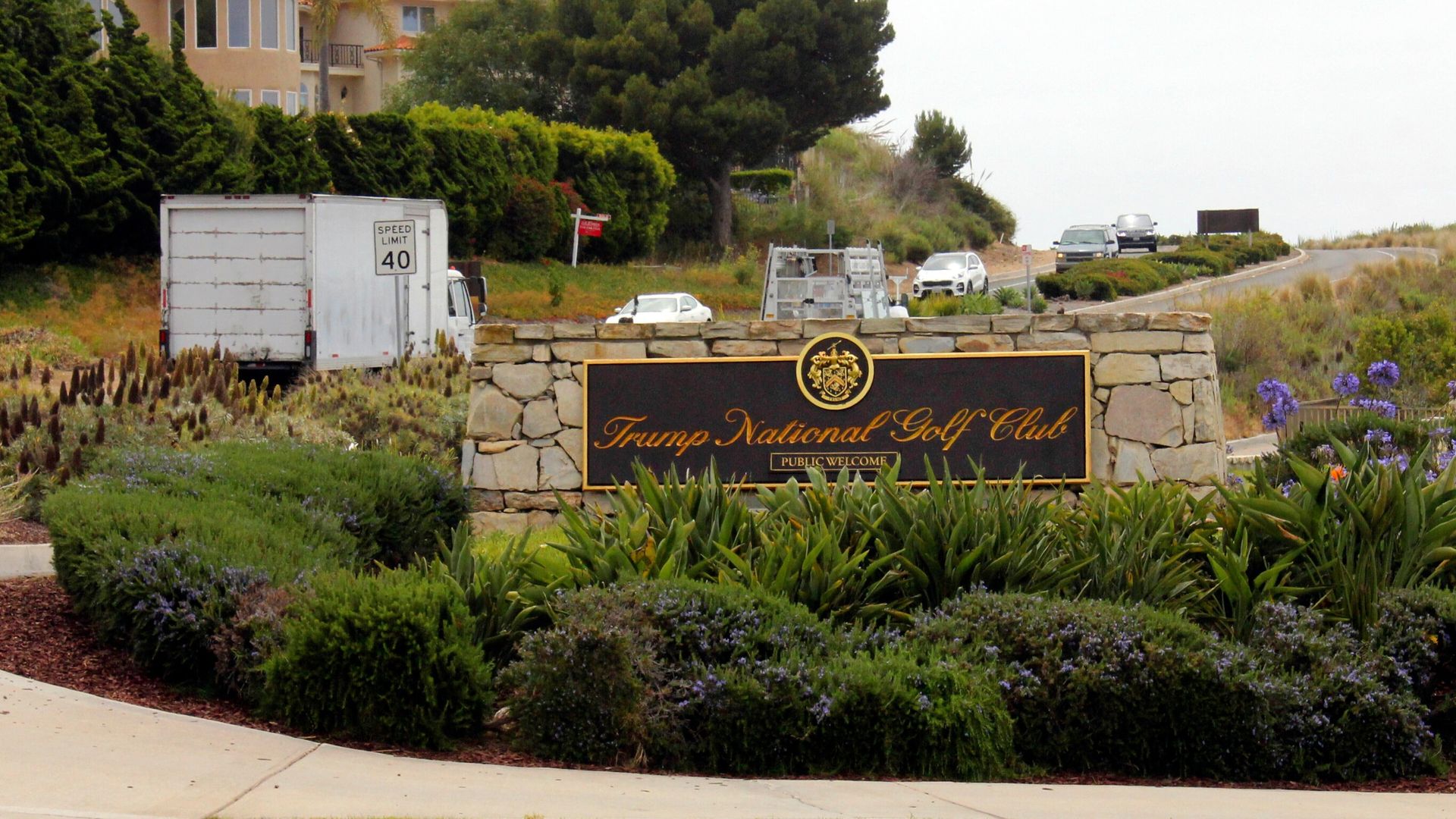
Security details do not live in the realm of relaxation. They live in a state of hyper-vigilant suspension, waiting for the statistical anomaly that can rewrite history in a fraction of a second. When an agent spotted the barrel of a rifle poking through the treeline near the perimeter of Trump International Golf Club in West Palm Beach, the amber morning shattered.
Consider the mathematics of protection. A modern political figure does not simply move through space; they drag a shifting sphere of probability behind them. Every fence line, every drainage ditch, every patch of overgrown palmetto is a variable. On that September morning, those variables converged.
The suspect, Ryan Wesley Routh, had staked out a vantage point roughly three to five hundred yards from where Donald Trump was playing. In the language of modern ballistics, that distance is nothing. It is a fraction of a second for a high-powered rifle round. Yet, it is an eternity for a Secret Service agent whose primary job is to intercept the unthinkable before it becomes an obituary.
An agent opened fire. The suspect fled, leaving behind a digital camera, a backpack, a loaded SKS-style rifle, and a GoPro camera rigged to capture an event the world was fortunately spared from witnessing. Within minutes, a coordinated dragnet spanned the highways, culminating in a traffic stop on Interstate 95 where law enforcement took the man into custody.
Silence followed. Then came the frantic media cycle, the dry police bulletins, and the endless chyrons on cable news ticker tapes.
We have grown numb to these bulletins. That is the quiet tragedy of our era. The threat matrix has expanded so drastically that an attempted assassination of a former president—occurring just two months after a bloody ear in Butler, Pennsylvania—begins to register as background noise. We digest the shock, compartmentalize the danger, and scroll to the next headline.
We forget the human pulse beneath the panic.
Imagine standing on a fairway, completely unaware that a sniper's nest sits just beyond the property line. Imagine the sudden, jarring shouts of men trained to take a bullet, the immediate scramble, the adrenaline spiking through veins as the golf cart accelerates into a hard, protective turn. For the Secret Service agents who spotted the threat that day, heroism was not a cinematic monologue. It was a split-second observation born of agonizingly repetitive training. They look at trees differently than the rest of us. They see vectors. They see angles of vulnerability.
This is not a partisan story. This is a story about the terrifying fragility of public life in contemporary America.
When political violence shifts from the theoretical to the suburban sidewalk, the entire psychological architecture of a nation bends. We have normalized the abnormal. We look at metal detectors at school board meetings, armored glass around podiums, and perimeter sweeps at local golf courses as the baseline of civic engagement.
Consider what happens to a society when its leaders must be hermetically sealed away from the populace just to play nine holes of golf. The distance between the governed and the governing becomes absolute. It is measured in armed guards, drone surveillance, and reinforced steel. Every security breach pushes the walls higher, isolating the figures at the center of our political maelstrom even further from the common touch of everyday life.
The suspect's digital footprint revealed a man unmoored, radicalized by shifting grievances, writing self-published manifestos about global conflicts, and drifting through life convinced he had a personal role to play in the grand theater of history. It is a chillingly familiar profile. Modern political violence is rarely the product of vast, shadowy conspiracies orchestrated by foreign intelligence agencies. More often, it is born in the lonely glow of a computer screen, cultivated by isolation, grievance, and the toxic democratization of outrage.
A lone man with a cheap rifle and a cheap camera, hiding in the Floridian underbrush, believing he could alter the destiny of three hundred million people.
The system worked that day, but relying on the system to catch every anomaly is like bailing out an ocean with a teaspoon. Prevention requires something far more difficult than a wider perimeter or a faster response time on the interstate. It requires an interrogation of our cultural fever pitch.
As the legal proceedings grind forward and the federal indictments pile high, the brush at the edge of the golf course has been cleared. The grass has grown back. Tournaments resume. The Secret Service continues its endless, exhausting dance of shadows and shields.
Yet the question lingers, heavy and unresolved, hanging in the humid air long after the last cart has rolled back to the clubhouse. How long can a society skate along the razor's edge before the blade finally cuts too deep?