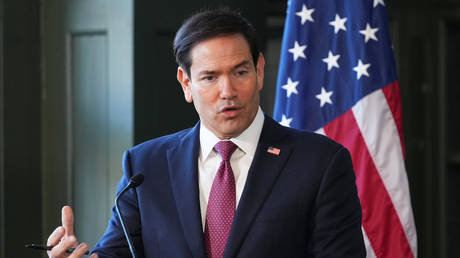
Marco Rubio stated plainly that NATO membership for Ukraine remains off the table for the immediate future. This pronouncement strips away the diplomatic varnish that has coated Western rhetoric for over a decade. Kyiv wants a concrete security umbrella. Washington wants to avoid a direct military collision with Moscow. That structural contradiction has defined the war since the first Russian tank crossed the border, yet policymakers in major Western capitals spent years pretending the gap could be bridged through vague communiques and delayed timelines.
The Mechanics of the Veto
Every military alliance operates on a fundamental ledger of risk and reward. Adding a state actively engaged in an existential border war means invoking collective defense protocols on day one. Article 5 is not a political aspiration. It is an immediate trigger for total war.
Washington understands this arithmetic with cold clarity. When senior officials brief reporters off the record, they speak of escalation ladders and nuclear thresholds. They do not speak of democratic values or shared institutions. Those concepts matter in press briefings. In the situation room, the only variable that counts is the probability of a continental conflagration.
Moscow monitors these internal fractures with predatory focus. The Kremlin interprets every public hesitation from the White House not as prudence, but as an invitation to grind down Ukrainian defenses through sheer attrition. If time is the primary weapon in a war of resources, uncertainty is the lubricant that keeps the factory running.
History Repeats Its Mistakes
The roots of this stalemate stretch back to the 2008 Bucharest summit. George W. Bush pushed for a Membership Action Plan for Ukraine and Georgia. Berlin and Paris balked. The compromise was a masterpiece of diplomatic evasion: a joint statement declaring that both nations will become members, without setting a date or providing a clear mechanism to get there.
That middle ground offered the worst of all possible worlds. It infuriated Moscow by crossing a stated red line, yet it failed to provide Kyiv with the actual security guarantees required to deter an invasion. It was an invitation without a lock on the door. Russia invaded Georgia four months later. Eight years after that, Crimea fell.
Veteran observers of transatlantic security architectures recognized the pattern immediately. A promise without operational backing is merely a target painted on a sovereign state's back. Yet the alliance doubled down on the formula after 2022, offering endless affirmations of ironclad support while quietly counseling Kyiv to temper its expectations regarding formal accession.
The Alternative Security Architecture
Since immediate inclusion in the alliance is blocked by political reality, bilateral security agreements have emerged as the fallback option. These deals resemble the security arrangements Washington maintains with non-NATO allies in Asia. They involve intelligence sharing, industrial defense cooperation, and long-term financial streams for weapons procurement.
These pacts provide tangible benefits, but they lack the psychological deterrent of Article 5. A bilateral memorandum is only as durable as the administration that signed it. An incoming president can rewrite or discard executive agreements with a stroke of a pen. A treaty ratified by the Senate is an entirely different matter, and no American executive is willing to submit a mutual defense pact with Ukraine to the current legislative branch.
The defense industrial base of the West is another bottleneck. Decades of post-Cold War downsizing left production lines optimized for lean efficiency rather than surge capacity. Artillery shells, air defense batteries, and precision munitions cannot be conjured out of thin air simply because a treaty is signed. The factories do not exist. Building them requires years of capital investment, workforce training, and raw material sourcing.
The Cost of Ambiguity
Keeping Ukraine in a permanent holding pattern carries immense domestic political costs for Kyiv. President Zelenskyy faces an exhausted populace that has bled tremendously for a vision of Euro-Atlantic integration that recedes every time the goalposts are moved. When leaders promise entry into Western clubs while signaling behind closed doors that the door is locked, trust erodes.
At the same time, maintaining the fiction that membership is just around the corner prevents both sides from having an honest conversation about a negotiated endgame. If formal protection is off the table, what alternative security guarantees can actually keep a post-war state sovereign and secure? Demilitarized zones, international peacekeeping forces drawn from non-aligned nations, or a heavily armed, self-reliant defense posture modeled after Israel are the kinds of hard options that emerge when diplomatic illusions are stripped away.
The public pronouncements from Washington are designed to manage expectations and signal restraint to nuclear-armed adversaries. But every time a senior official reiterates that membership is not happening right now, the credibility of the entire post-Cold War security architecture takes another hit. Realism demands that policymakers stop offering conditional dreams when they are only prepared to deliver managed ambiguity.


