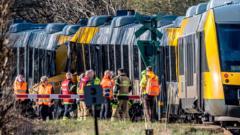
Denmark just witnessed a nightmare scenario on the tracks. Two trains slammed into each other head-on, leaving five people fighting for their lives in critical condition. It's the kind of disaster that isn't supposed to happen in a country known for its precision and high-tech infrastructure. Emergency crews swarmed the wreckage near the town of Holbæk, working against the clock to pull survivors from twisted metal. This wasn't just a minor fender-bender on the rails. It was a high-energy impact that raises uncomfortable questions about the signaling systems we trust with our lives every single day.
The Brutal Reality of the Holbæk Crash
When the call came in, the scale of the chaos was immediately clear. Two passenger trains were occupying the same stretch of single-track line, moving toward each other with no room to maneuver. It's a terrifying thought. You're sitting on your morning commute, maybe checking emails or sipping coffee, and suddenly the world turns upside down.
Rescue teams faced a grim scene. Initial reports confirm that at least 20 people were injured, but the focus remains on the five individuals rushed to the hospital with life-threatening trauma. In a head-on collision, the kinetic energy has nowhere to go but through the carriages. Steel buckles. Glass shatters. People get thrown like ragdolls.
Local police and the Danish Accident Investigation Board (Haverikommissionen) immediately cordoned off the area. They aren't just looking for broken parts. They're looking for why the system failed to stop those trains from being in the same place at the same time. Denmark usually prides itself on the ERTMS (European Rail Traffic Management System), but clearly, something went catastrophically wrong here.
Why Human Error Is Rarely the Whole Story
Whenever a train crash happens, the first thing people do is blame the driver. It's easy. It's convenient. But honestly, it's usually wrong—or at least incomplete. Modern rail networks are designed with "fail-safes" specifically to prevent human mistakes from turning into body counts.
If a driver misses a signal, the Automatic Train Protection (ATP) system should kick in. It’s supposed to trip the brakes. If that didn't happen in Denmark, we’re looking at a systemic failure. We have to ask if the signaling hardware was undergoing maintenance or if a software glitch bypassed the safety protocols.
In many recent European rail incidents, investigators found that "safety-critical" updates were either delayed or improperly implemented. Denmark has been aggressively upgrading its rail network to digital signaling. While these upgrades are meant to make things safer, the transition period—where old analog gear meets new digital code—is notoriously dangerous. You’ve got different generations of technology trying to talk to each other. Sometimes, they stop communicating entirely.
The Single Track Trap
The stretch of track where this happened is a known bottleneck. Single-track lines require absolute synchronization. If one train is running five minutes late, the entire schedule shifts. It’s a domino effect.
- Timing is everything. On single tracks, trains pass each other at designated loops or stations.
- Signaling must be perfect. There is zero margin for error when two objects weighing hundreds of tons are headed toward each other.
- Manual overrides are risky. Sometimes, to keep trains moving during a delay, dispatchers use manual "talk-past" orders. This is where a human tells a driver to ignore a red signal. If the dispatcher is wrong, the results are fatal.
Data from the European Union Agency for Railways (ERA) shows that while rail remains significantly safer than driving, "collision" incidents have seen a slight uptick in regions undergoing massive infrastructure overhauls. Denmark is right in the middle of that storm.
What This Means for Future Rail Travel
People are going to be scared to hop on a train tomorrow. That's a natural reaction. But we need to look at the hard numbers. Rail is still the safest way to travel on land. However, "safe" isn't "perfect."
This crash should be a wake-up call for Banedanmark, the agency responsible for Danish tracks. They’ve been pushing for faster trains and more frequent departures. But speed without upgraded safety is just a recipe for a higher body count. You can't run 21st-century frequencies on 20th-century safety logic.
We need to see a full, transparent report on the technical status of the ATP on both trains involved. If those systems were functional and still allowed a collision, the entire European rail community has a massive problem on its hands. It would mean the "gold standard" of safety has a blind spot.
How to Stay Informed and What to Watch For
If you’re a regular commuter or have family traveling through the Zealand region, you need to stay on top of the service updates. This isn't just about one afternoon of delays. This investigation will likely shut down or slow down that corridor for weeks as investigators recreate the scene.
Watch the official statements from the Danish Police and the Ministry of Transport. Don't just look for the "who." Look for the "what." Was it a signal passed at danger (SPAD)? Was it a mechanical brake failure? The answers will dictate how the government spends billions in the next budget cycle.
Pay attention to the condition of the five critically injured passengers. Their recovery is the priority, but the severity of their injuries also tells us a lot about the speed at which the collision occurred. A low-speed "bump" doesn't put five people in the ICU. This was a high-velocity failure.
Stay updated through the official Rejseplanen for route changes. If you’re feeling uneasy about rail travel, look into the specific safety records of the lines you use. Most are impeccable, but pressure on the system is at an all-time high.
Demand better from the authorities. We pay for these tickets with the expectation that the smartest engineers in the country have our backs. Right now, in a hospital in Copenhagen or Roskilde, five people are proving that isn't always the case. Check the news feeds every few hours. The preliminary report from the Accident Investigation Board usually drops within a few days of the site being cleared. That’s when the real truth will start to leak out.