The grass at the Lusail Stadium is cut to exactly 23 millimeters, slicked with a fine mist of water that makes a sliding tackle sound like tearing silk. Under the floodlights, the humidity clings to your skin like a wet wool blanket. You are twenty minutes into a World Cup knockout match. Your lungs feel like they are lined with sandpaper. Your heartbeat isn't a pulse anymore; it is a frantic drumming against your ribs.
Then, the whistle blows.
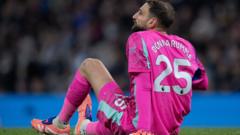
Not for a foul. Not for an offside. The opposing goalkeeper has sat down. He isn’t clutching a hamstring or grimacing at a twisted ankle. He is simply sitting. He calls for the trainer. He points vaguely at his boot, or perhaps his calf. The stadium air, once vibrating with the roar of eighty thousand people, curdles into a frustrated hum.
This is the "tactical timeout," a phantom injury designed to kill momentum. It is a sixty-second heist of time. And it has just been sentenced to death.
FIFA’s decision to scrub these manufactured pauses from the World Cup is more than a simple rule change. It is an attempt to reclaim the soul of a game that was always meant to be an exercise in suffering.
The Architecture of a Fake Cramp
Football is a game of flow. It relies on the slow accumulation of fatigue—the way a defender’s legs grow heavy in the 70th minute, the way a midfielder’s peripheral vision begins to blur, the way a striker finds that extra half-yard of space because his marker is gasping for air. This exhaustion is the crucible where greatness is forged.
When a goalkeeper fakes an injury to stop the clock, they aren't just getting treatment. They are resetting the biological clock of twenty-one other players.
Consider a hypothetical scenario: England is down 1-0 against a relentless Brazilian side. The Brazilians are a tidal wave. They are moving the ball with a one-touch rhythm that is impossible to track. The English defenders are red-faced, their hands on their knees during every throw-in. They are breaking.
Suddenly, the Brazilian keeper goes down.
The medical bag comes out. The spray is applied. The English players walk to the touchline. they drink water. They breathe. Their heart rates drop from 180 beats per minute to a manageable 120. The adrenaline spike levels out. When the game restarts three minutes later, the Brazilian "wave" has vanished. The rhythm is broken. The chaos has been replaced by order.
FIFA’s new directive is a blunt instrument for a delicate problem. Referees are now instructed that unless a goalkeeper has suffered a clear, traumatic head injury or an obvious bone-breaking collision, the game continues. If the keeper needs a lace tied or a "cramp" rubbed out, they must do it while the ball is in play, or they must leave the field.
The message is clear: if you can sit down, you can keep playing.
The Invisible Stakes of the Clock
We often talk about "added time" as if it’s a fair exchange. If a keeper wastes four minutes, the fourth official adds four minutes. Math solved.
But the math of human emotion doesn't work that way.
Time in football is psychological. There is a specific kind of pressure that exists when the clock shows 88:00 and you are chasing a goal. That pressure creates mistakes. It forces a defender to lung when he should stand off. It makes a goalkeeper hesitate.
By allowing tactical timeouts, the game was essentially giving teams a "Save" button in a video game. It allowed them to pause the pressure right when it became unbearable. This didn't just affect the players; it robbed the fans of the very thing they pay to see: the spectacle of a human being cracking under the weight of the moment.
Watch the tapes of the 2022 World Cup. You will see it everywhere. Goalkeepers falling to the turf the moment their team loses control of the midfield. It became a coached behavior. It was cynical. It was effective. And it was boring.
FIFA has realized that "effective but boring" is a death sentence for a global product. They are shifting the burden of fitness back onto the athlete. No more hidden breaks. No more manufactured breathers.
The Cost of Pure Continuity
There is a dark side to this, of course.
If we remove the ability to pause, we increase the physical toll on players who are already playing too many games in a year. We are asking for more sprints, more high-intensity bursts, and less recovery. We might see more genuine injuries because players are denied those thirty-second windows to catch their breath.
But sport has never been about safety in its purest form. It is about the limit.
When we look back at the greatest moments in World Cup history, they rarely happen in the first ten minutes. They happen in the dying embers of the match, when the structure of the teams has collapsed due to sheer exhaustion. Diego Maradona’s second goal against England in 1986 wasn't just a display of skill; it was a display of a man moving through a field of defenders who were too tired to catch him.
If Maradona had tried that run today, a modern goalkeeper might have simply sat down at the halfway point of his dribble. The referee would have blown the whistle. The moment would have withered on the vine.
By banning these timeouts, the authorities are betting on the "unfiltered" version of the sport. They want the chaos. They want the mistakes. They want the player who is so tired he can barely stand to be the one who has to decide the game.
The New Reality in the Tunnel
Imagine standing in the tunnel before the opening match of the next World Cup.
The goalkeeper looks at the referee. Usually, there is a silent understanding—a professional courtesy. "If I go down, give me a minute."
Not anymore.
The referee’s eyes now say something different. They say that the pitch is a vacuum. Once the whistle blows, you are on your own. If your lungs burn, let them burn. If your laces come undone, pray the ball stays at the other end of the field. If you feel the pressure mounting, you have no escape valve.
This change turns the goalkeeper back into what they were always supposed to be: the last line of defense, not the master of ceremonies. They can no longer dictate the tempo of the universe from their six-yard box.
The game is returning to its roots as a test of endurance. We are going back to a world where the clock is an enemy that cannot be bargained with.
The sixty-second breath is gone. What remains is ninety minutes of relentless, un-paused reality.
As the sun sets over the next host city, and the lights hum to life, the players will realize that there is no help coming from the bench or the medical bag. The game will flow until it ends, and the only way to stop the pressure is to win the ball.
The theater of the fake injury has closed its doors.
Now, we play.