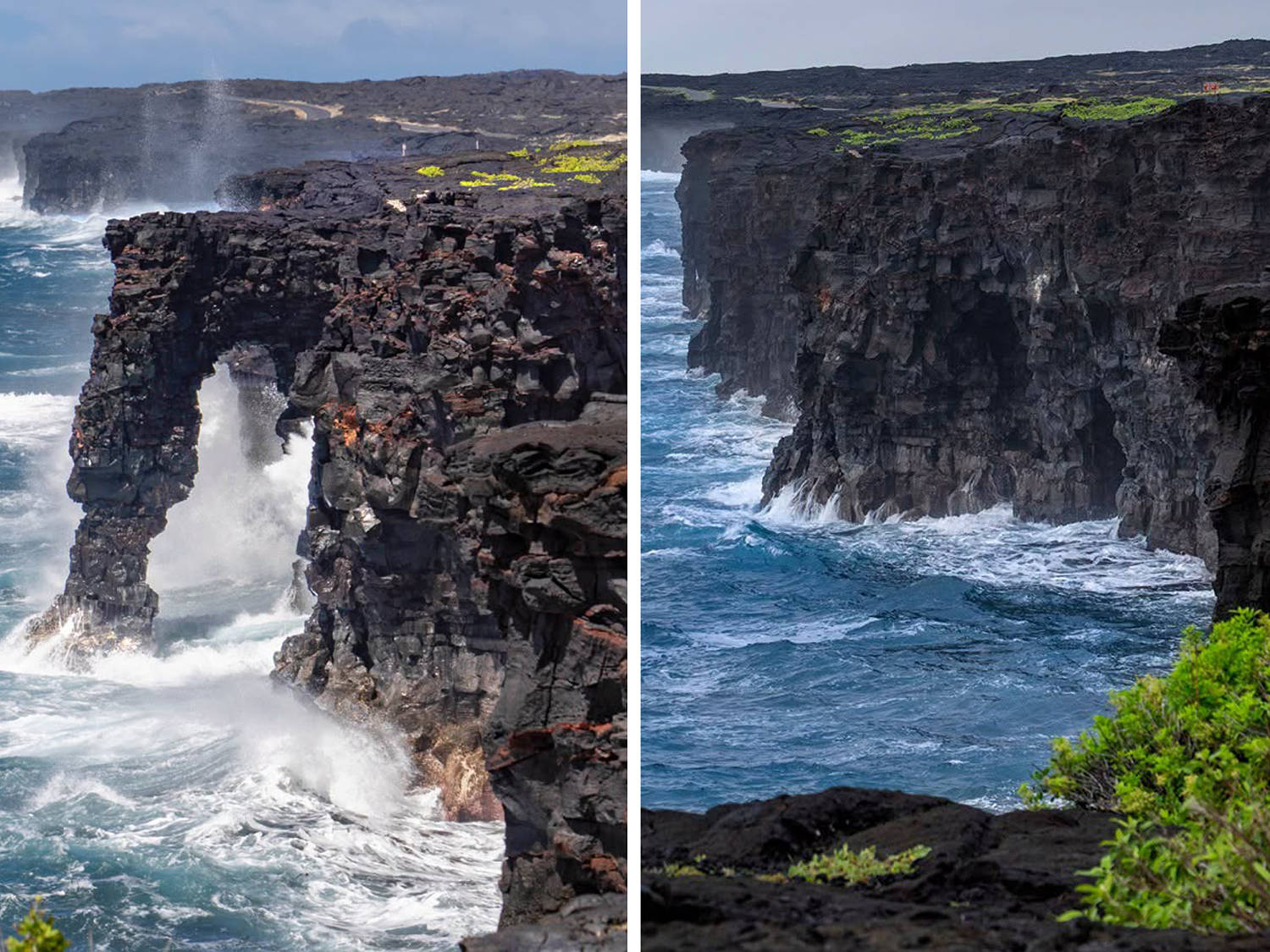
The sea collapses quietly before anyone is watching. On a remote stretch of Hawaii Volcanoes National Park, the famous Holei Sea Arch finally gave way, plunging into the Pacific Ocean and erasing a geologic landmark that had stood against relentless wave action for centuries. Park visitors noticed the sudden absence on August 1, 2024, when ranger patrols confirmed that the slender basalt span connecting the sheer cliff to the sea had snapped.
For decades, the arch served as a mandatory photo stop for tourists driving down the end of Chain of Craters Road. It was a picturesque monument to the creative and destructive forces of Kilauea volcano, carved from lava flows that hardened centuries ago. But its sudden disappearance is more than a sentimental loss for travelers. It marks a brutal acceleration of coastal erosion along an island chain that is literally washing away beneath our feet.
Geologically speaking, sea arches are temporary architecture. They represent a brief, middle phase in the relentless lifecycle of marine erosion. Ocean waves hammer against weaknesses in coastal headlands, gouging out sea caves until the water breaks through to the other side. This creates an arch. Eventually, gravity and constant hydraulic pressure win the argument. The roof grows too thin, the foundation undercuts, and the span collapses into a rubble pile of sea stacks and submerged debris.
Yet the collapse of the Holei Sea Arch happened against a backdrop of compounding environmental stress. Sea levels around the Hawaiian Islands are rising faster than the global average, a byproduct of thermal expansion and melting polar ice coupled with regional oceanographic shifts. Higher water levels mean that storm surges reach higher up the cliff faces, attacking sections of basalt that evolved to handle less aggressive wave energy. When you combine rising tides with the constant thermal shock of hot volcanic rock meeting cold seawater, the erosion clock shifts from geological time to human time.
Visitors often romanticize the raw power of nature in Hawaii, viewing active lava flows and crumbling cliffs as thrilling spectacles. The reality is far less cinematic. The park service has spent millions of dollars over the decades trying to manage the infrastructure leading to these natural wonders. Chain of Craters Road itself is a testament to futility. Original sections built in the mid-twentieth century lie buried beneath dozens of feet of fresh pahoehoe lava from Kilauea's historic eruptions. Engineers learned early on that fighting the volcano is a losing battle. Now, they are discovering that fighting the ocean is equally impossible.
When the arch collapsed, it did not happen in a vacuum. Just weeks prior, scientists recorded accelerated retreat rates along the southern flank of the Big Island. The basalt here is young, porous, and heavily fractured. Unlike the ancient, weathered cliffs of Kauai or Oahu, the southern coastline of Hawaii Island is built from unstable basalt layers that cool rapidly and shatter under mechanical stress. Each tropical storm pushing out of the South Pacific delivers swells that strip away tons of sediment and rock in a single afternoon.
The loss of the arch strips away a vital visual benchmark for how fast this coast is changing. Tour operators and park naturalists relied on the formation to explain coastal geomorphology to millions of visitors. Now, guides must point to an empty expanse of gray water and jagged shoreline, explaining that the geologic record is erasing itself in real time.
Local communities along the Puna district understand this vulnerability intimately. They lived through the devastating 2018 lower Puna eruption, which obliterated entire neighborhoods and reshaped the coastline miles down the road. For residents who watched their ancestral lands swallowed by molten rock, the collapse of a rock bridge feels like a minor footnote. But geologists argue that both events point to the same underlying truth. The landscape is dynamic, volatile, and profoundly indifferent to human permanence.
Tourism models built around static attractions face a severe reckoning. Travel itineraries marketed to people seeking timeless tropical paradises must now contend with an ecosystem in rapid transition. When a major landmark vanishes overnight, it shatters the illusion of permanence that underpins the state's tourism marketing. Visitors arrive expecting postcard stability, only to find a coastline actively dismantling itself.
Mitigation options are virtually nonexistent. You cannot shore up a sea arch with concrete or inject grout into a thousand feet of unstable sea cliff pounded by twenty-foot swells. Nature dictates the terms on this coastline. The best the National Park Service can do is adjust viewing areas back from the edge, update interpretive signs to reflect the new geography, and watch as the next headland begins the inevitable process of becoming a sea cave, then an arch, and finally, memories at the bottom of the sea.
The ocean has already begun chewing away at the remaining stub of the cliff where the Holei Sea Arch once anchored. New arches are forming elsewhere along the remote Puna and Kau coasts, hidden from the highway, waiting for the day their roofs too thin out and give way. The water keeps rising. The waves keep breaking. The basalt keeps yielding.