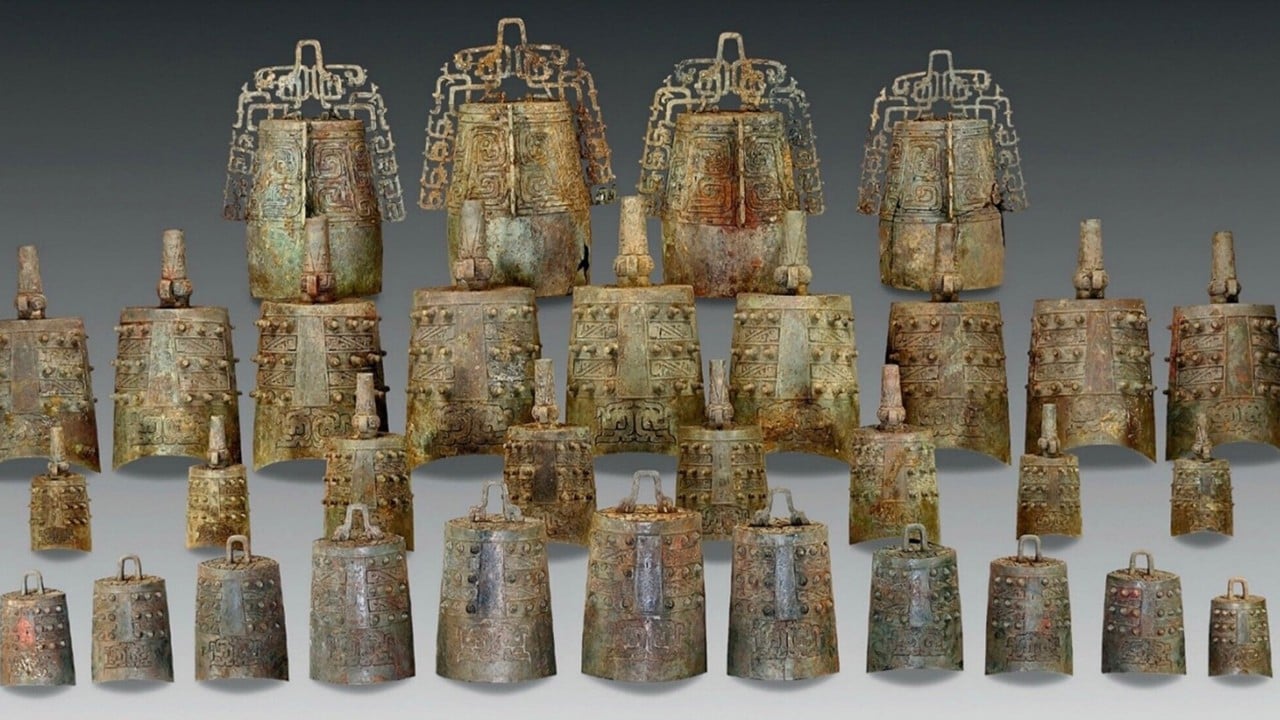
In 656 B.C., Lord Qiu of the ancient state of Zeng faced an existential military crisis. Situated in a volatile geographic bottleneck between the Yangtze River and the core territory of the Zhou dynasty, the minor state of Zeng was directly exposed to the aggressive southward expansion of the Chu state. To survive, the ruler of Zeng did not merely mobilize troops; he commissioned a highly specialized set of bronze bells (Zeng Gong Qiu bianzhong) explicitly engineered to invoke ancestral intervention and neutralize the Chu military threat.
Yet, when archaeologists recently opened Lord Qiu’s intact 2,600-year-old tomb at the Zaoshulin Cemetery in Hubei province, they did not find these sacred instruments proudly mounted on display. Instead, they uncovered a scene of calculated, systematic destruction: the heavy, ornate bells lay scattered across the floor of the burial chamber, their massive wooden suspension frames shattered and strewn about.
This was not the chaotic work of tomb raiders. Because the grave’s other valuable treasures remained untouched, the physical state of the burial chamber points to a deliberate ritual act carried out by Lord Qiu’s own family during his funeral. This systematic disruption reveals a sophisticated understanding of spiritual technology, where ritual objects were not treated as passive, symbolic art, but as active metaphysical machinery that had to be physically deactivated when geopolitical realities shifted.
The Mechanics of Bronze as Ritual Technology
To understand why Lord Qiu’s mourners scattered these artifacts, we must first reconstruct the operational framework of Bronze Age ritual systems. In the Eastern Zhou dynasty, bronze vessels and musical bells did not merely represent wealth; they functioned as trans-dimensional communication portals.
[System Input: Human Performance/Invocations]
                     │
                     ▼
           [The Resonant Bell Set]
 (Acoustically Calibrated & Inscribed Bronze)
                     │
                     ▼
[System Output: Ancestral Activation / Protection]
This spiritual technology relied on three core variables:
- Acoustic Transmitters: The bells were cast as complex, bi-tonal instruments. When struck, they produced precise pitches designed to mimic "ornithomorphic" or bird-like sounds. These specific frequencies were believed to be the only linguistic medium capable of traveling to the heavenly realms to capture the attention of ancestral spirits.
- The Inscribed Ledger: Cast directly into the bronze, the inscriptions served as a permanent, physical record of the ruler's appeals. On Lord Qiu’s bells, the text praised his powerful ancestors, acknowledged his humble status as a "little child" seeking virtue, and explicitly requested direct military intervention against the state of Chu.
- Structural Resonance: The spiritual efficacy of the system was entirely dependent on its structural integrity. The bells could only "speak" to the spirit world when hung in precise, harmonious order from their wooden racks. Without the frame, the system lost its capacity to broadcast.
The Geopolitical Shift and the Redundant System
Between the time Lord Qiu commissioned the war bells and the day he died, the geopolitical landscape changed completely. The existential threat from Chu was solved not through military victory, but through a diplomatic marriage alliance: the King of Chu married his sister to Lord Qiu.
This alliance created a severe metaphysical crisis for Lord Qiu's heirs. The state of Chu was no longer an enemy; it was now a key political ally.
Because the ancient Chinese viewed deceased ancestors as active participants in ongoing political affairs, burying Lord Qiu with fully functioning war bells would have carried disastrous consequences. Had Lord Qiu entered the afterlife with an active, permanently broadcasting system designed to summon ancestral wrath against Chu, he would have risked triggering a spiritual war. This metaphysical conflict could have shattered the earthly peace, invalidated the royal marriage, and brought down ruin upon the living state of Zeng.
Systematic Deactivation: The Funeral Ritual as a Kill Switch
To mitigate this risk, Lord Qiu’s mourners did not discard the expensive bronze. Instead, they executed a precise, multi-step decommissioning process during the funeral rites:
1. Destabilizing the Frame
The mourners systematically dismantled the wooden suspension rack. By shattering the timber and scattering the fragments throughout the burial chamber, they severed the structural loop required for the bells to function as a coherent, resonant unit. Without the rack to hang them on, the bells were physically silenced, permanently cutting their connection to the ancestors.
2. Dispersing the Chimes
Rather than storing the bronze pieces neatly, the mourners scattered the bells across the floor in a deliberate state of disorder. This calculated disarray disrupted the sacred geometry of the chime set, ensuring that even if a wandering spirit attempted to use them, the system's harmonious alignment was permanently broken.
3. Deploying a New System
To ensure Lord Qiu was not left entirely without spiritual support in the afterlife, his family placed a second, smaller, and simpler set of bronze bells in the tomb. In contrast to the scattered war bells, this second set was found stacked neatly and oriented in parallel lines toward the southeast.
The inscriptions on this newer set contained no mention of military conflict or the state of Chu. Instead, they were designed strictly for peaceful afterlife rituals.
Archaeological Implications
The deliberate deactivation of Lord Qiu's bells challenges a long-standing assumption in archaeology. For decades, when researchers discovered disordered, broken, or scattered ritual objects within ancient Chinese tombs, they routinely attributed the mess to grave robbers or ancient vandalism.
The integrity of Lord Qiu’s tomb proves that ritual deactivation was a recognized political and spiritual tool. It demonstrates that ancient societies did not view sacred objects as static heirlooms. Instead, they managed them like active, powerful systems—tools that had to be carefully monitored, updated, or decommissioned to protect the living from the unintended consequences of their own spiritual technology.