The sound of water at three o'clock in the morning is different when it belongs to the sea. It is not the gentle patter of rain on a zinc roof, nor the rhythmic lullaby of a distant tide. It is a low, guttural growl. It vibrates through the floorboards, rattles the teacups in the cupboard, and settles deep into the marrow of your bones.
For generations, if you lived in the lowlands of the Netherlands, that sound meant one thing. Panic. Recently making headlines lately: The Anatomy of Marine Incident Response: A Brutal Breakdown of the Phu Quoc Speedboat Capsize.
You grabbed the children. You grabbed the family ledger. You ran for the high ground, praying the earthen dikes built by your grandfathers would hold against the brown, bloated fury of the Rhine or the Meuse. Most of the time, they did. But when they didn't, the world ended.
We spent nearly a thousand years building walls. We treated the water as an invading army, an apex predator that needed to be caged, channeled, and conquered. We poured billions into concrete, steel, and hubris. We boasted to the world that God created the Earth, but the Dutch created the Netherlands. Further information regarding the matter are covered by Associated Press.
Then came 1993. Then came 1995.
The walls failed. Not because they broke, but because the world had changed. The rivers grew too heavy, too fast, swollen by heavy rains and melting Alpine snow. Two hundred and fifty thousand people were forced to flee their homes, driving their cattle down flooded lanes, leaving everything behind.
It was a wake-up call wrapped in a disaster. We realized that our ultimate weapon—the dike—was actually a trap. By squeezing rivers into narrow, artificial channels to protect farmland and expanding cities, we had turned them into high-pressure water cannons. The higher we built the walls, the catastrophic the eventual failure would be.
We had to do something unthinkable. We had to surrender the land to save the people.
The Geography of Fear
To understand the sheer madness of what we did next, you have to understand what it feels like to live below sea level. Imagine walking down a street where the hulls of passing cargo ships glide by at the level of your second-story window. That is life in the polders.
For centuries, our response to this vulnerability was absolute control. If a river threatened a town, we built a wall. If the wall wasn't enough, we built a bigger wall.
But rivers are living things. They need to breathe. They need to stretch. When you deprive a river of its natural floodplain, the water has nowhere to go but up.
Consider a hypothetical farmer named Bram. For four generations, Bram’s family worked a patch of dark, fertile soil along the Waal River. The land was his identity. It was his retirement. It was the place his children took their first steps. Now, imagine a government official sitting at Bram’s kitchen table, drinking coffee from a mismatched mug, telling him that the state is going to buy his farm. Not to build a highway. Not to build a shopping mall.
They wanted to tear down the dike, flood his fields, and let the river swallow his history.
"We are giving the river more room," the official says.
Bram looks out the window at the land his grandfather cleared by hand. To him, it doesn't sound like a visionary engineering project. It sounds like treason.
The Grand Bargain
This was the genesis of Ruimte voor de Rivier—Room for the River. It was a radical detour from everything Dutch engineering had stood for since the Middle Ages. Instead of fighting the water, we decided to invite it in.
The budget was astronomical: over two billion euros. The scope was staggering: thirty-nine distinct locations across the country targeted for major structural changes. But the financial cost was nothing compared to the human cost.
We weren't just moving dirt; we were moving communities.
The strategy relied on a few deceptively simple concepts. We lowered floodplains. We relocated dikes further inland, creating wide, empty channels where the river could safely spill over during peak flows. We dug side channels to give the water a detour around major bottlenecks.
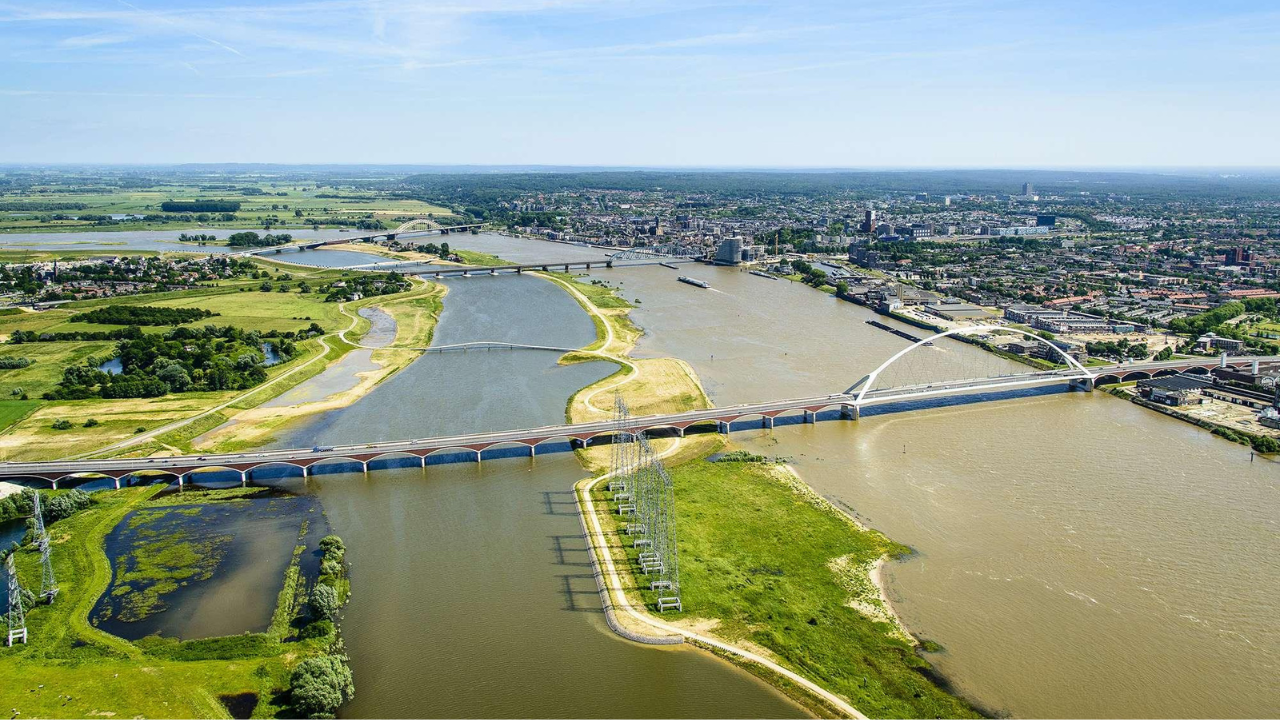
In the historic city of Nijmegen, the challenge was terrifying. The Waal River made a sharp, narrow turn right at the city’s historic center. It was a massive bottleneck. If the river rose too high, Nijmegen would become an aquarium.
The solution? The city decided to move an entire dike three hundred and fifty meters inland. This meant demolishing fifty homes. It meant erasing an entire neighborhood to dig a massive, secondary channel, effectively turning a chunk of the city into an artificial island.
The protests were fierce. The anger was real. People don't care about macroeconomic resilience or hydrologic modeling when it's their living room being bulldozed.
The turning point came when the engineers stopped talking like engineers. They stopped showing spreadsheets and started listening to stories. They sat in those threatened living rooms. They adjusted the plans to save a historic farmhouse here, an old orchard there. They promised that this sacrifice would create something beautiful.
When the Experiment Met the Storm
For years, critics scoffed. They looked at the vast, empty parks, the newly created wetlands, and the expensive side channels that sat dry and useless during the summer months. They called it an expensive playground for environmentalists. They wondered if we had lost our collective minds.
Then came the summer of 2021.
A catastrophic weather system stalled over Western Europe. In a matter of days, two months’ worth of rain fell on Germany, Belgium, and the southern hills of the Netherlands. Small streams turned into raging torrents in hours.
In Germany and Belgium, the results were horrific. Entire villages were wiped off the map. Houses collapsed like cardboard boxes. More than two hundred people lost their lives in a matter of days. The water was relentless, unpredictable, and deadly.
As the crest of that historic flood moved down the Meuse and the Rhine toward the heart of the Netherlands, the country held its breath. The volume of water entering the Dutch river system was unprecedented. It was the exact scenario the Room for the River project had been designed to handle.
This was the moment of truth.
What happened next felt like a miracle, though it was actually just very good physics.
As the wall of water hit the Dutch border, it didn't smash through dikes or submerge cities. Instead, it quietly, smoothly spilled sideways.
It filled the lowered floodplains. It poured into the empty side channels we had spent a decade digging. In Nijmegen, the new Spiegelwaal channel filled to the brim, turning the city’s new island into a temporary shield. The water rose, yes, but it spread out over thousands of acres of designated, empty land instead of rushing into the basements of millions of homes.
The water rose to the very edge of our expectations, paused, and then began to recede.
While our neighbors were mourning their dead and shoveling thick, toxic mud out of their ruined schools, the Dutch were walking their dogs along the edges of the newly created lakes. Children were watching the high water from the safety of the relocated dikes, eating ice cream.
The system had worked perfectly. Not a single life was lost. Not a single home was flooded in the project areas.
The New Reality
Today, if you visit the places where the rivers were given room, you won't see a landscape of industrial concrete barriers or sterile flood walls. You will see nature.
The areas that double as safety valves during the winter are vibrant regional parks during the summer. They are filled with kayakers, hikers, and wild Konik horses roaming the wetlands. We traded concrete for reeds, and fear for flexibility.
We learned a hard, beautiful lesson through this experiment. You cannot defeat nature with an iron fist. It has more time than we do, and it possesses an infinite capacity for violence when cornered. True resilience doesn't come from building bigger walls; it comes from knowing when to step back, how to yield, and where to make space.
The next time the dark water rises at three o'clock in the morning, the growl will still be there. It will always be there. But the people sleeping behind the dikes won't reach for their ledgers, and they won't grab their children in terror.
They will simply turn over, listen to the river reclaim its ancient territory for a day or two, and go back to sleep.