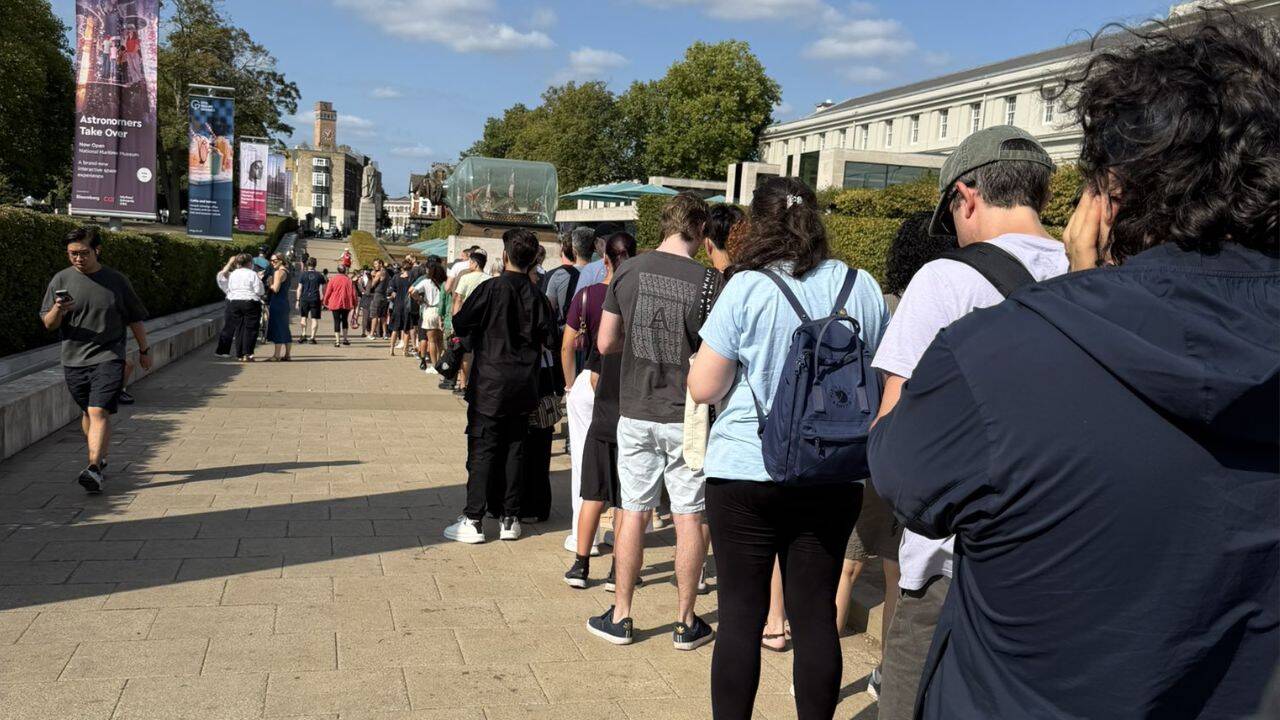
The queue outside the optician in central London wrapped around the corner and dissolved into the grey drizzle of a Tuesday morning. It looked like a line for bread in a winter of scarcity. It looked like a queue for tickets to a ghost train.
Instead, people stood shoulder-to-shoulder in the damp air waiting for a strip of cardboard and polymer.
They held wet umbrellas. They clutched damp banknotes. They checked their watches with a jittery urgency that usually belongs to airport security gates or maternity wards. In their pockets, smartphones buzzed with breaking alerts, transit delays, and frantic messages from cousins in Cornwall and office workers in Leeds.
A solar eclipse was coming. And the island had run out of glass.
The Scramble for the Sky
To understand the frantic scramble that gripped the United Kingdom, you have to look past the logistics and peer into human neurology. We are creatures tethered to routine. We wake, we commute, we type into screens, we buy overpriced coffee, we complain about the weather. The sky is just a ceiling of variable grey. It is background noise.
Until it isn't.
When the moon slips precisely between the Earth and the sun, a cosmic geometry plays out overhead that has terrified kings and inspired poetry since humanity first gathered around fires. We know the science. We can calculate the orbits down to a millisecond. We understand gravitational mechanics, corona discharge, and eye safety standards.
Yet, when the shadow starts to eat the light, the ancient lizard brain wakes up.
By midday, shelves across high-street pharmacies and museum gift shops were barren. Online retailers reported inventory vanishing at a rate of thousands of units per minute. Prices on secondary auction sites spiked tenfold for a pair of paper-framed solar viewing filters that cost less than a cup of tea to manufacture.
Drivers parked illegally on motorway hard shoulders, risking fines and disaster, just to catch a glimpse of the twilight noon. Supermarket carparks transformed impromptu viewing platforms. People leaned against delivery vans and tilted their heads back with cardboard strapped to their faces, looking like a crowd of blindfolded time travelers.
The Invisible Stakes
Why do we panic-buy darkness?
Part of the answer lies in our desperate need for a shared interruption. Modern life is hyper-fragmented. We inhabit algorithmic silos, streaming our own shows, listening to our own playlists, working remote jobs in solitary rooms. We rarely experience anything truly collectively anymore, save for the occasional football final or national tragedy.
An eclipse offers something else. Awe.
Psychologists call it the overview effect on a local scale, or simply the awe response. When confronted with vast, incomprehensible scales, our self-absorption shrinks. The petty worries of mortgages, deadlines, and political squabbles temporarily dissolve in the sudden, eerie drop in temperature. The birds stop singing. The streetlights flicker on at noon. The shadows cast on the pavement sharpen into strange, crescent-shaped crescendos.
For a few minutes, everyone is looking at the exact same miracle.
That is why people stood in the rain for three hours. They weren't just buying safety certification ISO 12312-2. They were buying permission to stop. They were purchasing a ticket to a planetary event that promised to remind them they lived on a spinning rock hurtling through an indifferent void.
The Cost of Looking Away
Of course, the physical stakes are real. Ophthalmologists spent the days leading up to the event issuing stern, frantic warnings. Staring at the sun without proper filtration is a quick route to solar retinopathy, a painless burning of the macula that can leave permanent blind spots in your vision.
The human eye is remarkably vulnerable. It trusts. It assumes the light is friendly.
When the sun is ninety-nine percent obscured, the ambient light drops enough to trick the pupil into dilating, letting in a flood of invisible, destructive ultraviolet and infrared radiation during the brief moments before totality or during a partial phase. You don't feel it happening. There are no pain receptors in the retina. You only notice the damage the next morning, when the center of your vision is smudged with a permanent, grey ghost stamp.
This creates a strange psychological tension. The urge to look up clashes with the biological penalty for doing so. We require artificial armor—a sliver of aluminized polyester—to witness the naked universe.
We live behind glass screens all day, yet we needed a different kind of glass entirely just to look at the oldest screen of all.
The Quiet Aftermath
As the shadow drifted eastward across the North Sea, leaving the British Isles to return to its standard, dependable drizzle, the queues evaporated. The discarded cardboard glasses littered the gutters like autumn leaves. Commuters stuffed them into coat pockets, folded them into wallets, or tossed them into recycling bins with the casual indifference of yesterday’s newspaper.
Traffic crawled back to normal speeds. The stock market reopened. Emails piled up in unread inboxes.
Yet, for a brief window, the rigid machinery of modern existence had jammed. Millions of people had paused in unison, squinting through cheap plastic film at the ancient dance of spheres, reminded of the fragile, temporary nature of the light by which we measure our lives.
The glasses were gone. The shelves were empty. But the sky remained overhead, vast, quiet, and waiting for the next time the world decided to look up.


