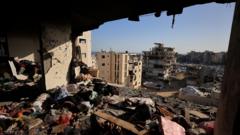
Standard conflict reporting has degenerated into a predictable spreadsheet exercise. A strike occurs in Gaza City. Eleven people are reported dead by local medics. The wire services copy and paste the casualty figures, attach a boilerplate paragraph about regional tensions, and move on to the next alert.
This is not journalism. It is bookkeeping masked as analysis.
By focusing entirely on the immediate, tragic calculus of daily body counts, mainstream media coverage completely misreads the strategic reality of modern urban warfare. The lazy consensus insists that every kinetic strike is merely a isolated incident of violence or a retaliatory reflex. It frames the conflict through a narrow humanitarian lens while ignoring the colder, systemic chess game being played beneath the rubble.
If you want to understand where this crisis is actually heading, you have to stop looking at the daily death tolls and start looking at the structural shifts in logistics, territorial control, and asymmetric leverage.
The Flaw of Liquid Metrics
In any high-stakes conflict, relying on immediate casualty reports to measure operational success or failure is a fundamental analytical error. Analysts call this the "kinetic fallacy"—the belief that causing physical damage or eliminating specific personnel automatically translates to achieving a strategic objective.
When a strike hits an urban center like Gaza City, the immediate data points are almost always flawed, unverified, or weaponized for information warfare.
- The Identification Problem: Local medical sources routinely conflate combatants with non-combatants in their initial tallies. This is not just a clerical error; it is a deliberate obfuscation designed to maximize international outrage.
- The Tactical Echo: A single strike is rarely an isolated event. It is usually the tail end of a long intelligence-gathering cycle aimed at disrupting command networks, subterranean supply lines, or weapon manufacturing cells.
- The Strategic Vacuum: Counting bodies tells us nothing about whether the striking force achieved its actual goal—such as degrading an adversary's ability to launch future attacks—or whether it inadvertently accelerated its own diplomatic isolation.
I have watched defense analysts and risk management firms burn through millions of dollars trying to predict geopolitical outcomes by aggregating daily strike data. It fails every single time. Why? Because they are measuring the noise, not the signal.
The Reality of Urban Attrition
To truly comprehend the dynamics of the Gaza conflict, we must look past the headlines and dissect the brutal mechanics of siege warfare and urban counterinsurgency.
Modern military doctrine, from the U.S. Army's asymmetric warfare guides to Israeli defensive strategies, recognizes that urban terrain is the ultimate equalizer for an insurgent force. In a densely populated environment, traditional military superiority is neutralized. Every alleyway is a choke point; every apartment building is a potential defensive fortification.
Therefore, kinetic strikes are not designed to capture territory in the traditional sense. They are designed to do three things:
1. Shape the Terrain
Air and artillery strikes physically alter the geography of the battlefield. By collapsing specific structures, forces can block transit routes, create clear lines of sight for surveillance, and force adversarial fighters into designated kill zones. The destruction is rarely random; it is highly engineered spatial management.
2. Force Communications Exposure
When a command node is disrupted, the surviving elements must communicate to regroup. This sudden spike in electronic and human communication allows signals intelligence to map the broader network. A strike that kills eleven people today is often just the bait used to intercept the communications that will target a hundred more tomorrow.
3. Resource Depletion
Asymmetric forces rely heavily on hidden stockpiles of fuel, ammunition, and food. Constant bombardment forces the consumption of these finite resources at an unsustainable rate, breaking the logistics of the defense without requiring a costly block-by-block infantry advance.
A Lesson from History: During the Battle of Mosul in 2016-2017, early international reporting focused heavily on the staggering civilian toll and the slow pace of the coalition advance. The mainstream consensus predicted a permanent quagmire. What they missed was the systematic, quiet degradation of ISIS's logistical backbone across the Nineveh Province, which ultimately led to the sudden, total collapse of their defense.
Dismantling the Mainstream Premise
Let us address the questions that routinely flood search engines and opinion columns, usually built on completely flawed premises.
Does international condemnation stop military operations?
The short answer is no. Mainstream reporting operates under the assumption that if the human cost of a strike is publicized enough, it will force a ceasefire. This ignores the internal political calculus of the warring parties. For a state actor facing what it perceives as an existential security threat, the long-term risk of inaction far outweighs the short-term cost of diplomatic friction or negative press.
Why do strikes continue when civilian casualties are inevitable?
The prevailing narrative chalks this up to either malice or incompetence. The colder reality is found in the military principle of proportionality under international humanitarian law. This principle does not forbid civilian casualties; it states that the incidental loss of civilian life must not be excessive in relation to the concrete and direct military advantage anticipated. When a high-value target—such as a senior commander or a major munitions depot—is identified inside a civilian area, the perceived military advantage shifts the operational calculation. Accepting this grim logic is essential to understanding why the bombs keep falling, regardless of global public opinion.
The Hidden Cost of the Contrarian View
It is easy to sit in an air-conditioned office and reduce a conflict zones to vectors, logistics, and strategic trade-offs. But realism has its own blindspots, and any honest analysis must acknowledge them.
The primary risk of focusing solely on structural mechanics is that you can easily miscalculate the breaking point of human endurance. While a military strategy may successfully degrade an adversary's physical infrastructure, it can simultaneously radicalize the surviving population, creating an endless supply of recruits for the next iteration of the conflict. You might win the tactical engagement in Gaza City today, only to guarantee another war five years down the line.
Furthermore, relying strictly on hard military metrics ignores the economic fallout. The long-term cost of maintaining a high-tempo military campaign—coupled with the degradation of international trade partnerships and foreign investment—can hollow out a nation's economy from the inside out, turning a series of tactical victories into a strategic defeat.
Shift Your Analytical Framework
Stop reading the news to feel vindicated or outraged. Stop treating casualty reports as a scoreboard that indicates who is winning or losing.
If you want to understand the true trajectory of the conflict in Gaza, delete the bookkeepers from your feed and start asking the hard structural questions:
- How are the underground supply corridors across the border being managed or disrupted?
- What is the current operational capacity of the adversary's short-range rocket inventory?
- How is the domestic political stability of the attacking nation holding up under prolonged mobilization?
The answers to these questions cannot be found in the daily dispatches from Gaza City medics. The real determinants of geopolitical outcomes are silent, structural, and completely ignored by the cameras. Look where the cameras aren't pointing. That is where the war is being decided.


