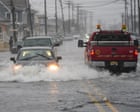
When the wind shrieks off the Atlantic and drives sheets of freezing rain against the eastern seaboard, meteorologists reach for familiar shorthand. They call it a Nor'easter. To the public, it sounds like an act of atmospheric violence, a wrathful weather event scripted by nature to humble human ambition from the Carolinas up to Maine.
Yet reality is far more mundane and far more damning. The storm that recently battered the US East Coast, plunging hundreds of thousands into darkness and paralyzing regional transit, was not an unprecedented meteorological anomaly. It was a well-documented seasonal cycle. What turned a standard autumn gale into a systemic crisis was not the velocity of the wind or the volume of the precipitation. It was the chronic, deliberate underinvestment in the structural foundations of regional power grids and municipal drainage systems.
For decades, utility monopolies and municipal planners have treated grid hardening as an expensive luxury rather than an operational necessity. They rely on aging poles, unburied transmission lines, and reactive maintenance cycles that kick into gear only after the transformers blow. When the gales hit, the failure points were entirely predictable. They were plotted out in engineering reports gathering dust in municipal basements across New York, Boston, and Philadelphia.
To understand why a routine coastal storm can still bring the world's most sophisticated financial and industrial corridor to a shuddering halt, we have to look past the dramatic footage of downed power lines and flooded coastal roads. We have to examine the balance sheets of the private utilities charged with keeping the lights on.
The Economics of Deferred Maintenance
Electricity delivery in the American northeast is governed by a patchwork of investor-owned utilities. These corporations answer primarily to shareholders who demand steady quarterly dividends and predictable capital expenditure returns. Hardening a distribution grid against a one-in-fifty-year storm requires billions of dollars in upfront capital. Undergrounding distribution lines, clearing wide corridors of aging canopy trees, and installing smart-grid switching gear yield little immediate financial return on investment during calm weather.
Consequently, maintenance budgets are routinely trimmed at the margins. Vegetation management programs—the systematic trimming of tree branches away from medium-voltage lines—are stretched from a three-year cycle to a five- or six-year cycle to save operational cash. When a Nor'easter arrives with saturated ground and gale-force gusts, those overhanging limbs become battering rams.
The financial calculus of the modern utility model creates a perverse incentive structure. Under current regulatory frameworks, utilities are often permitted to pass the exorbitant costs of post-storm emergency restoration directly back to ratepayers through temporary rate hikes or storm recovery riders. In effect, the consumer pays twice. They pay for the chronic neglect through routine service fees, and they pay again through emergency surcharges when the inevitable storm knocks out the grid.
When millions of residents lost power during the recent gale, utility executives appeared on local news broadcasts to lament the "unprecedented ferocity" of Mother Nature. They praised the tireless dedication of line crews working in bucket trucks through the freezing rain. That praise is entirely deserved for the workers on the ground. But it serves as a convenient rhetorical shield for executive suites that deferred the infrastructure updates which could have prevented widespread outages in the first place.
Cascading Failures in Regional Transit
A grid failure never remains localized to home lighting and refrigerator compressors. Modern municipal systems are dangerously interdependent. When the power distribution networks fail, the secondary and tertiary systems unravel within hours.
Consider the commuter rail networks and subway systems that bind the northeast megalopolis together. During the recent storm, overhead catenary wires snapped under the weight of wind-driven ice and falling timber. Signaling systems lost primary power, forcing thousands of commuters onto stranded trains or into gridlocked highway corridors where traffic lights had gone dark due to missing backup generators.
Municipalities have spent decades building glamorous downtown revivals and transit expansions while starving the subterranean and structural life support systems of basic funding. Drainage pumps installed during the mid-20th century were overwhelmed not because the rainfall broke all-time records, but because storm drains clogged with autumn leaves had not been cleared on an aggressive schedule. Public works departments face persistent staff shortages and budget freezes, leaving them incapable of performing routine preventative maintenance before storm season peaks.
The result is a cascading paralysis. A downed tree takes out a suburban substation. That substation trips a regional transit corridor. The transit stoppage forces stranded workers onto local roads, which quickly gridlock because traffic signals lack uninterrupted power supplies. By evening rush hour, a weather event that dropped two inches of rain and produced 50-mile-per-hour gusts had successfully disrupted the economic output of three major metropolitan areas.
The Cost of Reactive Governance
Politicians love a natural disaster. It provides an uncontroversial backdrop for press conferences staged in yellow slickers, where elected officials can project empathy, declare states of emergency, and demand federal disaster relief funds.
Yet declarations of emergency are admissions of governance failure. They signal that the state is permanently trapped in a reactive posture. Federal Emergency Management Agency disbursements and state-level disaster funds are routinely funneled into cleaning up the wreckage rather than reconstructing infrastructure to withstand the next predictable gale.
If a bridge collapses because its steel supports were allowed to rust through, investigators do not blame the river for flowing underneath it. We recognize structural negligence for what it is. Yet when a utility pole snaps because its treated wood core rotted through twenty years ago, we accept the resulting blackout as an act of God.
This double standard protects institutional actors from accountability. State public utility commissions, ostensibly created to protect consumer interests against monopolistic abuse, are frequently captured by the very utilities they regulate. Commissioners cycle through industry lobbyist positions before and after their regulatory service, ensuring that safety mandates remain toothless and financial penalties for preventable outages remain negligible fractions of corporate annual profits.
Reengineering the Seaboard
Fixing the resilience deficit along the East Coast requires abandoning the fiction that these storms are unpredictable anomalies. They are seasonal certainties. The Atlantic basin produces robust low-pressure systems every autumn and winter with mathematical regularity.
Transforming the power delivery network requires regulatory enforcement that treats grid hardening as a non-negotiable public safety mandate. Public utility commissions must tie executive compensation and shareholder return caps directly to reliability metrics and storm recovery speed. If a utility fails to maintain basic vegetation clearance standards, the financial penalty should dwarf the cost of the trimming work they skipped.
Municipalities must stop treating stormwater management as an afterthought. Green infrastructure initiatives, porous pavement installations, and localized microgrids with battery storage capacity can decouple critical services from centralized transmission lines that remain vulnerable to single points of failure miles away.
Until we stop subsidizing corporate negligence through emergency disaster declarations and start enforcing rigorous engineering standards across our energy and transit networks, every Nor'easter will remain a crisis. The wind is simply doing what the wind has always done. The vulnerability is entirely of our own construction.