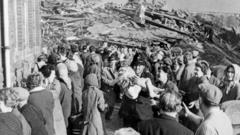
The camera is often described as a shield, a glass barrier that allows a photographer to witness the unthinkable without being consumed by it. But on October 21, 1966, that shield shattered for every journalist who climbed the sodden slopes of Merthyr Vale. When 150,000 tonnes of coal waste liquefied and engulfed Pantglas Junior School, it didn't just kill 116 children and 28 adults; it created a visual trauma that would haunt the British press for over half a century.
Photographers arrived in a town that had gone silent, save for the sound of shovels hitting grit. They were tasked with capturing the "definitive" image of a national tragedy, a demand that forces a cruel trade-off between professional duty and human decency. While the public consumed these images to understand the scale of the National Coal Board’s negligence, the men behind the viewfinders were left to carry the psychological weight of what they had framed, cropped, and flashed into history.
The Myth of the Objective Witness
We like to believe that a photograph is a factual record. In reality, every iconic image of Aberfan was a choice made in a split second of profound grief. For the photographers on the ground, the struggle wasn't just the mud or the rain. It was the ethical vertigo of realizing that a "good shot" required someone else’s worst moment.
The industry rarely discusses the cost of this voyeurism. We celebrate the Pulitzer-winning frame but ignore the man who had to stand over a grieving father to get the lighting right. In the 1960s, there was no vocabulary for Post-Traumatic Stress Disorder. You took your photos, you drove back to Fleet Street, and you drowned the images in Scotch. The haunting isn’t just about the dead; it’s about the guilt of being the one who watched.
Engineering a Disaster through Apathy
The slide wasn't an act of God. It was a predictable consequence of industrial arrogance. For years, the villagers of Aberfan had warned that Tip 7 was unstable. They saw the "slurry" moving. They knew the springs beneath the coal waste were turning the mountain into a ticking bomb.
The National Coal Board, led by Lord Robens, ignored these warnings with a bureaucratic coldness that mirrors the worst corporate scandals of the modern era. When the collapse happened, the initial response from the authorities was defensive rather than repentant. This context matters because it changed the nature of the photography. Journalists weren't just documenting a tragedy; they were collecting evidence of a crime.
Every photo of a mud-caked clock stopped at 9:13 AM was a piece of testimony. The photographers knew this. They felt the pressure to make the world care enough to demand justice. This sense of mission is what kept them clicking, even when their hands shook.
The Mechanics of the Haunting
Why do these specific images remain burned into the collective consciousness? It’s the contrast. The black coal waste against the white shirts of the rescuers. The smallness of the victims against the vastness of the slide.
The Weight of the Unseen
For every photo that made the front page, there are thousands of frames that were never developed or were tucked away in desk drawers. These are the images of the morgue set up in the local chapel, the faces of parents who had reached the end of hope, and the visceral details of a town being buried alive.
Veterans of the Aberfan beat often speak of the smells and sounds that a camera cannot capture. The scent of stagnant water and old coal. The rhythmic "shh" of the rescuers whenever they thought they heard a cry from the rubble. These sensory memories attach themselves to the visual ones, creating a composite trauma that time doesn't heal. It just hardens.
The Evolution of the Grief Industry
Looking back, Aberfan was a turning point for how the media handles mass casualty events. It was one of the first times the "human interest" angle was pushed to its absolute limit. The press stayed for weeks. They followed families to the mass graves. They turned private mourning into a public spectacle.
This set a precedent for the modern news cycle, where the "survivor interview" is a mandatory component of any disaster. But in 1966, the people of Aberfan didn't have the media literacy to protect themselves. They were open, raw, and vulnerable. The journalists who exploited that—even with the best intentions of raising money for the disaster fund—often look back with a sense of predatory shame.
- The Ethical Cost: Is it possible to document a tragedy without exploiting it?
- The Legacy of Negligence: How the NCB's lies forced the media's hand.
- The Psychological Toll: The long-term impact on the first responders and the press.
The Failure of Justice
The ultimate insult to the victims and the men who photographed them was the lack of accountability. No one was fired. No one was prosecuted. The National Coal Board even had the audacity to use £150,000 from the disaster fund—money donated by the public—to pay for the removal of the remaining tips.
This historical footnote is what makes the photos so painful to revisit. They represent a demand for change that was largely ignored by the power structures of the day. When a photographer looks at their famous shot of Aberfan, they don't just see a masterpiece of photojournalism. They see a record of a moment when the world promised "never again" and then looked the other way when the bill came due.
The Darkness in the Development Tank
The process of developing film is a slow reveal. In the 1960s, you didn't see what you had until you were back in the darkroom. For the Aberfan photographers, this was a second trauma. Standing in the red light of the lab, watching the faces of those children emerge from the chemical bath, was like witnessing the disaster all over again in slow motion.
There is no "off" switch for that kind of memory. You can stop being a journalist, but you cannot stop being the person who saw what was under the mud. The lens didn't protect them; it just focused the horror into a sharper, more permanent resolution.
The Long Shadow of Tip 7
The geography of Aberfan has changed, but the scars remain. The tips are gone, replaced by green grass and memorials, yet the town is still defined by those few minutes on a Friday morning. The media’s obsession with the anniversary every ten years ensures that the wound is never allowed to fully close.
We keep returning to these photos because they are the only way we can process the scale of the loss. But we must acknowledge that our need to "remember" is fueled by the lifelong pain of the people who were there. The photographers were the first to tell the story, and they are the last to be able to forget it.
The cameras have long since been put away, the film is archived in temperature-controlled vaults, and the men who pulled the triggers are fading into history. What remains is the realization that some stories don't have a "win." They only have a witness. And being a witness is a life sentence.
The mud has dried, the graves are silent, but the shutter still clicks in the mind of anyone who stood on that hillside and realized that some things are too heavy for a single frame to carry.
The industry moved on to the next crisis, the next war, the next disaster, but the ghosts of Pantglas stayed in the darkroom, waiting for the light to hit them one more time.