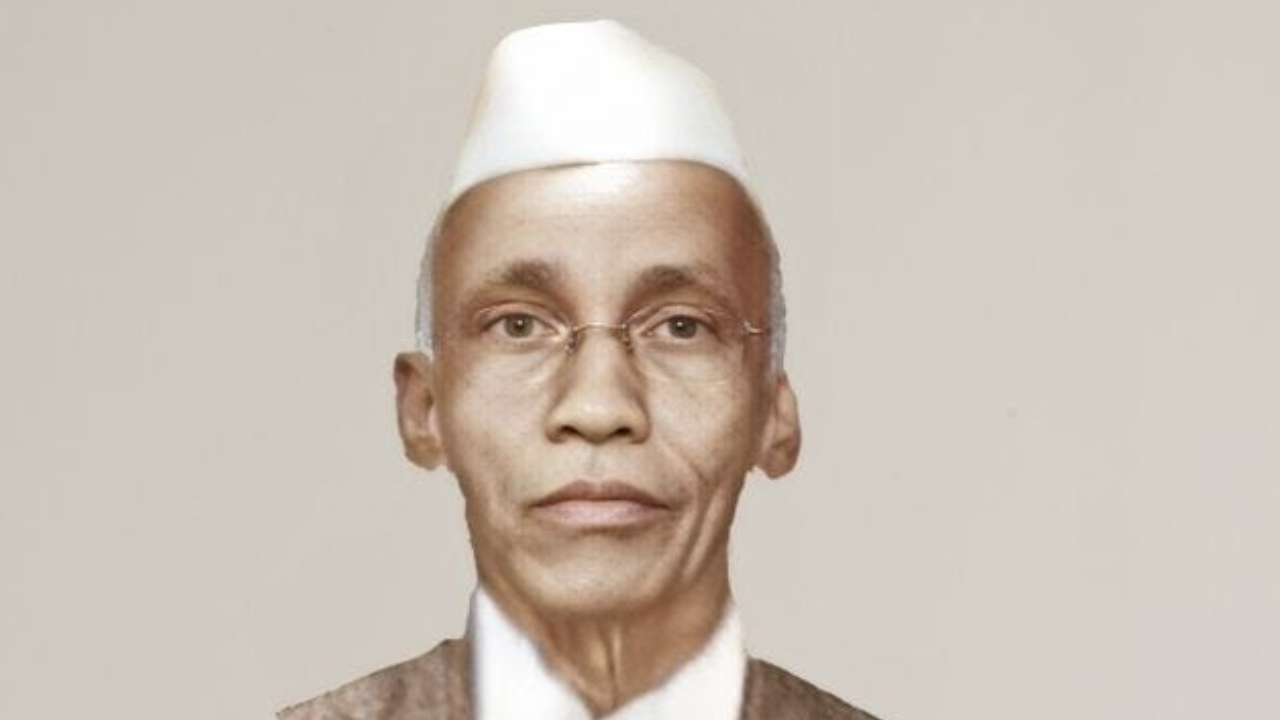
Most people think math is a rigid world of dry formulas and predictable outcomes. They’re wrong. For Dattatreya Ramchandra Kaprekar, numbers were living things with personalities. He didn't have a high-tech lab or a university chair. He was a schoolteacher in Devlali, India, who spent his life chasing "recreational math." While the academic elite ignored him, he found something they missed: a "ghost number" that haunts every four-digit combination you can think of.
The number is 6174.
It’s known as Kaprekar’s Constant. It’s not just a random digit; it’s a mathematical black hole. If you follow a specific set of steps, you’ll always end up at 6174, no matter where you start. Most mathematicians at the time brushed him off as a hobbyist. They thought his work was "trivial." Today, we know better. Kaprekar’s discovery is a masterclass in pattern recognition and a reminder that genius doesn't always wear a suit.
The Ritual of 6174
To understand why this is so cool, you’ve got to try it yourself. Pick any four-digit number. The only rule is that at least two of the digits must be different. Don’t pick 1111 or 2222. Let’s take 3524.
First, arrange those digits in descending order to get the biggest possible number: 5432. Next, flip them into ascending order for the smallest: 2345. Now, subtract the small one from the big one.
$$5432 - 2345 = 3087$$
Repeat the process with 3087.
- Big: 8730
- Small: 0378
- Subtract: $8730 - 0378 = 8352$
Do it again with 8352.
- Big: 8532
- Small: 2358
- Subtract: $8532 - 2358 = 6174$
Once you hit 6174, you’re stuck. If you try the process on 6174 ($7641 - 1467$), you get 6174 again. It’s a loop. An end-point. It never takes more than seven steps to get there. It’s weird, right? There’s no obvious reason why the universe would prefer 6174 over any other number. Yet, it does.
Why the Math World Ignored Him
Kaprekar wasn't part of the "in-crowd." He graduated from the University of Mumbai in 1929 but spent his career teaching kids in a small town. He called himself a "ganitanand," someone who finds joy in math. That kind of whimsical attitude usually gets you laughed out of serious academic circles.
He didn't care. He published papers in small journals that nobody read. He traveled to conferences on his own dime, often being treated like a sideshow. It wasn't until 1970 that Martin Gardner, a legendary math writer for Scientific American, wrote about him. Suddenly, the world realized this "schoolteacher" had discovered something profound.
Academic snobbery is a real thing. It blinds people to brilliance because the brilliance doesn't have the right credentials. Kaprekar proved that you don't need a PhD or a government grant to change how we see the world. You just need a pen, some paper, and an obsessive curiosity about how things fit together.
The Logic Behind the Ghost Number
Why does this happen? It’s about the distribution of differences between permutations. When you subtract the smallest permutation from the largest, you're essentially stripping away the magnitude and focusing on the internal relationship of the digits.
For a three-digit number, the constant is 495. For four digits, it’s 6174. Strangely, it doesn't work for five digits in the same way. Five-digit numbers don't collapse into a single constant; they often fall into loops. For instance, you might get stuck in a cycle of several different numbers that repeat forever. This makes the four-digit 6174 even more special. It’s a rare moment of absolute stability in a chaotic system.
Beyond the Constant
Kaprekar didn't stop at 6174. He had a knack for finding numbers with "special powers." He discovered "Self Numbers" (or Devlali numbers). These are numbers that can't be generated by taking another integer and adding its own digits to it. For example, 20 is not a self-number because you can get it by taking 14 and adding its digits ($14 + 1 + 4 = 19$, wait, let's try 15: $15 + 1 + 5 = 21$). Actually, let’s look at 21. You can’t reach 20 through this specific addition method. It’s an "un-generated" number.
He also found "Kaprekar Numbers." These are numbers where if you square them and split the result into two parts, the sum of those parts equals the original number. Take 45. $45^2 = 2025$. If you split 2025 into 20 and 25, then add them up ($20 + 25$), you get 45.
It’s pure play. There isn't necessarily a massive "practical" application for Kaprekar numbers in building bridges or launching rockets. But that’s missing the point. Kaprekar taught us that math is an art form. It’s about finding symmetry where others see clutter.
The Lesson for Modern Problem Solvers
We live in a world obsessed with big data and AI. We think we need massive computing power to find new insights. Kaprekar is a direct challenge to that mindset. He found these patterns by hand. He sat with piles of paper and just... looked.
If you're trying to solve a problem in your own work, maybe stop looking for the most complex tool. Try looking for the simplest pattern. Most people miss the obvious because they’re looking for the complicated. Kaprekar succeeded because he wasn't afraid to look at the "obvious" things until they yielded something miraculous.
Don't let experts tell you what's worth studying. If you find a pattern that fascinates you, chase it. Even if people call it "recreational" or "trivial," remember that the world eventually caught up to Kaprekar. It took forty years, but the "ghost number" is now a staple of number theory.
Try It With Your Own Data
If you want to feel the "magic" of 6174, don't just take my word for it. Grab a piece of paper right now. Use your birth year (if the digits aren't all the same). Use the last four digits of your phone number. Run the subtraction. Watch how quickly the numbers start to narrow down.
It’s a great party trick, sure. But it’s also a meditative exercise. Every time you reach 6174, you’re touching a piece of a hidden structure that’s been there since the beginning of time. Kaprekar didn't invent 6174; he just had the patience to introduce himself to it.
Stop thinking of math as a chore. Think of it as a hunt for hidden treasures. Start with the Kaprekar routine today. See how many steps it takes you to reach the constant from different starting points. If you find a number that takes exactly seven steps, you’ve found the "long way" to the black hole. Enjoy the ride.