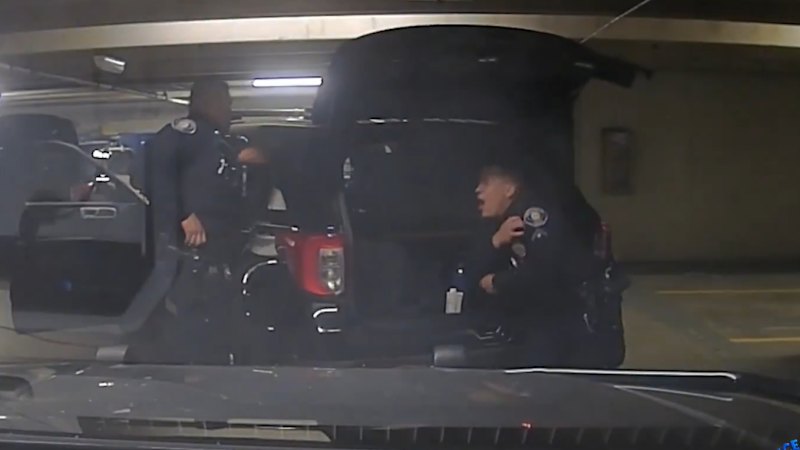
The metal is always cold before it gets warm. Anyone who has ever strapped twelve pounds of nylon, steel, and polymer around their waist every morning knows that specific chill. It rests against the hip, a quiet, heavy reminder of the thin line between an ordinary Tuesday and the worst day of your life. You put it on. You click the retention hood. You step out into a world that expects you to be a shield.
But shields are made of people. And people, even the ones in uniform, get tired. They get bored. Sometimes, in the quiet spaces between calls, when the adrenaline dips and the locker room doors shut, they forget that the steel is always hungry.
It starts with a laugh. A joke told too many times, a bit of bravado to cut the tension of a twelve-hour shift. Then comes the movement. The casual draw. The weapon clearing the holster not because a threat emerged from the shadows, but because someone wanted to break the monotony.
The industry calls it horseplay.
It is a soft word for a hard reality. It conjures images of kids in a backyard, splashing water or tossing a ball. It suggests innocence. But when applied to a semi-automatic pistol with a five-pound trigger pull, the word dissolves. It becomes a mask for a systemic failure of discipline, a momentary lapse that echoes through families, police departments, and communities for decades.
Consider what happens next: the flash, the noise that fills a small room until your ears ring with a high, metallic whine, and the sudden, sickening smell of burnt gunpowder.
Then, the silence.
The Illusion of Total Control
We train police officers to believe they are masters of their environment. They spend hundreds of hours on the firing line, punching neat holes into paper silhouettes. They practice clearing malfunctions, reloading under stress, and transitioning from lethal to non-lethal options. The muscle memory becomes so deeply ingrained that the weapon feels like an extension of the hand.
That familiarity is dangerous.
When you handle a tool every day, your brain stops treating it as an object of profound consequence. It becomes like a hammer to a carpenter or a scalpel to a surgeon. You forget the physics involved. You forget that the bullet inside the chamber does not care about your intentions. It does not know the difference between a desperate defense against an armed suspect and a reckless gesture between friends.
The data tells a grim story, though the numbers are often buried under bureaucratic phrasing. Accidental discharges within law enforcement agencies are rarely broadcast on the evening news unless the outcome is fatal. They are handled internally, filed away as disciplinary infractions, or settled quietly. Yet, every year, officers are wounded or killed not by the citizens they patrol, but by the people wearing the exact same badge.
It is a unique betrayal of the bond. The police subculture relies on an absolute, unshakable trust. You trust your partner with your back. You trust them to see the danger you missed. To have that same partner be the source of the round that tears through your flesh is a psychological trauma that conventional medicine struggles to heal.
The Mechanics of a Mistake
Let us dismantle the physics of the moment the trigger moves.
A modern duty weapon does not fire by accident. Mechanical failures do occur, but they are vanishingly rare—fractional percentages in the history of modern firearms manufacturing. Almost every single unintended discharge is a human failure. It requires a violation of the foundational rules of safety that every recruit learns in the first week of the academy.
- Rule One: Treat every weapon as if it is loaded.
- Rule Two: Never point the muzzle at anything you are not willing to destroy.
- Rule Three: Keep your finger off the trigger until your sights are on the target.
To shoot a colleague during horseplay, an officer must violate all three rules simultaneously. It is not a singular slip. It is a cascade of negligence.
Imagine the scene. Two officers, perhaps waiting for a shift change or killing time in an administrative office. The conversation turns to a new piece of gear, or a shooting technique seen online. One officer draws. The muzzle sweeps across the room. The finger enters the trigger guard. In that microsecond, the brain is convinced the weapon is empty. Perhaps the magazine was removed, but the round nestled tightly in the chamber was forgotten.
The human mind is a master of shortcuts. It convinces us that because we checked the weapon an hour ago, it remains in the same state now. It tells us that because we are professionals, we are immune to the basic laws of cause and effect.
Then the finger twitches.
The firing pin strikes the primer. The pressure inside the casing skyrockets to over thirty thousand pounds per square inch in less than a millisecond. The bullet expands into the rifling of the barrel, spinning furiously as it exits the muzzle at over a thousand feet per second.
There is no taking it back. There is no edit button.
The Invisible Ripples
The bullet is only the first piece of destruction. The true damage spreads outward like a shockwave through water.
First comes the medical reality. A handgun wound at close range does not look like it does on television. There is no clean, tiny hole. The kinetic energy transfers into the human body, creating a temporary cavity that tears muscles, shatters bone, and severs arteries. The immediate aftermath is frantic, chaotic, and bloody. Officers who are trained to apply tourniquets to strangers suddenly find themselves kneeling in the blood of their best friend, screaming into a radio for an ambulance that feels hours away.
Then comes the institutional fallout. A department must explain to the public why an officer was shot inside a secure facility. The community’s trust, already a fragile thing, cracks further. If the people trusted with the monopoly on legitimate violence cannot handle their own weapons safely around each other, how can they be trusted on the streets?
Internal affairs investigators arrive. The room becomes a crime scene. The officer who pulled the trigger is stripped of their shield. The career they spent years building, the identity they wrapped themselves in, vanishes. They face criminal charges, negligence lawsuits, and the permanent, crushing weight of knowing they destroyed a colleague’s life for the sake of a moment's amusement.
But the heaviest burden is carried by the families. The spouse who receives the phone call at midnight, expecting to hear that their partner was hurt in the line of duty, only to discover the truth was far more senseless. The children who have to grow up explaining that their parent’s injury wasn't the result of bravery, but of stupidity.
Redefining the Culture
The solution is not found in more policy manuals. Every police department in the country already has a policy strictly forbidding the unauthorized drawing or handling of weapons. You cannot write a rule that eliminates human boredom or arrogance.
The change has to be cultural. It requires an environment where calling out a colleague for unsafe handling isn't seen as being a killjoy or breaking the blue wall of silence. It means the veteran officer must check the rookie, and the rookie must have the courage to tell the veteran to put their weapon away.
We must stop using the word horseplay. We need to call it what it is: a reckless endangerment that borders on criminal intent. When you point a loaded firearm at another human being without legal justification, you have crossed a line from professional to liability.
The badge does not grant immunity from gravity, nor does it make an officer's body bulletproof against friendly fire.
The shift ends. The lights in the squad room dim. Somewhere, an officer sits alone, looking at the piece of black polymer in their holster. They might think about the story they read, the officer who was shot by a friend, and think it could never happen to them. They are too fast. Too smart. Too careful.
That thought is the first step toward the next tragedy.
The metal is cold. It waits. It demands respect every single time it is touched, because it only takes a single second to turn a protector into a patient, and a partner into a shooter.