Every evening in Beijing, the lights inside Xiaomi’s headquarters flicker against the smoggy skyline, a testament to a corporate culture that treats survival as a daily combat sport. For years, this was the company that could do no wrong. They made sleek smartphones for half the price of an iPhone. They made smart rice cookers, electric scooters, and air purifiers. They built an ecosystem so vast and interconnected that it felt less like a tech brand and more like a digital net cast over modern life.
But Walk into any trading floor in Hong Kong right now, and you will find a completely different energy. The mood is predatory.
Short sellers—the investors who make money only when a company bleeds—are circling Xiaomi in numbers never seen before in the company’s history. To these traders, the twinkling lights of the Beijing headquarters do not represent innovation. They represent a giant running out of breath. The bears have placed record-breaking bets against the Chinese tech darling, wagered on a single, brutal premise: Xiaomi has finally bitten off more than it can chew.
To understand why a company that just launched a critically acclaimed electric vehicle is suddenly facing a wall of financial skepticism, you have to look past the shiny product launches. You have to look at the invisible gears of global supply chains and the cutthroat reality of the Chinese automotive price war.
The Invisible Tax on Every Screen
Consider a hypothetical smartphone designer named Chen. Chen does not worry about macroeconomics or global trade disputes. His entire universe is three inches wide and less than half an inch thick. His job is to squeeze more speed, more brightness, and more memory into Xiaomi’s next mid-tier phone without raising the retail price by a single yuan.
Lately, Chen’s job has become impossible.
The problem is memory. The DRAM and NAND flash chips that allow a phone to multitask and store photos have quietly skyrocketed in cost. A cyclical shortage in semiconductor manufacturing has turned silicon into gold. For a company like Apple, which enjoys massive profit margins, a spike in component costs is a minor speed bump. They absorb it, or they pass it to the consumer, who shrugs and pays the premium.
Xiaomi cannot do that.
Xiaomi built its empire on a sacred promise: high quality at a near-zero profit margin on hardware. They hooked hundreds of millions of users with the hardware, intending to monetize them later through software services and ads. It was a brilliant strategy for an era of cheap parts. But when the cost of memory chips spikes, that razor-thin margin vanishes entirely. Suddenly, every phone Chen designs is either too expensive for Xiaomi’s price-sensitive fan base, or it is being sold at a loss.
The short sellers saw this bleeding edge first. They realized that Xiaomi’s core engine—the smartphone business that funds all its wild dreams—was running on fumes.
The Seventy Thousand Dollar Gamble
If the pressure on smartphones was a slow-burning fire, Xiaomi’s foray into the electric vehicle market was a lightning strike.
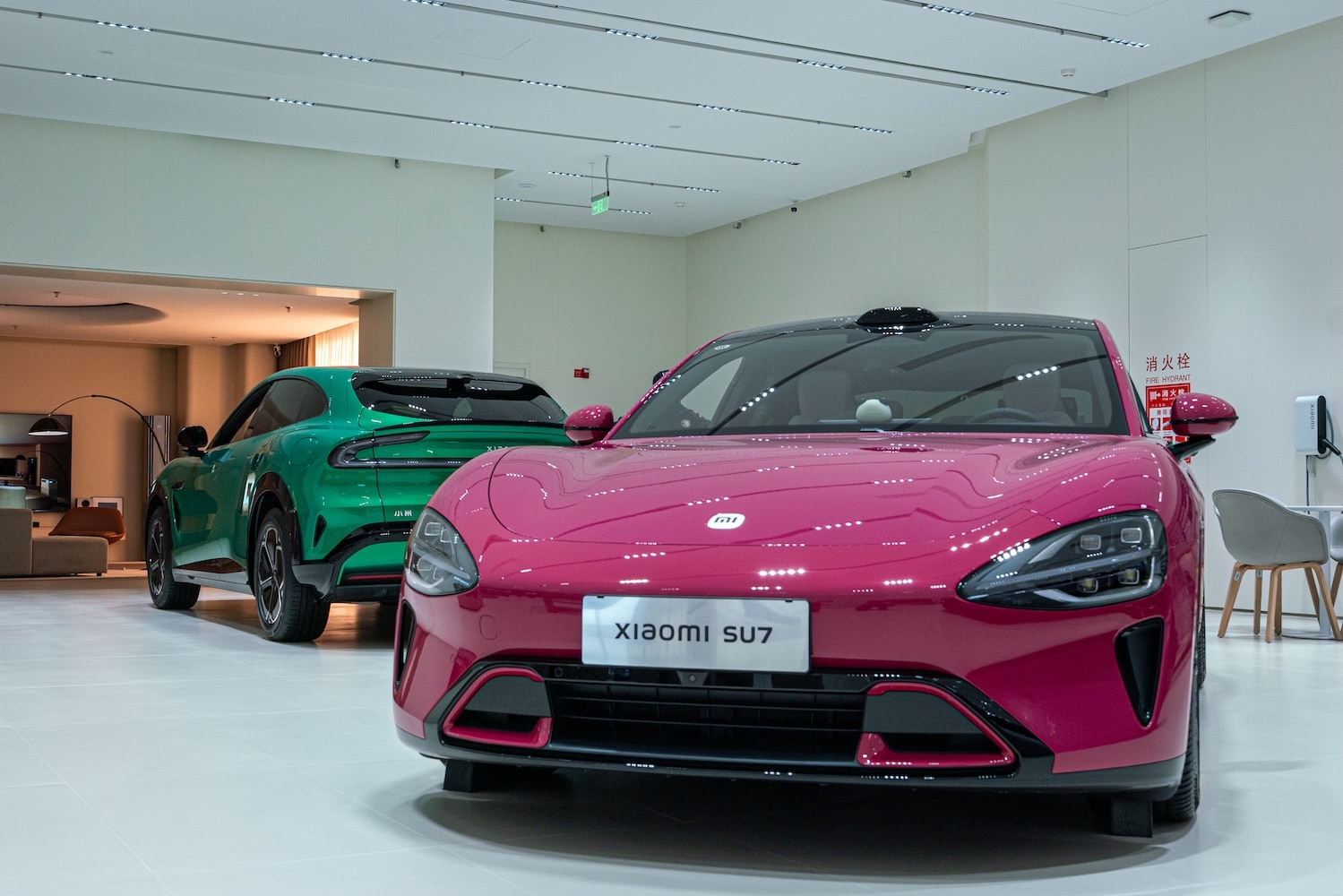
When Lei Jun, Xiaomi’s charismatic founder, announced the SU7 electric sedan, the tech world gasped. It was beautiful. It was fast. It integrated with Xiaomi’s existing ecosystem. On paper, it was a triumph of speed-to-market that shamed legacy automakers who take five years to design a new cup holder.
But cars are not phones.
Step onto the floor of a modern automotive assembly plant. The scale is dizzying. Stamping presses the size of apartment buildings slam down on sheets of steel with enough force to shake the earth. The capital required to keep these machines running is monstrous.
When Xiaomi entered the EV arena, they did not just enter a new market; they jumped naked into a meat grinder. China’s EV market is currently the most hostile business environment on earth. Dozens of brands are locked in a vicious price war, cutting stickers to the bone just to keep their factories moving.
Imagine another hypothetical character: Zhao, a middle-class consumer in Shanghai. He wants an EV. He looks at Tesla, he looks at BYD, and now he looks at Xiaomi’s SU7. He loves the Xiaomi brand. But Zhao is practical. He knows that every player in the market is desperate. He can afford to wait, to demand discounts, to watch the titans destroy each other's margins.
Xiaomi is reportedly losing thousands of dollars on every single SU7 that rolls off the assembly line. Lei Jun has openly admitted that the car is being sold at a loss to gain market share. In the tech world, this is called a "blitzscale." You lose money today to own tomorrow.
The bears in Hong Kong are betting that tomorrow will never come. They look at the cash reserves being pumped into the automotive division and see a black hole. They see a company abandoning a profitable, if squeezed, tech business to chase a low-margin, capital-intensive automotive dream in a saturated market.
The Psychology of the Short
It is easy to view short sellers as villains. We prefer builders. We celebrate the engineers who sweat over blueprints and the executives who take massive risks to create something tangible. Short sellers produce nothing. They merely watch, calculate, and wait for failure.
Yet, there is a brutal honesty to their math.
To short a stock at record levels requires an immense amount of conviction—and courage. If you buy a stock, your risk is limited to the money you put in. The stock can only go to zero. But if you short a stock, your potential losses are infinite because a stock price can theoretically rise forever.
When short interest in Xiaomi hits historic highs, it means the smartest, most cynical minds in finance are willing to risk billions on the belief that Xiaomi’s narrative is a house of cards. They are betting that the rising cost of memory will choke the smartphone cash cow before the EV business can ever become profitable. They are betting that the sheer gravity of automotive manufacturing will pull the tech giant down.
This is the invisible war playing out behind the flashing numbers on the Hong Kong Stock Exchange. It is a battle of narratives. On one side is Lei Jun, preaching a future of total digital integration, where your phone, your home, and your car speak the same language. On the other side are the spreadsheet warriors, pointing at the soaring cost of silicon and the bleeding balance sheet of the auto plant.
The Breaking Point
Every great corporate drama eventually reaches a point where physics overtakes marketing. Xiaomi is approaching that intersection.
The company cannot stop making phones; that is its identity and its distribution channel. It cannot abandon the SU7; doing so would be a catastrophic humiliation that would shatter the brand's prestige. So, it must march forward, caught between the hammer of rising chip costs and the anvil of the EV price war.
The employees in Beijing keep working late. The assembly lines keep stamping steel. The customers keep clicking "order." But the financial shadow growing over the company is a reminder that even the most spectacular ambition must eventually pay its bills.
The short sellers are not looking away. They have made their wager. They are sitting in the dark, watching the headlights of the SU7, waiting to see if it makes the next turn or drives straight off the cliff.


