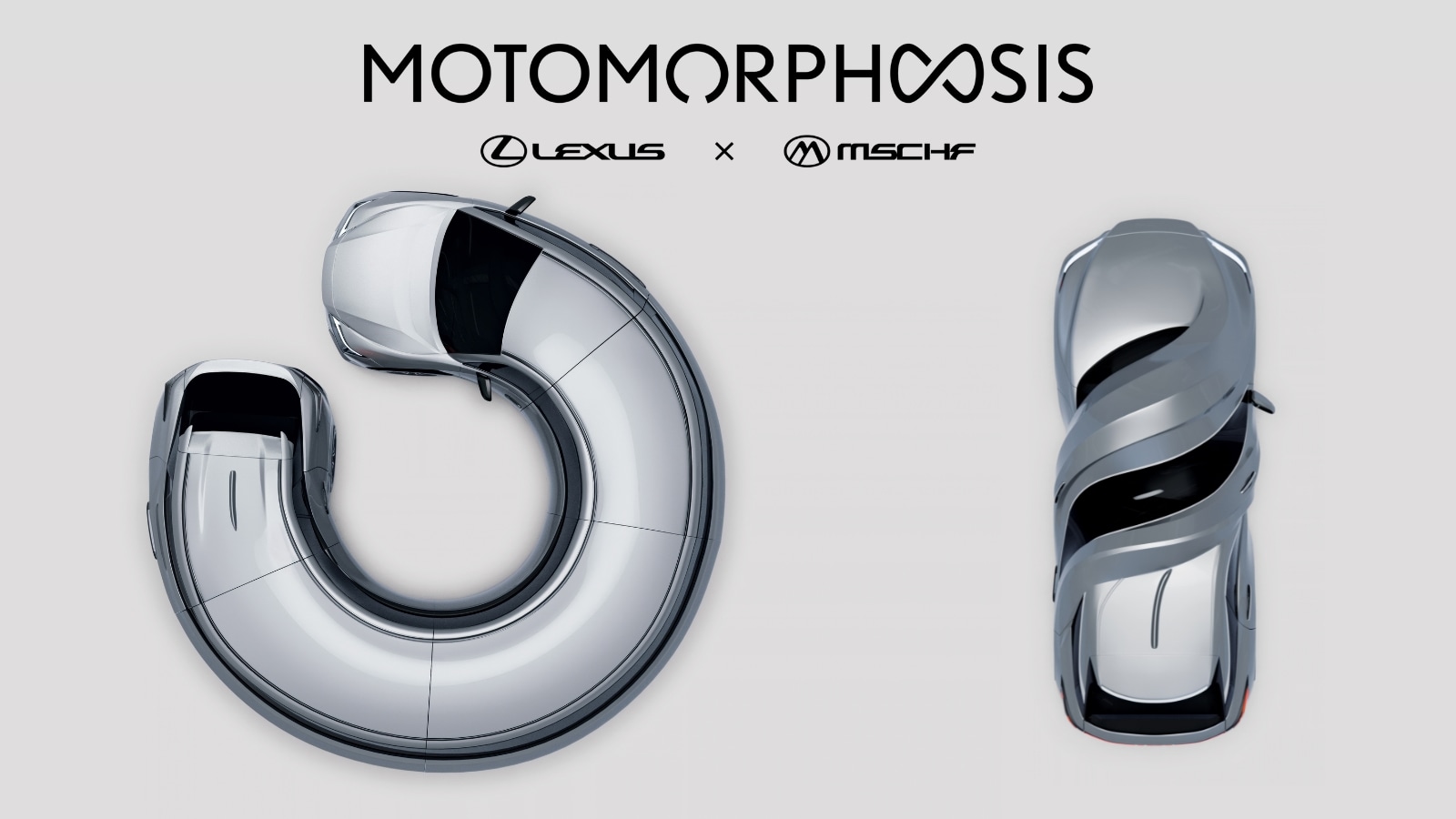
We are supposed to applaud when a multi-billion-dollar luxury automotive division hands a blank check to a clever Brooklyn prankster collective. The internet eats it up. Design blogs publish breathless architectural breakdowns of the resulting metal shapes.
The installation is called Motomorphosis. Lexus and MSCHF took two production electric vehicles—a Lexus RZ 450e and an RX 450h+—and distorted them. One was looped nose-to-tail into a continuous circle. The other was wrung out like a wet rag into a helical spiral. The critical consensus praises this as a brave deconstruction of the concept car, a cheeky middle finger to rigid industrial design, and an avant-garde exploration of digital 3D modeling software translated into physical space.
It is none of those things. It is brand laundering masquerading as rebellion.
I have watched legacy brands panic over the flatlining soul of the electric vehicle transition for years. Automakers spend millions trying to convince consumers that battery-powered crossovers possess personality. When traditional marketing fails to inject a pulse into anonymous aerodynamic blobs, they outsource the disruption to professional provocateurs.
The lazy narrative treats this collaboration as an organic collision between corporate scale and street-level critique. The reality is far more clinical. MSCHF did not subvert Lexus; Lexus weaponized MSCHF to sanitize its own irrelevance in the cultural vanguard.
The Safe Transgression Economy
True subversion requires skin in the game. When MSCHF previously launched stunt projects, they targeted closed systems with external friction. They forced corporate gatekeepers to react with legal threats, awkward public relations statements, and genuine confusion.
When a luxury automaker commissions the stunt from the jump, the friction evaporates. Every welded seam on that twisted spiral and circular loop was insulated by legal counsel, insured by corporate risk management, and previewed in slide decks. The disclaimer on the project even notes that these are non-street-legal custom builds that void the factory warranty. That is not a badge of honor; it is a liability waiver wrapped in a velvet gallery rope.
Look at how the art world consumes it. Patrons walk through Chelsea Industrial, sip curated beverages during Armory Week, snap photos for social feeds, and nod sagely at the "post-industrial commentary."
This is the safety valve of modern capitalism. It takes genuine unease about our hyper-mechanized, carbon-heavy consumer ecosystem and redirects it into a clean, well-lit gallery space where nobody has to confront supply chains, lithium mining realities, or the mind-numbing monotony of suburban utility vehicles.
The Digital Nostalgia Trap
The justification for these sculptures relies on a specific technical sleight of hand. The collective argues that these forms mimic digital 3D modeling software, where operators can twist, bend, and stretch meshes infinitely without physical consequence. They call them "Form Cars," mimicking the smear frames of animation.
It is a clever intellectual coat of paint on a very old trick: making something useless so it can become precious.
Yet, translating a digital glitch into a multi-ton physical sculpture made from thousands of hand-welded parts misses the point of software freedom. Digital distortion is powerful because it is fluid, weightless, and infinitely revisable. Freezing a software glitch into a heavy steel armature doesn't liberate the car; it turns it into a tombstone for software workflows that the designers abandoned two updates ago.
By treating the physical automobile as a canvas for arbitrary geometry, the project validates the worst impulse of modern car design: the belief that vehicles are primarily lifestyle accessories and sculptural status symbols rather than tools for moving human bodies efficiently.
The Real Cost of Aesthetic Cynicism
When a brand known for counter-cultural stunts signs a direct invoice from a premier automotive manufacturer, the currency being traded is not irony. It is permission.
Lexus buys permission to be seen as daring, unpredictable, and culturally fluent. MSCHF gets a massive production budget and mainstream institutional validation. The loser is the audience, who is trained to accept that critique can be bought, packaged, and displayed as a lifestyle perk next to the new model year release.
If you want to disrupt automotive design, don't weld a crossover into a donut ring. Redesign the entire economic logic that forces cities to prioritize private multi-ton steel boxes in the first place. Stop dressing up corporate PR as an anti-capitalist manifesto.
The next time a legacy conglomerate pays an insurgent art crew to mutilate their own inventory, don't look for the profound meaning in the twisted sheet metal. Look at the invoice. That is where the design actually happened.