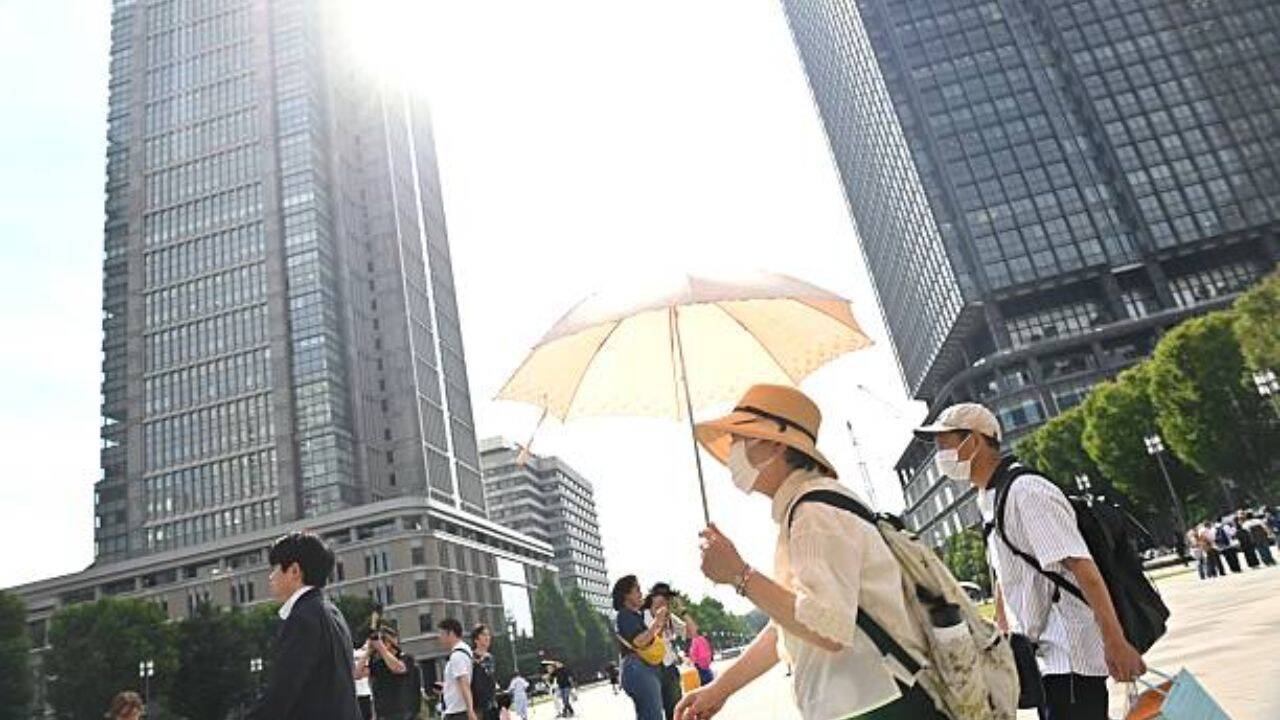
The air in Tokyo does not simply move; it presses. It is a dense, wet weight that settles against the skin before the morning commute even begins, turning every breath into a conscious effort. Asphalt radiates a steady, shimmering breath of heat upward, while towering glass facades trap the humidity below like a lid on a boiling pot.
Step outside, and the city feels less like a metropolis and more like an oven left on low for a century.
For most of my life, summer in Japan was a season defined by cicadas screaming in the shrines, sudden afternoon downpours that smelled of hot dust, and the rhythmic clicking of woodengeta sandals on pavement. It was hot, yes. It was humid, absolutely. But it was a weather pattern you could inhabit. You adjusted your shutters, you ate chilled somen noodles, you fanned yourself with a paper uchiwa, and you endured.
Something changed.
The air now carries an edge of desperation. Across the country, the numbers are climbing past historic thresholds, rewriting charts that meteorologists thought were fixed for good. Temperatures routinely shatter records, pushing past 40 degrees Celsius in places where such heat was once unthinkable. This is not just a hot summer. This is an environment turning hostile to life.
Consider what happens next: the asphalt expands, the electric grids hum with a frantic, overloaded whine, and the living world begins to break under the strain.
Take a walk through a Japanese zoo in the middle of August, and the illusion of urban insulation shatters completely. In Ueno or Kyoto, behind heavy steel mesh and artificial moats, the lions—symbols of unyielding majesty, kings of the dry savanna—lie flat on their sides. Their rib cages heave with rapid, shallow breaths. Their thick manes, evolved to shed the heat of an African dry season, are useless against the trapped, stagnant humidity of a concrete enclosure surrounded by millions of air-conditioning units pumping out waste heat. Zookeepers scramble, tossing blocks of frozen blood and hosing down rocks, fighting a losing battle against a climate that has outpaced adaptation.
If the apex predators are melting, what hope does the rest of the ecosystem have?
The heatwave does not care about species boundaries. It reaches equally for the lion in its enclosure and the elderly shopkeeper down the narrow alleyway who refuses to turn on the air conditioning because of a fixed pension and a lifelong habit of thrift.
We talk about heatwaves as meteorological events, but they are fundamentally social disasters. They exploit every fracture line in our infrastructure and our communities.
(Note: All references to rising temperatures, record-breaking hospitalizations for heatstroke, and stressed zoo wildlife are grounded in official meteorological data and reports from Japanese municipal authorities and wildlife parks.)
A hypothetical neighbor named Kenji lives alone on the third floor of an aging apartment building in western Tokyo. Kenji is eighty-two. His apartment faces west, catching the merciless afternoon sun through uninsulated glass. He remembers the summers of his youth as golden and manageable. His body, however, no longer remembers how to cool itself. As we age, our internal thermostats fray. The blood vessels near the skin lose their elasticity; the brain's signals to sweat grow sluggish.
Kenji thinks he is fine. That is the insidious trick of heat exhaustion. It dulls the very faculties required to recognize its danger.
By the time the indoor temperature hits 38 degrees Celsius, Kenji is confused. His mouth is dry, his heart races to pump thick, dehydrated blood through narrowed arteries, and his kidneys begin to whisper of failure. He doesn't call for help because asking for help feels like an admission of defeat. He is waiting for the evening breeze that never comes.
Statistically, Kenji is not alone. Every summer, thousands of people across Japan find themselves in rooms that have quietly transformed into silent chambers. The emergency services report a rhythmic, terrifying surge of sirens. Ambulances stack up outside emergency rooms because hospitals are overwhelmed with patients suffering from severe heatstroke. The system groans under the weight, paramedics wipe sweat from their visors, and the triage tents fill up with people who simply stepped outside to buy a carton of milk and forgot how to make it home upright.
Why is this happening with such brutal acceleration?
The answer lies in a combination of global climate shifts and local geography. Japan is an urbanized archipelago. Its major cities are dominated by concrete, steel, and glass—materials that absorb solar radiation during the day and release it slowly through the night, preventing the urban core from ever truly cooling down. This is the urban heat island effect, amplified by rising global baseline temperatures.
Compounding this is the Pacific High, a massive system of high atmospheric pressure that routinely bulges over Japan during the summer months, locking hot, moist air in place with a lid of high pressure. Wind patterns stall. Clouds vanish. The sun beats down day after day with uninterrupted malice.
We built our modern world for efficiency, speed, and density. We paved over the green spaces, channeled the rivers into concrete flumes, and replaced natural shade with towering skyscrapers that bounce thermal energy back and forth like pinballs. In doing so, we created an environment that magnifies nature's worst moods.
The lions in the zoo and the seniors in their apartments are telling us the exact same story. They are biological indicators in a system pushed past its breaking point.
When a society faces a crisis this invisible, the natural response is denial. We crank up the air conditioning—ironically pumping more waste heat into the streets, worsening the very problem we are trying to escape. We tell ourselves it is just an unusually bad year. We wait for autumn as if it were a savior rather than an inevitable calendar page.
But autumn is arriving later and later each year, bruised and delayed by lingering heat.
The challenge we face is not merely technological; it is imaginative. We have to learn how to design cities that breathe. We have to rethink how we shade our streets, how we care for our most vulnerable neighbors when the mercury spikes, and how we value the living world around us.
A cooler city is not a luxury. It is a survival requirement.
Until we accept that reality, the summer will remain what it has become: a season of quiet holding of breath, a test of endurance where the weakest—whether they wear a mane or a faded cardigan—pay the highest price for the concrete world we built around them.
The sun dips below the horizon, but the walls of the buildings radiate a dull, orange warmth into the dark, waiting for tomorrow's dawn.