Silence has a weight in Arlington.
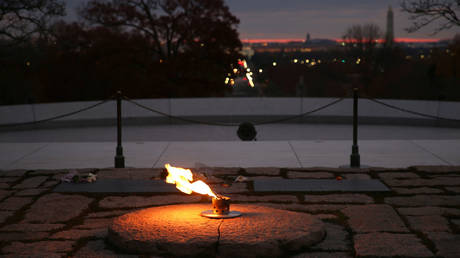
If you walk up the steep, manicured slopes of Arlington National Cemetery on a cold November morning, the air tastes of damp earth and cut grass. The rows of white marble headstones march across the hills with military precision, each one a quiet period at the end of a human sentence. At the crest of the hill, just below the stately columns of Arlington House, burns a small, restless tongue of orange fire.
The Eternal Flame.
For more than six decades, that gas-fed jet has flickered over the grave of John F. Kennedy. Millions of people have stood behind the low granite wall, listening to the wind whip off the Potomac River, staring down across the water toward the white marble monuments of Washington, D.C. The sightline was deliberate. Jacqueline Kennedy and architect John Carl Warnecke designed the gravesite specifically so that the slain president would look out over the Lincoln Memorial, the Washington Monument, and the Capitol—a visual axis binding one era of American sacrifice to the nation’s founding promises.
Now, imagine standing at that exact spot, looking down toward the river, and seeing a colossal new structure rising into the sky, casting a literal and political shadow across the line of sight.
That is not a hypothetical dread for the surviving members of the Kennedy family. It is the center of a fierce, deeply personal battle over memory, ego, and who gets to claim the skyline of American history.
The Architecture of Memory
To understand why a family already steeped in tragedy would mobilize against a construction project, you have to understand how Washington speaks. Washington does not just communicate through laws passed in Congress or rulings handed down by the Supreme Court. It speaks through stone.
Every monument on the National Mall is an argument frozen in marble and bronze. The Lincoln Memorial argues for union and equality. The Vietnam Veterans Memorial, a black granite gash cut into the earth, argues for the quiet, unvarnished truth of grief. When you alter the skyline of the capital, you are editing the national autobiography.
Proposals and ongoing efforts tied to Donald Trump—ranging from grandiose monument concepts near the Potomac to towering tributes celebrating his presidency and populist movement—have collided directly with the sacred geography surrounding the Kennedy legacy. Whether it is a massive triumphal arch, a towering column, or a sprawling commemorative complex positioned along the riverside corridor between Virginia and the District of Columbia, the physical footprint threatens to interrupt the visual corridor linking Arlington to the Mall.
For the Kennedys, this is not merely a zoning dispute or an aesthetic disagreement between rival political dynasties. It is an existential clash over what public memorials are supposed to be.
Consider what happens when a monument is built not to mourn a shared national loss, but to celebrate a living political movement. Traditional memorials in Washington typically adhere to a strict, unspoken rule: distance. Under the Commemorative Works Act of 1986, Congress established buffer zones and waiting periods—usually requiring a person to be dead for at least twenty-five years before a permanent memorial can be authorized on federal land in the capital. The law exists for a simple reason. Time cools the fever of partisanship. History needs decades to separate enduring statesmanship from the noise of the daily news cycle.
When political allies, wealthy donors, or executive maneuvers push to bypass those norms—either by leveraging private land just across the river in Northern Virginia or by pressuring federal commissions to fast-track monumental tributes to Trump—they are taking a sledgehammer to that cooling-off period.
A View From the Hill
Picture a fictionalized composite of the thousands of visitors who make the pilgrimage to Arlington every week—let’s call her Elena, a retired high school history teacher from Ohio.
Elena saves for three years to bring her teenage grandson to Washington. She remembers watching Walter Cronkite take off his glasses in 1963. She remembers the muffled drums of the caisson rolling down Pennsylvania Avenue. When she reaches the Kennedy gravesite, she wants her grandson to feel the unbroken thread connecting the 1960s to the 1860s. She points out the direct line from JFK’s terrace straight across the Memorial Bridge to Abraham Lincoln’s temple.
"Look at how they align," she tells him. "One saved the union, the other tried to carry it forward."
Now, insert a massive, gleaming monument to Donald Trump directly into the peripheral or central frame of that view. Suddenly, the quiet contemplation of history is interrupted by the blaring volume of modern political warfare. The sightline is no longer a bridge between Lincoln and Kennedy; it becomes a billboard for the grievances and triumphs of the twenty-first century.
This is the invisible stake that keeps Caroline Kennedy, Jack Schlossberg, and the broader Kennedy clan awake at night. To them, the threat is twofold: physical intrusion and moral equivalence.
Physically, high-rise developments and monumental structures on the Rosslyn shoreline or along the Potomac approaches have long been fought by preservationists because they dwarf the low-slung, classical dignity of Washington’s federal core. The Height of Buildings Act of 1910 kept Washington’s skyline open, ensuring that no commercial tower or private vanity project would ever look down upon the Capitol dome or the Washington Monument. Virginia, across the river, has no such restriction, which is why the glass towers of Rosslyn already crowd the western horizon behind Arlington. Adding an overtly political monument to that perimeter—or worse, carving out space along the riverside parkways—turns a protected sanctuary into a contested battleground.
Morally, the friction runs even deeper.
The Clash of Two Americas
It is impossible to ignore the profound philosophical chasm separating the Kennedy ethos from the Trump phenomenon.
John F. Kennedy’s presidency, for all its documented flaws and Cold War brinkmanship, was anchored in a specific civic religion: the idea that public service is a noble calling, that democratic institutions are fragile and must be tended with reverence, and that Americans should ask what they can do for their country. His death at forty-six froze him in the national imagination as a symbol of unfinished promise.
Donald Trump’s political rise was built on the exact opposite premise—the conviction that traditional institutions are corrupt, that norms are tools used by elites to silence ordinary people, and that strength is measured by dominance rather than restraint. To his millions of devoted supporters, a towering monument in the shadow of the nation’s capital is long overdue validation. They see a leader who fought for them against entrenched power, and they believe his likeness or legacy deserves to stand shoulder-to-shoulder with the giants of American history.
You do not have to hate Trump or idolize Kennedy to recognize the volatility of placing those two symbols in physical proximity.
I remember standing near the Lincoln Memorial during the summer of 2020, watching protesters and counter-protesters shout across police barricades while helicopters thumped overhead. The marble columns behind them looked exhausted, as if the stone itself were absorbing more rage than it was ever engineered to hold. Washington’s monuments work best when they serve as common ground—places where people who disagree violently about tax policy or foreign wars can stand side by side in quiet awe.
The moment a monument becomes a partisan provocation, that common ground fractures.
How the Battle Is Fought
The Kennedys are not strangers to political combat, though their methods today look very different from the backroom machine politics of Joseph P. Kennedy Sr. in the mid-twentieth century. Today, the family operates through a blend of institutional leverage, public advocacy, and quiet pressure on the obscure federal boards that actually control Washington’s dirt.
In the capital, beauty and permanence are guarded by bureaucracy. Before a single shovel hits federal soil, a project must survive a gauntlet of reviews by the National Capital Planning Commission, the U.S. Commission of Fine Arts, and the National Park Service. These bodies are staffed by architects, urban planners, and historians whose entire job is to say "no" to bad ideas—especially ideas driven by fleeting political vanity.
When proposals emerge to erect massive Trump tributes—whether through congressional bills introduced by loyalists, executive proclamations, or private foundations buying up strategic parcels near the Potomac—the Kennedy family and their allies mobilize along three distinct fronts:
- Viewshed Protection: Preservation lawyers and landscape architects use federal environmental and historic preservation statutes, such as Section 106 of the National Historic Preservation Act, to argue that any towering structure within the visual corridor of Arlington National Cemetery degrades a registered historic landmark. You do not have to argue politics when you can prove with laser sightlines and architectural renderings that a new structure ruins a protected view.
- Institutional Gatekeeping: Members of the Kennedy family maintain deep ties to cultural institutions, foundations, and congressional committees. By rallying historians, former Park Service directors, and bipartisan preservationists, they frame the fight not as "Kennedys versus Trump," but as "stewardship versus vandalism."
- Public Narrative: Perhaps most effectively, younger voices in the family, particularly Jack Schlossberg, have taken the fight directly to the public sphere, using sharp, unvarnished commentary to frame attempts to insert Trump into the pantheon of national heroes as a grotesque distortion of American history.
Yet, there is an uncomfortable vulnerability in their position that even the most ardent Kennedy defenders have to confront.
The Paradox of Dynasty
When a Kennedy argues against the cult of personality in American politics, skeptics are quick to raise an eyebrow.
No family in American history has benefited more from myth-making than the Kennedys. From the carefully curated Camelot narrative promoted by Jacqueline Kennedy in the days after the assassination to the naming of space centers, airports, performing arts venues, and naval vessels after JFK, the Kennedy brand itself is woven into the physical infrastructure of the United States. Critics on the right routinely point out the irony: a family whose name adorns everything from Cape Canaveral to a major cultural center on the Potomac is now objecting to another political figure claiming space on the map.
It is a fair point, and pretending otherwise weakens the argument.
The difference, historians argue, lies in process and consensus. The John F. Kennedy Center for the Performing Arts was originally conceived under Dwight D. Eisenhower as a National Cultural Center and was renamed by Congress after Kennedy’s assassination as a bipartisan act of national mourning. Cape Canaveral was renamed to honor the president who set the nation on a course to the moon, a goal that united the country across party lines.
Even so, the backlash against excessive memorialization was so strong after the 1960s that Congress eventually tightened the rules specifically to prevent future presidents—and their families—from turning Washington into a crowded gallery of partisan statues. The rules the Kennedys are invoking today were designed to restrain everyone, including future Kennedys.
What Happens When Stone Takes Sides
Let us step back from the immediate political theater and look at what happens to a democracy when its public spaces lose their neutrality.
Think of a family dinner table. Every family has painful memories and unresolved arguments, yet most families keep a few shared photos on the mantel—grandparents on their wedding day, a childhood home, moments that remind everyone that they belong to the same story despite their fights. Now imagine one relative showing up at Thanksgiving, shoving the old frames aside, and bolting a massive neon sign to the wall declaring their own victory in last week’s argument.
Nobody eats in peace after that. The room stops being a home and becomes a stage.
That is the precise danger hovering over the Potomac. Washington’s commemorative core is supposed to be the nation’s mantel. It is deliberately incomplete, intentionally restrained, and fiercely guarded against the loud, temporary passions of the present. When you allow contemporary political movements to erect colossal monuments before the dust of their era has even settled, you invite permanent retaliation.
If a monument to Trump rises on the edge of the Mall or across the river in Arlington’s sightline today, what stops the next administration from building an equally massive monument to Barack Obama right next to it? What stops the one after that from erecting a bronze colossus to Ronald Reagan, or Joe Biden, or whatever populist firebrand dominates the 2030s? Within fifty years, the serene green expanse between the Capitol and the Potomac would look less like a sanctuary of democratic ideals and more like a Las Vegas strip of competing political billboards.
The Weight of the Flame
The tragedy of the current fight is that it forces a grieving family—and a divided nation—to litigate the meaning of sacrifice in real time.
At Arlington, the rules are absolute. No political speeches are permitted at the gravesites. No campaign banners are waved among the headstones. Four-star generals lie beside twenty-year-old privates, separated only by the dates carved into identical slabs of stone. Death, in that place, is the great equalizer.
John F. Kennedy is not buried at Arlington because he was a successful politician or a wealthy scion of Boston. He is buried there because he was a decorated Navy veteran of World War II and a president who died in the service of his country. The flame over his grave is small—barely taller than a human hand—precisely because greatness does not need to shout to be seen.
Across the river, the machinery of modern politics continues to grind, loud and relentless, hungry for validation, determined to carve its name into bedrock before history has had a chance to render a verdict. Bulldozers wait on blueprints. Donors sign checks. Lawyers file briefs.
And up on the hill in Virginia, as twilight settles over the Potomac and the white marble turns gray in the fading light, that small orange flame keeps burning against the wind, stubbornly refusing to go out.