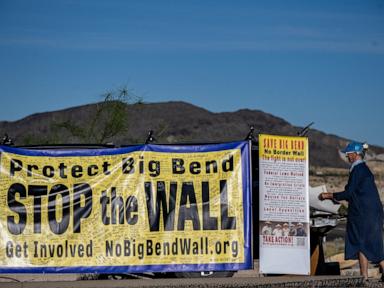
The federal government has abruptly halted construction of border security infrastructure within Big Bend National Park, a retreat forced by an unusual surge of bipartisan fury that highlights the widening gap between Washington’s border policies and the realities of the remote Texas frontier. Customs and Border Protection Commissioner Rodney Scott announced the temporary suspension on Monday, confirming he would head to the region for an on-the-ground assessment following the arrival of bulldozers that began clearing land earlier this month.
While the agency maintains that the infrastructure—including access roads, vehicle barriers, and subterranean fiber-optic surveillance technology—is essential for national security, local stakeholders describe the project as an ecological and economic assault on one of the nation's most remote wilderness areas. The pause offers a rare moment of breathing room for environmentalists and local officials, but the underlying tension remains: Washington sees a gap to be plugged, while those living in the shadow of the Chisos Mountains see a natural fortress already doing the job.
For decades, the sheer brutality of the landscape has served as the primary enforcement mechanism in Big Bend. The region features thousand-foot limestone cliffs, deep canyons, and vast, waterless deserts that make human trafficking or clandestine entry notoriously difficult. Critics of the wall project, ranging from Democratic activists to high-ranking Texas Republicans, argue that installing industrial-grade barriers in such terrain is not merely redundant; it is a fundamental misunderstanding of the geography.
Senator John Cornyn, whose influence in the region remains substantial, signaled the political danger of the current approach in a recent correspondence with Homeland Security leadership. His frustration, mirrored by local sheriffs and business owners who rely on the park's pristine reputation for tourism, suggests that the administration’s aggressive use of regulatory waivers to expedite border projects has finally triggered a backlash it cannot ignore.
The construction plans originally stirred fears of a massive, 30-foot bollard wall that would have sliced through the park’s fragile ecosystem. While CBP eventually backed away from that specific design, the current iteration of "roads and surveillance" has proven almost as provocative. Heavy machinery moving through undisturbed soil has, in the eyes of many, already done the damage the administration claimed it would avoid. This raises a pressing question about federal oversight: how does an agency justify the destruction of protected public lands when even local law enforcement—those tasked with securing the border—claim the projects are unnecessary or actively detrimental to their operations?
The conflict points to a recurring failure in federal land management. When agencies operate under the shadow of a broad mandate—in this case, a $46 billion congressional appropriation for border security—the pressure to show visible, physical progress often overrides local expertise.
Building in a national park is never just about dirt and steel. It is about the preservation of an American asset that is meant to exist outside the sphere of everyday political combat. When the machinery stops, the questions begin. If the terrain is truly as impassable as the locals argue, then every mile of road built into the park represents an investment in environmental degradation rather than security.
CBP Commissioner Scott now faces a narrow window to navigate this political minefield. If he returns to Washington with a recommendation to resume, he will face not only lawsuits from environmental groups and state legislators but also a renewed rebellion from local officials who have made it clear they feel betrayed by the federal encroachment. If he recommends a full cancellation, he must defend that decision against an administration that has tied its political survival to the construction of a continuous border barrier.
The silence currently enveloping the construction sites in Big Bend is temporary. It is a calculated pause intended to quell a firestorm, but the underlying friction between a top-down federal mandate and the ground-level reality of a wilderness that serves as its own border patrol is far from resolved. The bulldozers may be idle for now, but the fundamental struggle for the identity of the American borderlands is just beginning to enter the public consciousness.
The real test will come when the boots hit the ground this week. Until then, the limestone cliffs and the desert floor remain the only entities truly in control of who gets through.