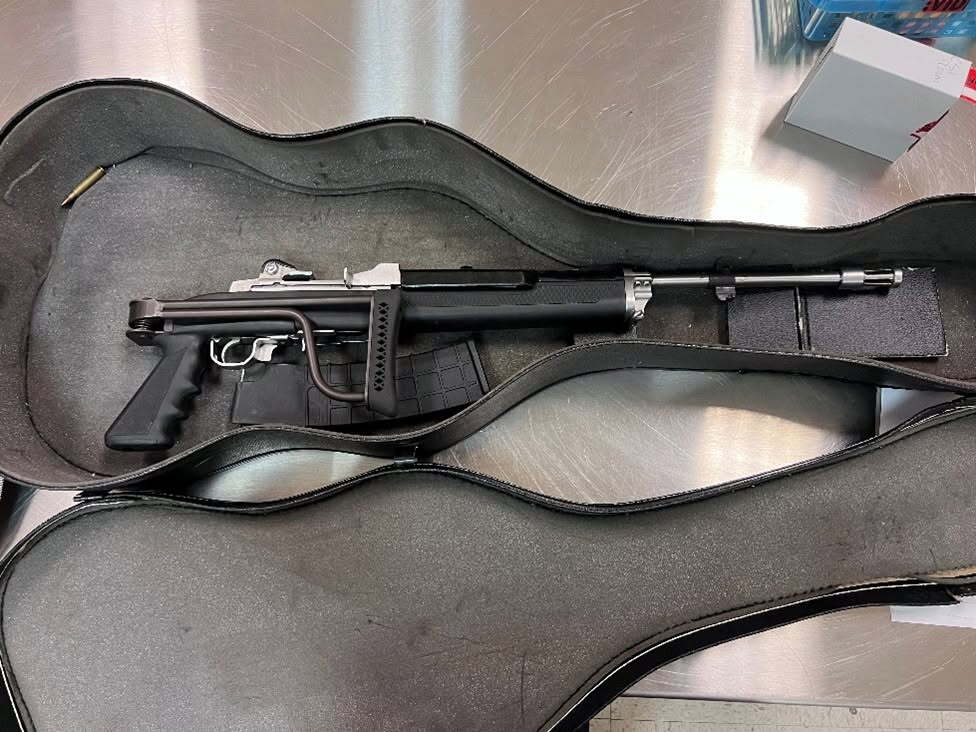
Every time a headline screams that a suspect hid a rifle inside a guitar case, the collective reaction is predictable. Gasps. Hand-wringing. Cinematic comparisons to Desperado or Once Upon a Time in Mexico. Standard crime reporting treats the guitar case like a masterstroke of stealth—a clever disguise that supposedly lets a dangerous person walk right past everyone unnoticed.
That reading is lazy. Worse, it misses how concealment actually works in the real world. If you enjoyed this post, you should read: this related article.
A guitar case is not a cloaking device. It is a bulky, oddly shaped, attention-grabbing box that screams "musician" in places where musicians rarely belong at two in the morning. When police in Northern California report a suspect carrying a rifle inside a guitar case, the lazy consensus focuses on the theatricality of the prop rather than the practical realities of concealment, detection, and trade-offs.
Let’s strip away the movie-script drama and look at what is actually happening when someone stuffs a long gun into a musical instrument case. For another look on this development, refer to the latest update from Reuters.
The Lazy Consensus Around "Clever" Concealment
Traditional crime coverage loves a neat narrative hook. "Suspect hid rifle in a guitar case" gives a desk editor an instant visual. It turns a routine or chaotic law enforcement encounter into a story about deception.
The implicit assumption in that framing is simple: disguise equals invisibility. If an object looks like a cello, a violin, or an acoustic guitar, observers supposedly register "art" and stop looking for "weapon."
That assumption falls apart under basic scrutiny.
First, concealment is not camouflage. Camouflage blends an object into its surroundings so it is hard to spot. Concealment just hides what is inside a container. A hard-shell guitar case does not blend into a quiet residential street, a transit station, or a commercial parking lot after dark. It stands out. A person lugging a three- or four-foot hardshell case on foot or getting in and out of a vehicle with it is handling a piece of equipment that has its own silhouette, weight distribution, and friction points.
Second, standard reporting rarely separates visual disguise from operational effectiveness. Hiding a rifle in a guitar case might delay identification at a glance. It might keep a casual passerby from knowing what is inside before the case opens. What it does not do is make the weapon quick to access, easy to maneuver in tight spaces, or invisible to trained eyes looking for behavioral anomalies.
Over years of reviewing security protocols, physical access failures, and incident post-mortems, I have watched organizations and individuals blow serious money obsessing over theatrical concealment while ignoring basic behavioral cues. People buy custom cases, padded compartments, and clever-looking bags thinking a disguise buys them immunity. Then they walk through a checkpoint or past an alert observer moving stiffly, guarding the strap, or showing up in a context that makes zero sense. The prop looks smart on paper. In practice, it draws the exact kind of scrutiny the carrier wanted to avoid.
Concealment Mechanics vs. Hollywood Myths
To understand why a guitar case is rarely the ultimate covert carrier people imagine, you have to look at the physical and tactical trade-offs involved.
1. Size, Weight, and Ergonomics
Rifles are long, rigid, and often heavy—especially once optics, slings, magazines, or folding/fixed stocks are factored in. A standard acoustic or electric guitar case has interior dimensions shaped around a specific body contour and neck channel.
- Fit issues: A rifle that does not match the internal foam or bracing shifts when you move. Shifting weight changes balance and creates noise.
- Draw time: Opening latches or zippers, lifting out a long gun, and bringing it online takes far longer than people who watch action movies assume. A case is a barrier between the carrier and the firearm.
- Maneuverability: Long cases swing wide in hallways, doorways, stairwells, and crowded aisles. Try turning quickly in a narrow space while carrying a four-foot case slung over one shoulder. It hits doorframes. It catches on obstacles. It announces itself.
2. Contextual Mismatch (The "Wrong Place, Wrong Time" Problem)
Security analysts and behavioral observation specialists—going back to foundational work on situational awareness and baseline behavior like Gavin de Becker’s The Gift of Fear and law enforcement field training manuals—emphasize anomaly detection over simple object recognition.
Humans and trained observers don't just catalog objects in isolation; they compare objects against context.
Imagine a scenario where a person walks into a quiet suburban neighborhood at 1:30 a.m. carrying a gleaming hardshell guitar case, wearing heavy boots, and keeping a tight grip on the handle while avoiding eye contact. Nothing in that scene says "open mic night." Even without seeing a gun, the mismatch between the item, the hour, and the demeanor creates friction. Context is king. A guitar case only fits naturally where guitars naturally go.
3. The Illusion of "Safe" Containers
There is a persistent myth that everyday objects enjoy some kind of built-in immunity from inspection. Briefcases, backpacks, diaper bags, toolboxes, sports bags, guitar cases—every era has its favorite container.
Once a specific container becomes a cliché in popular culture or news reports, its novelty value drops. Observers learn that anything can be inside a bag or case. Relying on a cliché to fool people is a bet on complacency, and complacency is unreliable.
What People Are Actually Asking When They Search This Story
When a story like a Northern California police report about a rifle in a guitar case trends, searchers usually type predictable questions into their phones. Most of those questions are framed around the wrong starting point.
"How do criminals hide weapons in everyday items?"
That question treats concealment like a magic trick to admire or fear. A sharper question is: Why do people choose awkward containers, and what happens the moment a container fails to match the situation? Usually, people use whatever large container they already have that roughly matches the length of the item. Convenience and desperation beat master-level engineering far more often than headlines admit.
"Can police tell if a weapon is inside a guitar case?"
Not by X-ray vision through solid wood and foam from fifty feet away—let’s stay grounded in reality. Law enforcement relies on tips, surveillance, vehicle stops, visible indicators, prior intelligence, or behavior that warrants investigation under applicable law. A guitar case does not grant legal immunity, and it does not stop an investigation once reasonable suspicion or probable cause develops.
"Is a guitar case a good way to transport a firearm legally?"
Bad question. The right question is: What do state and local laws actually require for transporting a firearm, and does a non-standard case create unnecessary risk during a lawful stop?
In places like California, firearm transport rules are strict, technical, and unforgiving. Depending on the type of firearm, whether it is unloaded, whether ammunition is separate, and where you are driving (including rules around school zones), getting transport wrong carries serious legal consequences. Putting a rifle inside a guitar case does not satisfy legal transport requirements on its own—and if an officer sees a firearm or has a lawful basis to inspect a container, a quirky case won't save you from a violation. In fact, unconventional transport can sometimes escalate confusion or scrutiny during an encounter.
Redefining the Real Issue: Signal, Not Disguise
If we stop treating the guitar case as a clever gimmick, what is the real takeaway from an incident like this?
It is about signal.
Every choice a person makes sends signals—some intentional, some accidental. Carrying a long, rigid case sends a clear visual signal of length and mass. How the person carries it sends a signal of weight and tension. Where they go with it sends a signal of intent and context.
The mistake the lazy consensus makes is assuming that a familiar outer shell erases all other signals. It doesn't. A guitar case changes the label on the outside of the box. It does not change the physics of carrying a rifle, the geometry of a doorway, or the oddness of a musician showing up where no music is happening.
Actionable Takeaways That Actually Hold Up in Reality
If you work in physical security, risk assessment, facility management, or journalism covering public safety, here is how to cut through the noise:
- Audit for anomaly, not just props. Train staff and observers to notice behavioral and contextual mismatches—odd hours, guarded posture, out-of-place bulky items—rather than waiting to spot a specific movie-style trope.
- Respect physical constraints. Never assume a concealed long item can be accessed fast or moved smoothly in tight quarters. Real-world movement with bulky gear is clumsy and slow.
- Separate headline drama from operational fact. When reading breaking crime reports, treat colorful details ("guitar case," "disguise") as what was found, not proof of how sophisticated the plan was. Most incidents are far messier and less calculated than the lead sentence implies.
- Know the exact statutory rules. Anyone moving firearms legally should verify exact state and local statutes on unloaded transport, locked containers, and restricted zones—never rely on a makeshift or decorative case to substitute for compliance.
Where This Contrarian Take Can Go Wrong
Pushing back against the "clever disguise" narrative has its own blind spots, and pretending otherwise would be dishonest.
First, underrating concealment completely is dangerous. A hard case does hide the silhouette of a firearm from casual public view until opened. In a crowded space, a person holding a rifle openly triggers immediate panic and rapid response; a person holding a closed case does not trigger that immediate visual alarm. Dismissing concealment as "useless" ignores that basic difference.
Second, context can sometimes work in the carrier's favor. If someone with a guitar case walks through a busy downtown street near a music venue or rehearsal space during normal daytime hours, they blend in far better than someone carrying an exposed weapon. A contrarian view that claims a guitar case never helps blend in goes too far the other way.
Third, police reports are initial snapshots, not complete records. Early statements from law enforcement reflect what officers know or allege at that stage. Over-interpreting a brief headline—in either direction—before full facts emerge is a trap every analyst has to guard against.
Stop Watching the Guitar Case and Watch the Mechanics
Headlines will keep using catchy nouns because catchy nouns sell clicks. A rifle in a guitar case makes a better sentence than a long firearm in an oversized non-standard container.
Fine. Let the headlines have their drama.
The rest of us should look past the prop. Look at the weight, the space, the timing, and the context. That is where reality lives—and it is a lot less cinematic than the story suggests.