The Weight of October
October air in Paris carries a distinct chill, a dampness that seeps through wool coats and settles against the stone of the Haussmann facades. It is a city that breathes history through its monuments, a place where every corner seems inscribed with a plaque or a ghost. On a Monday that marked the anniversary of a catastrophe that tore through the Israeli borderlands, the city’s asphalt became the canvas for a confrontation not of swords, but of grief, memory, and state power.
Consider the geography of the French capital. It is designed for perspective, for grand avenues that guide the eye toward obelisks and arches. Yet on October 7, those very avenues became narrow corridors of friction. Prefecture officials made a decision that rippled across the metropolis: a planned demonstration by the collective Urgence Palestine, scheduled precisely on the anniversary of the Hamas attacks, was banned.
The rationale offered by the authorities was straightforward, rooted in the preservation of public order and the prevention of antisemitic incitement during a period of national and international mourning. But laws and administrative decrees do not capture the sound of silence left behind when a crowd is told it cannot gather, nor do they quiet the anger of those whose voices were blocked from the public square.
The Architecture of Prohibition
To understand the interdiction, one must step inside the bureaucratic machinery of the French Ministry of the Interior. When a demonstration is prohibited, it is rarely just a matter of police logistics. It is an acknowledgment of a tinderbox.
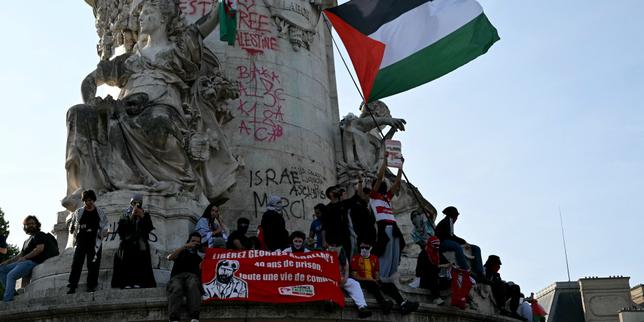
Imagine standing at the Place de la République, where protests usually swell into roaring human tides. On this anniversary, the square was patrolled by heavy contingents of mobile gendarmes. Their vans lined the side streets, dark blue hulks against the gray autumn light. The air was thick with anticipation—not of celebration or solidarity, but of the collision between two irreconcilable narratives of the Middle East conflict.
The collective Urgence Palestine had called for the mobilization to denounce the ongoing military campaign in Gaza and to express solidarity with the Palestinian people. For the organizers and participants, silence on October 7 was perceived as an erasure of the Palestinian suffering that followed the initial assault. They argued that grief is not the monopoly of one nation, and that public expression is a fundamental democratic right that should not be suspended because a calendar date carries heavy symbolism.
Conversely, the French government, alongside major Jewish community organizations, viewed the proposed timing as a deliberate provocation. To hold a pro-Palestinian march on the exact day dedicated to commemorating the victims of the October 7 massacres was interpreted as an insult to the dead, an act designed to minimize or contextualize atrocities that left over a thousand dead in Israel, including French citizens.
Paris police chief Laurent Nuñez invoked the risk of severe public disturbance. In a city where Jewish schools, synagogues, and cultural centers have lived under armed guard for years, the threshold for unrest is perilously low. The prohibition was enacted to prevent what authorities feared would degenerate into open street battles or inflammatory hate speech.
Echoes Behind Closed Doors
Law enforcement agencies do not make such decisions in a vacuum. They rely on intelligence assessments, threat matrices, and the bitter memory of previous demonstrations where geopolitical passions spilled over into violence.
In the weeks leading up to the anniversary, intelligence reports noted an alarming rise in antisemitic acts across France. Graffiti on housing blocks, verbal assaults in the metro, and anonymous threats had created an atmosphere of palpable anxiety within the French Jewish community, which numbers around 500,000—the largest in Europe. For them, the proposed demonstration was not a political debate; it was an existential affront, a reminder that their safety is intimately tied to the shifting currents of Middle Eastern geopolitics.
Yet, the ban raised uncomfortable questions about the limits of free expression in a liberal democracy. Where does legitimate political protest end, and where does incitement or psychological intimidation begin?
Legal challenges were mounted swiftly. Civil liberties groups argued that banning a protest preemptively sets a dangerous precedent, transforming the exception into the rule. If the state can prohibit a demonstration because the date is politically sensitive, what stops it from silencing other controversial assemblies tomorrow?
The administrative court upheld the ban, cementing the state's authority to prioritize public safety and the dignity of victims over the right to march. But court rulings do not resolve the underlying fractures. They merely push the conflict underground, moving it from the broad boulevards into digital spaces, university lecture halls, and quiet conversations over dinner tables where families across France weighed the cost of their convictions.
The Day the Streets Stood Still
When the afternoon of October 7 arrived, the designated meeting points for the banned protest were ghostly. Small clusters of activists attempted to gather near central stations, only to be quickly encircled, checked for identification, and dispersed by lines of riot police. Tensions flared in brief, sharp bursts. Shouts echoed between stone walls, placards were concealed beneath jackets, and the heavy scent of tear gas lingered briefly in an alleyway before dissipating in the breeze.
There was no massive march. There were no columns of chanting citizens stretching down the boulevard. Instead, Paris witnessed a fragmented, tense standoff between the state and those who felt the state had unjustly muzzled their grief.
Across town, official memorial ceremonies proceeded under heavy security. Wreaths were laid, names of the victims were read aloud, and political leaders stood shoulder to shoulder to reaffirm France's commitment to the security of its citizens and to remember the lives snuffed out in southern Israel a year prior. The contrast was stark: one side of the city draped in solemn remembrance, the other contained by batons and barricades.
The Lingering Question
A city is more than its laws. It is a living organism shaped by the memories of its inhabitants, both recent and ancient.
The events of October 7 in Paris demonstrated how deeply international conflicts are internalized within European societies. The ban prevented physical clashes on that specific afternoon, but it did nothing to heal the rupture between communities living side by side yet inhabiting entirely different emotional universes.
When the sun set behind the Eiffel Tower, casting long shadows over the Seine, the police vans slowly packed up and drove away. The asphalt was washed clean, but the questions remained hanging in the damp autumn air, waiting for the next day, the next crisis, the next inevitable collision on the streets of the Republic.