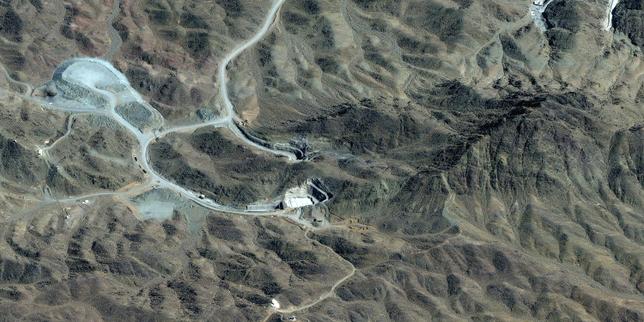
Explicit kinetic threats directed at Iran’s subterranean infrastructure—specifically targeting Mount Kolang Gaz La adjacent to the Natanz enrichment complex—expose a fundamental divergence between political signaling and physical engineering reality. When U.S. leadership threatens strikes on "one or two sites" to compel diplomatic concessions, the strategic calculus relies on the assumption that credible military force can neutralize hardened nuclear assets. In practice, the geological and architectural hardening of Mount Kolang shifts the operational equation from tactical destruction to prolonged attrition, rendering traditional coercive diplomacy structurally ineffective unless paired with sustained multi-vector containment.
The Architecture of Subterranean Deterrence
Standard reporting frames threats against Mount Kolang as an immediate escalation in the U.S.-Iran nuclear standoff. This framing misses the underlying engineering variable that dictates diplomatic leverage: depth of burial. The Natanz Fuel Enrichment Plant (FEP) was originally constructed roughly eight meters underground, protected by a reinforced concrete roof. That depth fell well within the penetration envelope of conventional bunker-busting munitions.
Mount Kolang Gaz La, situated immediately south of the main Natanz facility, represents a deliberate architectural countermeasure to Western kinetic superiority. The facility is excavated beneath a granite massif, placing critical centrifuge assembly halls and enrichment cascades at depths estimated between 80 and 100 meters below the surface.
To understand why threats against this specific site alter the geopolitical baseline, one must separate political rhetoric from munitions physics:
- The Penetration Threshold: The primary U.S. conventional earth-penetrating weapon, the GBU-57A/B Massive Ordnance Penetrator (MOP), weighs approximately 13,600 kilograms and is designed to penetrate up to 60 meters of reinforced concrete or rock under optimal impact conditions. At 80 to 100 meters beneath solid granite, Mount Kolang sits outside the single-strike destruction radius of non-nuclear ordnance.
- The Multi-Strike Requirement: Neutralizing a target buried at this depth requires a sequential "woodpecker" strike profile—dropping multiple MOPs onto the exact same GPS coordinates to bore through successive layers of fractured rock. This requires absolute air supremacy over central Iran for an extended window, alongside the deployment of specialized stealth bombers (B-2 Spirit or B-21 Raider) operating at the edge of their logistical endurance.
- The Ventilation and Access Vulnerability: While the main halls remain impervious to single-strike collapse, subterranean facilities depend on surface portals, ventilation shafts, and electrical substations. Kinetic strikes can seal tunnels and sever power grids, halting operations temporarily without destroying the underlying centrifuge machinery.
The strategic implication is clear. Threatening to strike Mount Kolang does not constitute a threat of permanent program elimination; it constitutes a threat of temporary operational disruption. Tehran’s leadership calculates their risk tolerance based on this exact engineering margin.
The Three Mechanisms of Coercive Signaling
When a state actor issues public ultimatums naming specific geographic targets—such as Mount Kolang—the communication serves three distinct strategic functions. Each function carries specific operational risks that conventional news coverage routinely conflates.
1. Compellence via Ambiguity
By specifying "one or two sites" while naming Mount Kolang, the signaling actor attempts to maximize psychological pressure while retaining operational flexibility. This is classic Thomas Schelling compellence theory: the threat must be specific enough to be credible, yet vague enough to keep the adversary guessing which assets are immediately expendable. If Tehran believes the strikes will target surface infrastructure at Natanz rather than the deep tunnels of Mount Kolang, they may absorb the blow rather than capitulate at the negotiating table.
2. Domestic Audience Calibration
Public threats of targeted kinetic action satisfy domestic political demands for decisive posture without committing ground forces or triggering an immediate, open-ended regional war. Naming a high-profile nuclear site projects strength to domestic constituencies and regional allies, signaling that the threshold for military intervention is active. The danger lies in commitment traps: once a leader publicly draws a red line around a specific facility, failing to act upon continued Iranian enrichment erodes deterrence credibility across all other geopolitical theaters.
3. Pre-Strike Intelligence Validation
Publicly naming a newly hardened site forces the adversary into defensive reallocation. When Mount Kolang is singled out, Iranian military planners must immediately disperse mobile air defense batteries (such as the Bavar-373 or S-300 systems), accelerate tunnel reinforcement, and relocate high-value centrifuge components. Western intelligence satellites monitor these frantic logistical movements, mapping hidden supply chains, command-and-control nodes, and previously undetected access portals in real time.
The Cost Function of Escalation
Evaluating the viability of a strike on Mount Kolang requires mapping the asymmetric cost function incurred by both parties. A kinetic operation against a deeply buried nuclear site is never an isolated tactical event; it initiates a cascading sequence of retaliatory economic and military vectors.
- Direct Military Expenditure vs. Reconstitution Time: Executing a multi-wave stealth bomber raid against central Iran consumes hundreds of millions of dollars in precision munitions, aerial refueling sorties, and electronic warfare support. If the strike only collapses tunnel entrances at Mount Kolang, Iranian engineering corps can excavate alternative access routes within six to twelve months. The attacker pays a high immediate political and military price for a temporary delay in the adversary's breakout timeline.
- The Maritime Chokepoint Multiplier: Iran’s primary retaliatory lever is not symmetric air defense, which cannot defeat stealth aircraft, but asymmetric maritime disruption in the Strait of Hormuz. Roughly 20 percent of global petroleum liquids consumption passes through this corridor. Even low-level harassment—limpet mines, drone swarms, or seizure of commercial tankers—immediately spikes global energy risk premiums, imposing an indirect economic tax on the striking nation’s domestic economy.
- The Breakout Acceleration Paradox: The most severe strategic risk of a partially successful strike is that it removes the remaining political inhibitions restraining Tehran from weaponization. Currently, Iran maintains a threshold posture—enriching uranium to high purity (60 percent) while stopping short of assembling a deliverable nuclear warhead. A kinetic strike on Mount Kolang that fails to destroy the buried centrifuges provides Tehran with the political justification to expel remaining International Atomic Energy Agency (IAEA) inspectors, withdraw from the Nuclear Non-Proliferation Treaty (NPT), and dash for a functional device inside a facility now proven impervious to conventional bombs.
Operational Limitations of Kinetic Containment
Strategic planners who rely exclusively on the threat of aerial bombardment to halt nuclear proliferation overlook three structural limitations inherent to modern airpower.
First, knowledge cannot be bombed. Over two decades of domestic centrifuge research and development, Iranian nuclear scientists have mastered the metallurgy, maraging steel fabrication, and cascade balancing required to build advanced IR-6 and IR-8 centrifuges. Even if a strike were to obliterate every physical structure at Natanz and Mount Kolang, the institutional knowledge base remains intact across dispersed university laboratories and industrial workshops.
Second, fissile material is highly portable. Highly enriched uranium gas (uranium hexafluoride) stored in cylinders occupies minimal physical volume. Iran’s entire stockpile of 60-percent enriched uranium can be transported in the back of standard commercial vans and hidden in unmapped civilian warehouses. Bombing fixed enrichment facilities does not eliminate the existing stockpile; it merely drives that stockpile into complete opacity.
Third, coalition cohesion fractures under unilateral strikes. Effective containment of Iran’s nuclear program relies on synchronized economic sanctions, financial isolation via SWIFT restrictions, and maritime interdiction supported by European and regional partners. Unilateral kinetic threats—and subsequent strikes—frequently alienate diplomatic allies who bear the brunt of regional instability and refugee flows, weakening the economic encirclement that actually constrains Tehran’s state budget.
Strategic Framework for Subterranean Neutralization
To achieve genuine strategic leverage over the Mount Kolang complex without triggering an uncontrolled regional conflict or an immediate nuclear breakout, policy execution must shift from isolated kinetic threats to integrated, multi-domain denial.
- Target the Supply Chain, Not the Granite: Instead of attempting to penetrate 100 meters of solid rock with conventional explosives, interdiction efforts must focus entirely on the specialized inputs required to operate deep-buried cascades. High-precision vacuum pumps, frequency converters, carbon fiber rotors, and specialized lubricants cannot be manufactured at scale without imported raw materials and precision machine tools. Severing these covert procurement networks chokes centrifuge attrition rates from the inside.
- Isolate Surface Power and Cooling Infrastructure: Deep subterranean enrichment halls generate immense thermal loads and require uninterrupted, high-voltage electrical feeds. Rather than expending scarce penetrating munitions on the mountain peak, tactical contingency plans should prioritize the repeated, surgical destruction of external high-voltage transformers, backup diesel fuel depots, and closed-loop water cooling arrays. Without external thermal regulation and stable grid power, high-speed centrifuges destroy themselves through mechanical vibration within minutes.
- Establish Permanent Surveillance Over Portal Excavation: Deploy persistent synthetic aperture radar (SAR) satellite tasking and high-altitude reconnaissance assets exclusively over the southern perimeter of Natanz. By detecting millimeter-level ground subsidence and spoil-pile expansion in real time, intelligence agencies can map the internal geometry of Mount Kolang’s tunnels before they are sealed, identifying weak points in the geological overburden for future targeted disruption.
- Enforce Binary Diplomatic Ultimatums Tied to Verification: Kinetic threats must never be issued in a vacuum; they must be tethered to verifiable, reversible technical benchmarks. The diplomatic baseline should demand continuous, real-time electronic monitoring of all portal entrances at Mount Kolang by international inspectors, backed by the explicit commitment that any unannounced sealing of tunnels or denial of access triggers immediate, automatic secondary sanctions on Iranian petrochemical exports—starving the regime of the hard currency required to fund subterranean construction.